Overview of Lochinvar by Sir Walter Scott
- Lochinvar is an example of a romantic A traditional poetic form used in narrative poetry. A ballad normally features repetition, regular rhyme scheme and rhythm. They were traditionally penned to be sung or read aloud. which forms part of Sir Walter Scott’s longer narrative poem Marmion, published in 1808.
- The ballad recounts the tale of ‘Young Lochinvar,’ a knight who is described in the poem as holding all of the qualities valued in a knight at that time (the early 1500s).
- He rides across the Scottish border to Netherby Hall in England where a wedding celebration is being held for his one-time beloved, Ellen, who is marrying another man.
- Lochinvar wins Ellen over, and the two escape together.
This poem explores the following themes:
- heroism and reputation
- love and marriage
- injustice, betrayal and defying social rules
- politics
- freedom and escape
Looking for some quick revision? Try an interactive quiz for National 5 English.
You can read Lochinvar by Sir Walter Scott on the Scottish Poetry Library website.
What is the setting and historical context of Lochinvar?
The poem is set on the border between Scotland and England in the early 1500s. The location is made evident through references to places like “all the wide Border,”“the Eske River,” and “the Solway,” which give Lochinvar’s adventure a sense of realism for its Scottish audience. The hero seems like a true, brave, noble Scotsman who is pursuing his rights in the borderlands, situated between England and Scotland.
The poet, Sir Walter Scott, was particularly interested in the turbulent history of Border life at this time, especially regarding battles that occurred there involving raiders, known as ‘reivers.’ These events are still commemorated in the border region with the annual ‘riding’ events. Locals continue to ‘ride’ the boundaries (or marches) to celebrate their culture. In the past, during days of lawlessness and border conflict, this involved defending against raiders, ‘reivers,’ coming across the border.
Learn more about the Borders and Reivers here.
In this context, Lochinvar could be considered a ‘reiver’ himself. He crosses the Border from Scotland to Netherby Hall, where Ellen lives, and steals her away.
Netherby Hall is a real place - a border fortress in Carlisle. The owners from the 15th to the 19th century, the Grahams, played a significant role in the conflict between Scotland and England. The area around the Hall was known as the Scottish Badlands, the position of the Scottish-English border was unclear, which made it uncertain which country's law would be upheld in that region. Because of this, criminal elements often moved to the area - and to legal grey areas like it - to conduct their dubious and potentially illegal activities.
It is therefore likely that Ellen’s father has refused Lochinvar’s proposal because he is Scottish, and he cannot trust that Lochinvar is not as ‘criminal’ as the reivers who come across the border to cause trouble. This setting and Lochinvar’s actions therefore make our knight’s actions a little more ambiguous – he is exhibiting reiver behaviour, seems to be regularly in the ‘Badlands,’ yet he is set up as a romantic hero to the audience.
What is a knight?
A knight was originally a medieval mounted soldier, who fought for an earl, baron or other nobleman in exchange for status or land. They were typically heavily armed and fought on horseback.
Learn more about medieval knights.
During this time, knights were held to a ‘chivalric code’ – a guiding set of rules for a knight's behaviour:
- Knights were expected to be loyal to their lords and kings while defending their territories, often – as in this ballad – in contested border areas.
- In combat, a knight had to demonstrate skill and bravery. Lochinvar is described as being “dauntless in war.” He shows no fear on his journey or in crashing a wedding where he is not welcome.
- Knights were also expected to uphold their reputation, show respect to women, and lead righteous lives. Lochinvar, in this case, had set aside his love to follow his duty, and this meant he would ultimately be unable to marry the woman he loved.
- Knights defend the weak and the vulnerable, whereas the man who had been permitted to marry Ellen, known only as the “bridegroom”, is referred to as a “laggard in love” and “dastard in war”.
- Knights were expected to be honest - Lochinvar seems not to uphold this value, claiming to have only come for a drink and a dance, before winning over Ellen and escaping with her.
Form and structure of Lochinvar
Form
This poem is a Border Ballad. Ballads are poems which tell a story, usually of love, bravery, or betrayal. In this case, Lochinvar tells the story of a dramatic rescue and romantic escape of a couple who have been prevented from being together.
It has a straightforward storytelling narrative, describing Lochinvar’s journey and arrival, what happens when he arrives at Ellen’s home, Lochinvar’s interactions with Ellen, and their subsequent escape and the pursuit by Ellen’s family. Dramatic action is a key genre marker of the ballad form, as are the romantic and heroic themes conveyed in the poem.
Border Ballads differ from other ballads due to their specific setting: the border between Scotland and England. This was a disputed place where a significant amount of crime and raiding took place. For this reason, Border Ballads are often tales of conflict that refer to real places and events.
Ballads were part of the oral tradition of storytelling. They followed strong rhythm and rhyme patterns to enable the story to be learned and told with ease. Ballads often contain direct speech from the characters' point of view, creating a sense of realism for the listeners. They also usually have a ‘refrain’ or a section, line or phrase which is repeated. This poem doesn’t have a formal refrain, like a repeated chorus, however, there are elements of repetition created. Parallel structures are used. The opening of the poem describes Lochinvar as:
So faithful in love, and so dauntless in war
This is echoed in the final stanza, which states that he is:
So daring in love, and so dauntless in war
We are told that Lochinvar “stayed not for brake, and he stopped not for stone,” creating a When two things are parallel. In writing, this can refer to language patterns and structures. Also known as parallelism..
Anaphora and repetition
The repetition of the same words at the start of successive sentences or clauses. and Where a word, phrase or idea is repeated for emphasis. are also used to show the connections and relationships between the people mentioned in the poem.
In this poem, anaphora emphasises Lochinvar and Ellen’s compatibility:
So stately his form, and so lovely her face.
The beauty of this couple is contrasted by another use of anaphora, referring to Ellen’s parents:
her mother did fret, and her father did fume
This highlights their negative qualities in comparison to the loving young couple. We learn of how easily convinced Ellen was to elope with Lochinvar through the repetition in
one touch to her hand, and one word in her ear.
“So, light” is used to refer to both Ellen and Lochinvar. This use of repetition enables the ballad to have a tight structure and a strong rhythm that effectively links ideas from one stanza to the next and creates a clear sense of unity between Lochinvar and Ellen.
Structure
The ballad follows an episodic structure. This means that each stanza forms a short chapter in the story as the narrative unfolds. It is told When a narrative jumps right "into the middle of things". The story opens with events already in progress., as many ballads are, starting mid-way through a story: in this case, with Lochinvar riding swiftly and courageously across the Scottish border to Ellen’s home.
The poem consists of eight stanzas with an AABBCCA repeated pattern of rhymes, usually written with letters ABAB would mean lines 1 and 3 rhyme; and lines 2 and 4 rhyme also rhyme but differently.. Each of the stanzas ends with the word ‘Lochinvar,’ which keeps the focus on the hero of the ballad.
The use of A pair of lines in a poem, usually rhyming and of the same length. as a rhyming scheme links to the theme of love and marriage: every line has a partner and counterpart, that it is closely connected to. Rhyming is also used to make other connections, such as the rhyme between “Lochinvar” and “war” (they would have rhymed better in the past), which connects brave Lochinvar to his prowess and skill in war.
What is anapaestic tetrameter?
Some lines have 11 syllables, and these contain one iamb and three anapaests. Some lines have 12 syllables and use ‘anapaestic tetrameter’.
- An iamb is a two-syllable pattern with an unstressed-stressed pattern (da-DUM).
- An ‘anapaest’ is a three-beat pattern, unstressed – unstressed – stressed (da-da-DUM).
- ‘Tetrameter’ means that there are four of these anapaests per line.
This rhythm sounds like a horse running at speed, which is appropriate for this poem as it echoes Lochinvar’s rapid horse ride to get to Ellen. The galloping pace of the stanza indicates that the story unfolds quickly, highlighting the hero’s bold nature and his confident, swift actions.
Learn more about different rhythmic patterns:How to understand rhythm in poetry: Stressed and unstressed syllables
Characters in Lochinvar
Lochinvar
Lochinvar, repeatedly called ‘young,’ is the romantic hero of this poem. He owns the best horse in the Borders, showing he's bold and gallant. Carrying only a broadsword, he’s there for love, not war, ready to fight if honour calls. He's defiant and confident, needing no support; his skill, courage, and love are his weapons. The narrator states he was:
So faithful in love, and so dauntless in war
This emphasises his honesty and bravery. The stanza concludes there was no knight like him.
The second stanza shows he is determined, not stopping for obstacles and swimming across a dangerous river to reach Ellen, risking safety for love. It highlights his physical strength and action-oriented nature, willing to risk personal safety for Ellen. He takes matters into his own hands by rejecting societal norms and not waiting for permission, demonstrating independence.
When he arrives at Netherby Hall, he does so “boldly,” ignoring the potential threat from the bride’s family and father, showing his confidence and fearlessness. When speaking to Ellen’s father, he lies, claiming he's there to drink and dance and that he’s fallen out of love with Ellen. He compares his love to a quick-turning tide in the Solway Firth, which seems odd since he’s described as “faithful in love,” indicating he’s not truthful. Ellen blushes and kisses her glass when speaking to him, reinforcing this.
Lochinvar drinks the whole drink in one gulp and throws it to the ground:
He quaffed off the wine, and he threw down the cup.
This shows his dominant nature, his rejection of social niceties, and contrasts him with the passivity of the groom. By throwing the cup, he asserts control over the room, showing he is not intimidated by the men around him. He controls the action without ever having to draw his sword.
His behaviour achieves its goal, as no one stops him when he takes Ellen by the hand for their first dance. This dance is both strategic and symbolic: it sets up their escape, distracts others, and delays suspicion, showcasing his tactical skill. It also subverts the wedding ritual by publicly claiming Ellen, symbolising his challenge to Ellen’s father, defending his honour.
As they dance, Lochinvar is described as “stately,” indicating that his appearance and posture are dignified, impressive, and commanding, making him a fitting companion for the “lovely” Ellen. Their dancing together was described as the best dance ever seen, highlighting how well-coordinated and well-matched the couple is.
Lochinvar is not daunted by Ellen’s parents, who “fret” and “fume” about this public insult to their family’s honour. The bridegroom is also painted as impotent in his reaction, unable to do anything but hold on to the limp feathers on his hat. While Lochinvar is dynamic, daring, and emotionally expressive, the bridegroom is silent, passive, and awkward, nothing more than an accessory.
In the seventh stanza, Lochinvar’s intentions and strategy become clear. The close bond between the pair – and the possibility this was pre-planned – becomes evident. With only “one touch” and “one word,” Lochinvar has convinced Ellen to leave with him – he is clearly also very persuasive. He shows he planned this carefully, keeping his horse nearby and quickly lifting Ellen onto the horse before jumping into the saddle and riding off. Words like “Light”, “swing”, and “sprung” highlight his dynamic movements. He loudly declares:
She is won! We are gone
He is stealing Ellen from the bridegroom and her family. He knows they will face difficult terrain and be chased by the family’s “fleet steeds” to retrieve Ellen.
This Border ballad highlights regional concerns and tells a romantic, dramatic story of love and daring. Lochinvar seemingly abandons his duty as a knight, lying and stealing to reunite with Ellen, dropping his knightly standards. From a Scottish perspective, this daring act is accepted as a clever tactic against the 'enemy.’ Regardless, Sir Walter Scott depicts the handsome Scotsman as capturing his lost English love, deemed acceptable. The narrator concludes by praising Lochinvar's love and bravery, leaving us to wonder who else matches his reputation.
Ellen
Ellen features little in the ballad, which is a celebration of Lochinvar. She is described as “fair Ellen of brave Lochinvar,” portraying her as a romantic heroine and beauty, but mainly as someone fought over by men rather than having independence. She has the “soft” hands of a well-bred young lady, unused to hard work.
In stanza five, Ellen publicly reveals her feelings by kissing a cup and passing it to Lochinvar, showing her preference for him over her bridegroom.
The bride kissed the goblet: the knight took it up,
Usually passive, her reaction indicates she prefers Lochinvar to her weak fiancé, at a time when women needed strong husbands to thrive.
She is very much portrayed as the romantic female lead of her time period. She is modest and quiet, making little sound and saying even less.
She look’d down to blush, and she look’d up to sigh, / With a smile on her lips and a tear in her eye.
Blushing and looking down show her modesty; sighing and looking up reveal her romantic longing for the man before her. This reflects good social judgement. She smiles at Lochinvar, hinting she favours him, and the tear in her eye shows deep feelings. She's torn between her reputation and her heart.
Lochinvar claims Ellen, who is passive and silent, but she shows her agency by running off with him, shocking for her era. A reputable lady would follow her family's wishes and not acknowledge another man. She gives him a cup she has kissed and her hand, indicating her consent. Lochinvar rides away with her, and Ellen is never seen again. By the end, she's called the “lost bride,” as if she was stolen property, just a part of Lochinvar’s legacy.
Stanzas one and two: Journey and arrival
Stanza one
In the first stanza, Lochinvar is painted as a romantic, noble, and fearless Scottish knight. The narrator holds him in high regard, portraying him as a chivalrous and brave young warrior:
O young Lochinvar is come out of the west,Through all the wide Border his steed was the best;And save his good broadsword he weapons had none,He rode all unarm’d, and he rode all alone.So faithful in love, and so dauntless in war,There never was knight like the young Lochinvar.
The poem begins When a narrative jumps right "into the middle of things". The story opens with events already in progress.. From the very start of the ballad, Lochinvar is in motion, swiftly traversing the countryside, demonstrating that he is a dynamic character whose motives will drive the poem forward.
We don’t know why Lochinvar is undertaking this journey, but we know straight away he is on a mission as he “comes out of the west” with only his sword and his horse. One interpretation of why the West could be significant is that it is where the setting sun creates a dramatic, golden and blazing end to the day, just like the drama, brightness and passion Lochinvar is about to bring.
We are given the first hints of his mission when the poet refers to him as “faithful in love.” This, combined with the fact that he isn’t armed for war (despite being brave when he is at war), shows that he is on a romantic mission.
Stanza two
Stanza two continues the idea of him being unstoppable and determined:
He staid not for brake, and he stopp’d not for stone,He swam the Eske river where ford there was none;
He isn’t slowed down by any obstacles in his path, such as “brake” and “stone.” A brake is a densely wooded area, a stone suggests rocky ground. Both of these show that Lochinvar scorns danger – he could easily be hurt by riding so fast on ground like this, but he doesn’t care and carries on regardless.
He also crosses the River Esk despite it not having a safe ford to cross at, This again demonstrates his recklessness and single-mindedness – he defies nature itself.
Despite all of his heroic efforts, Lochinvar comes too late to prevent his love being betrothed to another:
But ere he alighted at Netherby gate,The bride had consented, the gallant came late:For a laggard in love, and a dastard in war,Was to wed the fair Ellen of brave Lochinvar.
The mention of the gate comes just after descriptions of the countryside that leads up to it. By placing the gate at the end of the third line in the six-line stanza, Scott has used structure cleverly to put Ellen behind that gate. In the lines before, we see Lochinvar in the countryside. After the gate, we see Ellen, kept away from her love, kept with a “laggard in love” who is a contrast to the faithful Lochinvar. The bridegroom is lazy in love and “a dastard in war” – a coward. This is the man who separates Lochinvar from Ellen.
Stanzas three and four: At Netherby Hall
Stanza three
In stanza three, Lochinvar passes the gate and strides into the Hall itself. He does so with extreme levels of confidence:
So boldly he enter’d the Netherby Hall,Among bride’s-men, and kinsmen, and brothers and all:Then spoke the bride’s father, his hand on his sword,
He pays no attention to the hostile crowd made up of Ellen’s male relatives or to the implied threat of her father, who has “his hand on his sword” as if ready to fight at any moment. He is a foreigner here – an interloper who has barged into a wedding party, after all. However, the groom says nothing:
(For the poor craven bridegroom said never a word,)‘O come ye in peace here, or come ye in war,Or to dance at our bridal, young Lord Lochinvar?’
This stanza brings in the voice of Ellen’s father. As father of the bride and owner of the house where the ceremony is taking place, it is natural that he attempts to take charge of the situation. He offers Lochinvar three choices: peace, war or celebrating with the family. Ellen’s father calls him “Lord,” signifying a degree of respect, but also emphasises his own position as a superior by calling him “young.”
However, you might think it would have been the groom who would be defending his and his family’s honour. The use of Adding extra information using brackets (), commas , or dashes - -. on the fourth line indicates that the bridegroom is, indeed, a “laggard” – he is lazy and does not fight for his love, and, therefore, is also a “dastard” – a man who lacks courage, integrity, or moral strength. He is a A character whose traits contrast with another character's. This is often done to highlight specific qualities of the other character. for Lochinvar – a nameless, featureless, bland, and nondescript man who has nothing compared to Lochinvar’s many qualities. None of the other men present is named, showing how little they matter to the story.
Video - What is parenthesis?
Sir Walter Scott uses parenthesis to tell us more about Ellen's bridegroom:
(For the poor craven bridegroom said never a word,)
Brush up on your knowledge of parenthesis with this short National 5 English revision video.
Parenthesis
Adding extra information to a sentence (or paragraph) using brackets, dashes or commas.
If you take it out again, the passage should still make grammatical sense.
"The case was worn - and very full - and its straps struggled to keep in its contents.”
Most of the time, parenthesis is tucked into a sentence, but a parenthesis can also be its own sentence as part of a paragraph.
She opened the envelope, carefully sliding the paper out.
(She hadn’t received a handwritten letter in years).
You don’t need to read the parenthesis for this to make sense, but it does give you more detail.
Parenthesis can help us better understand things like setting, or aspects of a character, like their emotions, motivations or background.
It can almost feel like the writer is whispering a secret in your ear.
Liz Lochhead’s poem 'The Bargain' uses parenthesis to describe a character at the Barras market in Glasgow:
“nothing to sell, but three bent forks a torn, calendar (last year’s) and a broken plastic sandal.”
The person has nothing of value to offer, and the parenthesis reinforces this idea.
It’s bad enough that the calendar is torn, but the parenthesis makes it clear just how pitiful and worthless it is, by telling us it’s out of date too.
If your writing makes sense, but you want to add more info, try sticking in a parenthesis.
(You can really build on your ideas!)
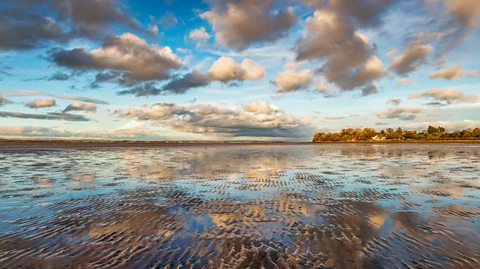 Image source, Getty Images
Stanza four
In stanza four, we are given some backstory. Lochinvar establishes that he has loved Ellen for a long time and that her father would not let him marry her:
‘I long woo’d your daughter, my suit you denied; —Love swells like the Solway, but ebbs like its tide —And now I am come, with this lost love of mine,To lead but one measure, drink one cup of wine.There are maidens in Scotland more lovely by far,That would gladly be bride to the young Lochinvar.’
He has “long woo’d” Ellen, showing again how he is faithful in love, but Ellen’s English father did not permit a Scottish knight to marry his daughter. Lochinvar indicates his love no longer exists. The simile used states that Lochinvar’s love “swells like the Solway, but ebbs like its tide” The Solway tides are known for their dramatically high and low points, so he suggests that his once passionate feelings have now subsided to nothing. This is where we begin to see Lochinvar’s strategy unfold – he is lulling the English family into a false sense of security about his intentions.
Lochinvar continues by saying that Ellen is his “lost love,” suggesting he has accepted that he cannot be with her, and instead has come to celebrate – to “lead but one measure” (to dance) and to “drink one cup of wine.” He ends with a confident (and perhaps insulting) comment that there were plenty of prettier girls in Scotland who would be glad to have him instead.
The dashes at the end of the first and second lines create a slowing effect, which is quite different from the galloping pace of the poem so far. It seems odd that he would hurtle through the countryside to be at the wedding of a girl he no longer loved, particularly when he is famously “faithful in love.”
Image source, Getty ImagesStanzas five and six: Ellen and Lochinvar
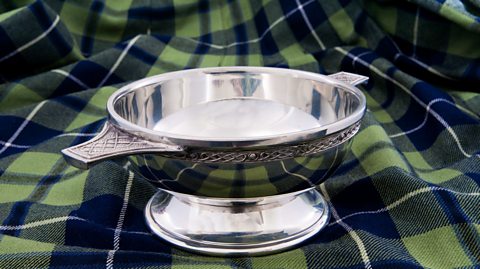 Image source, Getty Images
Stanza five
Stanza five brings Ellen into the picture. In a rather forward way, she kisses the cup that she gives to Lochinvar to drink:
The bride kiss’d the goblet: the knight took it up,He quaff’d off the wine, and he threw down the cup.
Drinking from a quaich (a ceremonial drinking bowl) is a traditional Scottish wedding ritual, so this action is symbolic of Ellen and Lochinvar being joined together. His reaction is to take the goblet, drain it in one gulp and slam down the cup. All of these actions indicate his confidence and strength.
Ellen’s response suggests that she still yearns for Lochinvar:
She look’d down to blush, and she look’d up to sigh,With a smile on her lips and a tear in her eye.
Blushing and looking down suggest her emotional conflict and romantic longing. Ellen is caught in this situation: she must follow her duty to her family, but she clearly desires Lochinvar more. She looked down, modestly avoiding his gaze, but blushed because she was attracted to him and was embarrassed by it.
Her “sigh” indicates she feels an emotional weight – that she regrets not marrying him or yearns for him. Having both a smile and a tear suggests that she is pleased to see Lochinvar but is unhappy that he has come too late. She is clearly experiencing inner turmoil, torn between her duty and what she desires most. The poet uses opposites here to create a balance and contrast: “look’d down” and “look’d up” show her conflicted feelings. This is continued in the contrasts between “blush” and “sigh” and “smile” and “tear” in the second line. This rhythm highlights the contrast between her emotions. Her reaction creates tension: everyone can see how Ellen feels, making the build-up to their dramatic escape seem almost inevitable.
He took her soft hand, ere her mother could bar,—“Now tread we a measure!” said young Lochinvar.
Ellen is portrayed as a gentle young woman, her “soft hand” - a sign of gentility and nobility - being boldly claimed by Lochinvar before her mother could stop him. Ellen is a passive counterpart to the vibrant, dynamic, and bold Lochinvar. Although she clearly has a mix of feelings she lacks agency and is purely at the whim and decision of the men around her. Even when brought to dance, Lochinvar is dominant: their dance will be “now” and Ellen has no part in this decision. However, Ellen does not appear to be opposed to the advances of Lochinvar. By giving him her hand, literally, she metaphorically gives him consent to wed her.
Image source, Getty ImagesStanza six
In stanza six, the gathered wedding party watch the two dance. It is as if they are watching the first dance of a newly-married couple at a wedding. Lochinvar and Ellen are described as being very well-matched:
So stately his form, and so lovely her face,That never a hall such a galliard did grace;
The two are described with similar phrases ("so…his" and "so…her") which links them together.
Lochinvar's body and posture are described as “stately”. He carries himself like a prince or knight, someone with status and moral superiority. They dance a ‘galliard,’ which was a popular dance at the time. It is a spirited and fast-paced dance, suitable for the character of Lochinvar.
This stanza also shows the impotent helplessness of Ellen’s parents and bridegroom, but contrasts that with the reactions of other young women in the room:
While her mother did fret, and her father did fume,And the bridegroom stood dangling his bonnet and plume;And the bride-maidens whisper’d, “’twere better by farTo have match’d our fair cousin with young Lochinvar.”
The use of alliteration highlights the connection between Ellen’s mother and father in their shared worry and anger about what they are watching. The impotent and weak behaviour of the groom is emphasised by the fact that his celebratory clothes, his wedding accessories of hat and feather, are left to dangle limply by his side.
They should be proudly on his head to indicate his position as groom and his pride in his marriage. By not wearing them, he acknowledges his inferiority to Lochinvar.
This is echoed by the “bride-maidens” who talk amongst themselves about how Lochinvar was a better match for their "fair cousin". Not only has Lochinvar won over Ellen, the other women at the wedding also admire him.
Stanzas seven and eight: escape and pursuit
Stanza seven is where Lochinvar’s plan comes to fruition. He is clearly very persuasive and attractive to his love, who immediately springs into action with the slightest of prompting:
One touch to her hand, and one word in her ear,When they reach’d the hall-door, and the charger stood near;So light to the croupe the fair lady he swung,So light to the saddle before her he sprung!
The repetition of ‘one’ indicates how easily it was to persuade Ellen to leave with him. She does not hesitate or object. This has, perhaps, even been planned.
In the galliard dance, there is a part where the man lifts the woman and spins her, and this is called a volta. This is also a technique used in poetry, and forms a ‘twist’ in the tale – as it does here. As Lochinvar spins Ellen in the dance, so the twist in the story appears. Their dance has progressed up the hall, towards the exit, where Lochinvar’s horse stands, ready and waiting.
Instead of simply swinging Ellen on the dance floor, Lochinvar swings her onto the hind quarters of his horse (the ‘croupe’). The poet’s word choice emphasises both his strength and Ellen’s petiteness by repeating “so light” to show how easily Ellen was “swung” and how easily Lochinvar “sprung” up into the saddle after her. The rhyme in that couplet again emphasises how the two are well matched.
Lochinvar makes his public declaration now, as was traditional in weddings at that time. He sweeps Ellen out, lifting her over the threshold (another wedding tradition):
“She is won! we are gone, over bank, bush, and scaur;They’ll have fleet steeds that follow,” quoth young Lochinvar.
Lochinvar is triumphant, proclaiming his victory and claiming his bride, exclaiming, “She is won!” Like a Borders reiver, he has walked into this stronghold and stolen its prized possession – Ellen is like a trophy being carried away. Lochinvar will again face many perils on his journey to safety, including riverbanks, bushy, overgrown ground, and steep banks or cliffs (“scaurs”) on the ride back to Scotland. He explains – presumably to Ellen - that they must rush as her family will have fast horses to pursue them.
Stanza eight
There is, indeed, a search which we are told about in stanza eight. The wronged family musters its allies to pursue the fleeing couple:
There was mounting ’mong Graemes of the Netherby clan;Forsters, Fenwicks, and Musgraves, they rode and they ran:There was racing and chasing on Cannobie Lee,But the lost bride of Netherby ne’er did they see.
The Graemes were the family who lived in Netherby Hall and who were presumably Ellen’s family. They roused their allies, the Forsters, Fenwicks and Musgraves, to ride out and give chase. The internal rhyme of “racing and chasing” helps convey the speed of the chase.
Another local landmark is named: Cannobie Lee was part of the Debatable Lands - the border area between Scotland and England, considered a lawless region with no social control. This is a perfect getaway location for a romantic outlaw! The couple have crossed into a place of wildness and freedom, away from the control of her family.
The “lost love” has now become “the lost bride”: the repetition emphasises the change in status for Ellen. She is now a runaway, outside of the respectability of her family, and is permanently tied to Lochinvar. The poem has come full circle, and Lochinvar and Ellen have righted the wrong of their denied love and come to Scotland for safety.
The final couplet of the poem returns to praise of Lochinvar. A biased Scottish audience would see his behaviour in a positive light, even if the English people he had just wronged would not:
So daring in love, and so dauntless in war,Have ye e’er heard of gallant like young Lochinvar?
The poem returns to the ideas of the opening stanza, about how “dauntless” Lochinvar was in war. We have seen his bravery demonstrated clearly in his actions. The description of his love has changed from “faithful” to “daring” now: he has shown his fidelity by claiming his bride through his bold and reckless actions.
The rhetorical question at the end concludes the narrative, using apostrophe. An apostrophe occurs when a writer or speaker addresses someone or something that isn’t present, as if it could hear and respond. In this case, it involves speaking directly to an audience, listening to the ballad. This final thought highlights that he is one of a kind; there is no one quite like him – striking a very admiring tone.
What techniques are used in Lochinvar?
- Alliteration – Lochinvar includes several examples of alliteration as Scott works to keep the pace and rhythm of the poem at pace, such as the “F” and “R” in the line “Fosters, Fenwicks, and Musgraves, they rode and they ran.”
- Aside – an aside is a brief comment, often written in Adding extra information using brackets (), commas , or dashes - -., where the narrator comments directly to the audience.
- “(For the poor craven bridegroom said never a word,).” Scott employs this device to critique Ellen’s bridegroom. He is separated from the action, stressing his lack of importance in the action and contrasting him with the hero.
- Hyperbole – the poem creates an almost mythical sense of Lochinvar’s heroism: “There never was knight like the young Lochinvar.”
- Parallelism is used when similar structures of words/sentences are used to create rhythm or emphasis. In this case, it establishes the speed of the chase and emphasises the mythic nature of its protagonist.
- “He rode all unarmed, and he rode all alone.” Creates the sound of the horse running and emphasises how vulnerable he could be, coming with only basic weaponry and no backup.
- Scott creates a parallel picture of Lochinvar and the groom: “So faithful in love, and so dauntless in war…” compared to “A laggard in love, and a dastard in war…” This To place two or more ideas/images close together to create further meaning for an audience. emphasises their stark differences.
- “She looked down to blush, and she looked up to sigh…” shows how conflicted Ellen feels: the contrast between up and down shows that she doesn’t know how to feel or where to look. The contrast between blushing and sighing shows both modesty and longing.
- Repetition – The repetition of the word ‘and’ in close succession is used to emphasise how many people were gathered in Netherby Hall, showing just how many potential enemies, Lochinvar had to face:
- “Among bride’s-men, and kinsmen, and brothers and all.” This is also called a ‘polysyndetic list.’
- Anaphora – a type of repetition where a word or phrase is repeated at the start of a line, sentence, or clause, enhances rhythm, emphasises points, and builds momentum.
- “He rode all unarmed, and he rode all alone.” emphasises Lochinvar is both isolated and brave.
- “So faithful in love, and so dauntless in war…” emphasises just how good Lochinvar was – it elevates him and adds to his heroic impression.
- Rhetorical question –
- “Have ye e’er heard of gallant like young Lochinvar?” is used at the very end of the poem to end with a flourish. It is there not to be answered, but to set up the legendary status of Lochinvar and to show that no one else can compare to him. This is a technique often used in ballads to create a mythical status for their heroes.
- This question also helps end the poem with a A structure where the ending connects back to the opening, and creates a circle or thought. as it links back to the beginning of the poem, which states, “There never was knight like the young Lochinvar.” This mirroring sets up the protagonist as a symbol of bravery and passion, creating a sense of awe in the narrator who wants the listener also to feel that admiration and nostalgia for bold love and unstoppable honour.
- Simile – “Love swells like the Solway, but ebbs like its tide.” The poem uses the simile to show that Lochinvar’s love, apparently, comes and goes. The Solway tide is notoriously variable, with extreme highs and extreme lows, and Lochinvar uses this to try to persuade Ellen’s father that it was at high tide when he proposed originally, but that it is at low tide now.
- Word choice – “So light to the croupe the fair lady he swung,” highlighting urgency and a sense of control. ‘Light’ has a positive A word used to describe the ideas or feelings that a word might suggest. For example, a skull conjures up thoughts of fear, mortality and death.: it is how you feel when a weight has been lifted from your shoulder; it is the brightness after dark times.
Symbolism in Lochinvar
Multiple items and events in the narrative have a deeper symbolic value, with Lochinvar’s journey and the landscape he travels through being significant. The groom’s hat, the lovers’ dance, and the kissed drink at the wedding all have a deeper meaning. Even Lochinvar’s horse has a symbolic meaning.
Lochinvar’s journey
The hero’s journey is symbolic of his purpose and determination. It symbolises his heroic nature, his fearlessness, and his disregard for his own safety. It establishes him as a romantic hero, setting off in pursuit of his love.
The return journey is his escape to freedom, having won the battle of the day and the love of ‘fair Ellen.’ This journey also symbolises her desire for freedom. She uses the only agency she has to escape the prospect of a loveless marriage, choosing love over transactional matches and social constraints. The final dash on horseback with Ellen represents their flight to freedom and the triumph of love over societal constraints.
Lochinvar's horse
In both of these journeys, Lochinvar’s horse is mentioned. In stanza one, we are told that his steed was the best, and this serves to emphasise Lochinvar’s heroic nature. In ballads, the horse is often used to symbolise freedom, nobility, and masculinity, all features attributed to Lochinvar. Having a good horse adds to Lochinvar’s image as the ideal romantic hero.
His horse is later described as a ‘charger’ - a horse specifically bred for battle. A charger had to be fast and strong and have plenty of stamina. This, of course, was important for the escape that the horse facilitated at the end of the poem. Without this fast horse, Lochinvar’s plan could not be completed, therefore the horse also comes to symbolise freedom and escape.
The setting
The river represents a boundary – in this case, between Scotland and England, between families and clans and between social classes. Crossing this line shows how Lochinvar is willing to be a rebel and how he will do anything to get to his love. By crossing a literal line on a map, he crosses a metaphorical boundary too.
This river doesn’t have a bridge or A shallow place in a river that can be used as a safe crossing point.. This makes Lochinvar’s journey dangerous and the river presents one of a number of obstacles (‘brake’ and ‘stone’) he must overcome, This signifies the challenges the hero must face, setting up his daring visit to the wedding and escape with Ellen.
The area at along the border is contested land, disputed by both Scottish and English. With no clear indication of who was in charge, this land was not well policed by either side. Bandits, reivers and criminals sought shelter in these areas where they felt free of control from either country. This is where the couple escape to, showing that their love has broken them free from social convention and duty.
Lochinvar also refers to another feature of setting: Love swells like the Solway, but ebbs like its tide”. The Solway tide is very variable and can suddenly reach very high and very low levels. The hero uses this simile to show that he once loved Ellen a huge amount, but then that his love had dropped away dramatically. Or at least, this is what he tells her father!
The groom’s hat
The poor groom was left behind! His hat should be on his head, symbolising his high status as the bridegroom. The feathers should be pointed and colourful, indicating his wealth and position. However, his head is bare; he holds the hat "dangling" in his hands. In contrast to Lochinvar's "stately" form, the groom is presented as limp and useless.
A man would traditionally take his hat off as a sign of respect to someone of higher rank, showing deference and loyalty. At that time, knights would remove their headwear to indicate that they had not come to fight or to demonstrate their submission. Symbolically, therefore, the groom sees Lochinvar as having a higher status than him; he is submissive and not likely to fight. We were told he was a ‘laggard in love’ and a ‘dastard at war,’ after all.
Lochinvar’s presence emasculates him, reducing him to an unnamed figure with no agency and nothing to contribute.
Wedding symbols
When Lochinvar approaches Ellen, several elements create symbols that mimic a wedding ceremony.
First of all, Ellen “kissed the goblet,” which, to an audience of the time, would indicate that she was accepting Lochinvar as a groom. In Scottish traditions, a drinking cup (a quaich) was used as part of the wedding ceremony to join the couple in marriage.
The lovers’ dance would also be seen as a sign of consent and as symbolic of marriage. Ellen publicly accepts Lochinvar’s ‘hand’: literally for the dance, but this would also symbolise taking his hand in marriage, in public, in front of witnesses.
Weddings were not always conducted in the church or even with a priest present to bind a couple; it was simply enough to declare your intentions in public and have no one object. This is precisely what happens here. It is also traditional for the bride and groom to do a ‘first dance’ at a wedding. This is a long-standing tradition that symbolises the married couple’s first steps together as a couple, both literally and metaphorically.
At the end of the dance, Lochinvar sweeps Ellen off her feet, onto his horse, and out of the hall. As a tradition, the groom in a wedding usually carries the bride across the threshold, a practice with ancient origins. It can symbolise the groom overcoming his bride’s reluctance to leave her family. Here it suggests Ellen breaking from her family and starting a new life with her love.
Themes in Lochinvar and comparisons with other poems in the collection
The ballad includes a range of themes:
- heroism and reputation
- love and marriage
- injustice, betrayal and defying social rules
- politics
- freedom and escape
- reputation
Heroism and reputation
Lochinvar embodies The spirit of medieval knighthood, and the qualities expected of a medieval knight., demonstrating honour, courtesy, loyalty, and courage.
The ballad depicts him as an ideal romantic hero. admired for his faithfulness in love and bravery in war. His horse, sword, and lone journey are traditional images, emphasising his heroic stature. He is determined and physically strong, overcoming natural barriers to reach Ellen.
Lochinvar makes a striking entrance at Netherby Hall. He's a fierce fighter but relies on his intelligence to achieve his aims and avoid unnecessary harm. Loyal to his love and respectful of Ellen’s father, his words are courteous and calm. He requests only a dance and a drink - a farewell, not a fight. His bold gestures show authority without violence. He leads the dance, escape, and story, demonstrating leadership and control.
Lochinvar’s actions at the wedding reflect the heroic journey: facing a challenge, taking risk, and winning. The poem celebrates bravery. To a Scottish audience, he's freeing Ellen from a loveless marriage and family control. Rescuing a maiden is the ultimate act of chivalry. He arrives unarmed, outsmarts enemies, and escapes peacefully, showing his mind is his greatest asset. He symbolises the knight errant – brave, bold, passionate.
The poem concludes with a flourish:
Have ye e’er heard of gallant like young Lochinvar?
This elevates him to a mythic stature, suggesting his deeds are one-of-a-kind and worth remembering forever.
The theme of heroism and reputation is also shown in:
| The Bonnie Earl o’ Moray | The Earl is well known as a noble and charming man. His character is so admirable that he "might hae been a king" |
| The Twa Corbies | In this poem, heroism and reputation are irrelevant in the face of death. We learn nothing of the knight's character but know he lies abandoned and forgotten. |
| A Red, Red Rose | The speaker is romantic and constant in his affections, like a knight was supposed to be. |
| Little Girls | Heroism is shown through survival against the harm society causes girls. Reputation is weaponised – girls are judged differently to men. |
| Auntie | The aunt is a hero to the speaker because of her quiet, yet impactful, presence in her life. There is no public celebration of the aunt, but she has left a legacy of affection and connection. |
Love and marriage
Love is central to the poem, motivating Lochinvar and Ellen's devotion. Lochinvar is faithful to Ellen, and his love is portrayed as bold, pure, and unwavering. This contrasts to Ellen’s would-be bridegroom, called a “laggard in love, and a dastard in war.”
Walter Scott subtly hints at a marriage between Lochinvar and Ellen through symbols, ritual interruptions, and romantic connection, despite no formal vows:
- The couple shares a drink from the same cup, marking their first act of unity.
- Lochinvar takes Ellen's hand, symbolising unity and trust.
- The couple dance together in front of wedding guests. Since no one interrupts and many observe, the dance may symbolise formalising their vows.
- Lochinvar carries Ellen over the threshold, swings her onto his horse and rides away - symbolising taking her away from her old life and home, so they can start a new life together.
The poem ends with them riding away together, presenting love as triumphant and transformative - worth defying societal rules for.
The theme of love and marriage is also shown in:
| The Bonnie Earl o’ Moray | The Earl is beloved by society, including the Queen. His own wife will mourn him, waiting for his return forever. |
| The Twa Corbies | Love is fleeting and conditional. His "fair lady"’s love has moved on to another. |
| A Red, Red Rose | Love is eternal and enduring, able to overcome separation. |
| Little Girls | The patriarchy distorts love into a tool of dominance. |
| Auntie | Love of her aunt is tied in to cultural bonds and personal memories. This love persists though they are separated. |
Injustice, betrayal and defying social rules
Lochinvar is a heroic poem that shows love triumphing over injustice. It is clear that Lochinvar and Ellen love each other, and her arranged marriage to a "craven" would have been a betrayal of this love. But it could be seen that Ellen is forced to betray her family
Despite his noble reputation, Lochinvar betrays conventional acceptable behaviour by lying to Ellen's father and 'stealing' her away.
These themes are also shown in:
| The Bonnie Earl o’ Moray | His murder is a betrayal; he does not get to face justice and his killer goes unpunished. His relationship with the queen potentially defies social rules. |
| The Twa Corbies | The knight is betrayed by those who should mourn him and is left lying forgotten. |
| Little Girls | Systemic misogyny, victim-blaming, and the silencing of girls and women is a key theme, but at the end, they scream in rebellion. |
Politics
Politics appears in this poem in a subtle way: we see that political alliances are made through marriage arrangements and that women had little say in any of this.
The poem also makes clear reference to the tensions between Scotland and England – reivers and border raids appear in this ballad.
These themes are also shown in:
| The Bonnie Earl o’ Moray | He was killed as a result of conflict with the King. The poem calls into question the King's inaction in response the the Earl's murder. |
| The Twa Corbies | The fallen and forgotten knight represents the breakdown of the feudal loyalty system. |
| Little Girls | Rejection of systemic misogyny, victim-blaming, and the silencing of girls and women is a key theme. |
Freedom and escape
In Lochinvar, freedom and escape are portrayed as thrilling, romantic, and rebellious, and the themes are integrated into the poem’s structure, imagery, and climax.
Ellen’s arranged marriage symbolises captivity and control, while her final ride signifies liberation from restrictions and tradition.
Lochinvar and Ellen do not seek permission; they act decisively. Their escape is not only romantic but also a daring protest against conformity.
The poem ends with a physical escape to the ungoverned borderlands, symbolising emotional freedom.
These themes are also shown in:
| The Bonnie Earl o’ Moray | His escape is impossible; he was murdered where he stood. |
| The Twa Corbies | The crows are free from imposed ideas of emotion, tradition and loyalty. They could represent ordinary people who are unconcerned with ideas of nobility imposed by feudal society. |
| A Red, Red Rose | Despite the strength of romantic love portrayed, there is a sense of freedom in that the lovers could be parted and go their separate ways, but their love would live on. |
| Little Girls | The speaker pledges to “break down barriers” and regain space, voice, and independence. |
| Auntie | Memories of her aunt offer the speaker an escape from the harshness of modern life. |
Reputation
Lochinvar is described as “so faithful in love, and so dauntless in war,” showing his heroic nature.
This reputation causes everyone at the wedding to be cautious around him. The bride’s father questions if Lochinvar comes “in peace here, or come ye in war?", and keeps his hand on his sword - a sign of how reputation can cause fear or suspicion. The would-be bridegroom is reduced to silence. Guests whisper, showing Lochinvar’s fame is based on both unease and fascination. He is seen as unpredictable yet powerful—respected without threats or fights.
Perception of Lochinvar likely varies; Scott, a Scot, depicts him as a hero, but Ellen's English family probably saw him differently.
Lochinvar's journey into 'enemy' territory and escape with his love presents a simple, dramatic story of heroism. He is portrayed as if a legendary figure, an icon of how a knight, and to an extent any man, should behave.
The theme of reputation is also shown in:
| The Bonnie Earl o’ Moray | The Earl's reputation (a strong leader, handsome, noble) suggest he could pose a threat to the king, both politically and romantically. His reputation lives on after he dies. |
| The Twa Corbies | The symbols of hound, hawk and lady fair suggest the knight was noble, and deserving of loyalty and love. But these count for nothing after his death and his his reputation seems to die with him. |
| A Red, Red Rose | While the poem does not deal directly with the theme of reputation, it presents an idealised version of romantic emotion, which could be seem as something to aspire to. |
| Little Girls | Girls are supposed to behave in particular ways to maintain their reputation. The poem ends with an image of breaking free of these ideals of reputation that women and girls have imposed on them. |
| Auntie | Rather than reflecting on her aunt's reputation, the speaker describes her through specific memories and sensory experiences. |
Revise Lochinvar by Sir Walter Scott
Revise Lochinvar and other poems with interactive quizzes for National 5 English.
More on Scottish poetry collection
Find out more by working through a topic
- count5 of 8
- count6 of 8
- count7 of 8
- count8 of 8