Overview of A Red, Red Rose by Robert Burns
- In A Red, Red Rose by Robert Burns, the speaker declares the intense love he feels for another.
- The speaker compares his love to a rose and insists that his love will be everlasting.
- After indicating an impending separation, the speaker concludes by insisting that his love will endure while the lovers are apart.
- Burns draws heavily upon the language of sentiment and emotion, as well as the traditional conventions of A type of poem traditionally set to music. Ballads usually tell a story – sometimes based on historical events.
- He conveys the A poetic persona is the voice, character, or identity that a poet uses in their work. It’s how the poet presents themselves in their writing. It’s not necessarily who the poet is in real life, but how they come across in the poetry itself. Some poets use the same persona across their work, others change depending on the theme or tone. of a determined young lover whose feelings will not be diminished by time or distance.
- Cumulatively, the generic and poetic devices employed by Burns evoke a feeling of sadness for the infatuated speaker so overpowered by his feelings.
A Red, Red Rose explores the following themes:
- everlasting or enduring love
- loss and the power of human emotions
Looking for some quick revision? Try an interactive quiz for National 5 English.
You can read A Red, Red Rose by Robert Burns on the Scottish Poetry Library website.
Form and structure of A Red, Red Rose
The ballad stanza
Poetic form is an important aspect of all poems within the National 5 Scottish poetry collection.
A Red, Red Rose follows the formal conventions of traditional Typically composed of quatrains that follow a regular, rhyme scheme. There is often a refrain – a repeated line or stanza – like a chorus in a song. and folksong. It is tightly controlled by:
- fixed rhyme
- The number and type of rhythmic beats in a line of poetry.
- line length
- stanza length
The ballad stanza is used in stanzas one and two. Each comprising of:
- four lines (or A type of stanza - or a complete poem - consisting of four lines that have a rhyming scheme.)
- the rhyme scheme abcb
Stanzas three and four are also quatrains, but with an alternating abab rhyme scheme using Basic rhyme on a stressed syllable. "Tense"/"Dense"/"Pretence"
- "dear"/"dear"/"sun"/"run"
- "luve"/"luve"/"while"/"mile"
This subtle change in rhythm and rhyme brings the poem to an emphatic An exciting end of a text..
A Red, Red Rose is first and foremost a song, and, as such, makes use of techniques designed to have Relating to the sense of hearing. appeal. In traditional Scottish balladry, the following techniques are used to make the song easier for the listener to commit to memory:
- phrase patterning
- repetition (particularly Repetition of a phrase with subtle changes throughout.)
Such techniques are referred to as A tool to help the memory, often by using a memorable pattern of sounds, letters or words. devices and prove highly effective here.
Further generic markers of folksong can be found within A Red, Red Rose such as references to:
- colour
- periods of time
- nature
These simplistic techniques create universal symbols that are easy for any audience to relate to emotionally.
Structure
A Red, Red Rose follows a very straightforward structure:
- Stanza one: The persona describes the love he feels for the object of his affections in highly figurative terms
- Stanza two: The persona gives an estimation of his love which seems to be as boundless as the woman is beautiful
- Stanza three: The persona promises his subject that he will love her eternally
- Stanza four: The persona bids farewell to his loved one – for now – but pledges to return to her at some point in the future
Stanza one: the rose
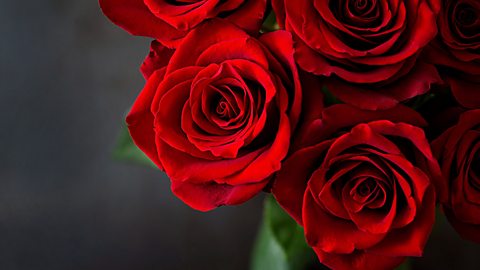
Stanza one of A Red, Red Rose opens with the simplistic A simile is a word or phrase used to make a comparison for dramatic effect, using 'like' or 'as'. comparing his love of a woman to a rose: a traditional symbol of love.
O my Love's like a red, red rose
The repetition of the colour "red" emphasises the strength of the speaker's love, as if it this is a deeper and richer red than usual.
newly sprung in June
His love of this woman is passionate but we note that this romance might be in its infancy, given the word choice of "newly". This suggests something fresh and pure, and it might account for the enthusiastic and Over-the-top exaggeration for effect. terms by which the speaker describes his love.
O my Love's like the melodie, / That's sweetly play'd in tune.
In a second simile, comparison is drawn between his love and a song - one that is both melodic and perfectly in tune. The A word used to describe the ideas or feelings that a word might suggest. For example, a skull conjures up thoughts of fear, mortality and death. associations of "sweetly" suggest that this relationship is in some way charming to the speaker. Being in love clearly pleases him.
Robert Burns uses The repetition of the same words at the start of successive sentences or clauses. in the repeated line opening "O my love". This suggests that the speaker is overpowered by intense emotion.
At the end of this stanza we are left with the impression that the speaker is earnest in his proclamations of love. The possessive pronoun "my" is repeated seven times in the course of the poem. Th speaker is proud to describe his strength of feeling At the same time, the word ‘my’ suggests that such passionate intensity in love is a feeling unique only to him.
Video - What is symbolism?
The poem A Red, Red Rose by Robert Burns is full of symbolism. For example, the rose is a traditional symbol of love and the colour red symbolises passion and deep affection.
Revise symbolism and why writers use it with this short National 5 English video.
What is symbolism? How and why would you use it?
Symbolism
The use of symbols to represent deeper meanings or themes.
Symbols are usually objects which are easy to understand.
What they represent is more complex.
We use symbols every day. Some are universal.
We all know that a red rose symbolises love or romance.
A clock is a symbol of time.
Diamonds can represent wealth or value.
A white flag symbolises surrender or a truce.
Symbolism helps writers illustrate and develop the themes of their story.
If you wanted to explore the theme of death, you might use symbols like:
The colour black
Angel’s wings
or even a skull
These symbols provoke emotions in the reader linked to death, adding depth beyond action or conversation.
In her poem 'Revelation', Liz Lochhead uses symbolism to explore the idea of evil through a young girl’s experience on a farm.
“I remember once being shown the black bull… In the yard outside, oblivious hens picked their way about…”
The black bull, half seen in the darkness, symbolises evil. This evil is a danger to order and calm, which is symbolised by eggs as well as innocent female hens.
“I had always half-known he existed – this antidote and Anti-Christ, his anarchy threatening the eggs”
Once these are established as the symbols of the poem, Lochhead uses them to guide us through the heavy concept of evil versus good.
The next time you explore difficult themes in your writing, why not give symbolism a go?
You might just crack it!
Stanza two: Boundless love
As fair are thou, my bonie lass
Stanza two opens with The reversal of the normal or expected order of the words and phrases in a sentence.. The unusual positioning of the word "fair" draws attention to how beautiful this woman is to the speaker. "Bonie" cements this image. Word choice of "lass" suggests the woman is young. This could imply the speaker himself is young and new to love. This fits with the strength of feeling and the simple terms used to express it.
So deep in luve am I
Burns again reverses word order in line two of this stanza. This call attention to the strength of love. Use of the word "deep" and the reference to "seas", in the last line of this stanza, suggest that his affection is vast and apparently boundless like the ocean.
I will luve thee still, my dear/till a’ the seas gang dry
The speaker asserts that his love will endure - presumably forever as the seas will never go dry. Over-the-top exaggeration for effect. is employed here to good effect, suggesting the speaker is almost overwhelmed by his strength of emotion.
Stanza three: Eternal love
Till a’ the seas gang dry./ Till a’ the seas gang dry, my Dear
Use of Repetition of a phrase with subtle changes throughout. in the final line of stanza two and first line of stanza three stresses that the speaker's love will endure.
the rocks melt wi' the sun
The idea of lasting love is enhanced by the naturalistic imagery in this verse. The speaker's love will have more permanence than "the rocks", and will go on even after all the oceans have run dry.
the sands o’ life shall run
As long as the speaker (or perhaps humanity as a whole) lives, his love will endure. In this stanza, the speaker again uses hyperbole to describe his love. The When a writer uses figurative language they do not simply state the facts, they use words or expressions with a meaning that is different from the literal interpretation. For example, they might use exaggeration to make a point, as in 'I have a ton of homework'. effectively presents a speaker who is filled with love and willing to pledge himself to one person for the rest of his life.
Stanza four: Farewell
Repetition of a phrase with subtle changes throughout. is used in the final stanza to strike a more sober tone than the impassioned and hyperbolic tones of previous stanzas. It is as if the speaker has been brought back down to reality.
In the phrasing of "my only luve" and the repetition of "my luve", the speaker pledges himself exclusively to his partner. He implies that he will remain faithful to her throughout their time apart.
And fare thee weel […] / And fare thee weel, a while!
The repetition of the first two lines makes clear the sense of loss felt by the persona as he considers their impending separation. Sentence structure here confirms that saying goodbye is difficult for the speaker.
The word choice of "a while" indicates that the speaker and his love will be separated for some time, But it also suggests that the separation will not be forever. This idea is reinforced in the third line; The speaker insists that he will "come again". This definitely indicates that he intends to return to her.
I will come again, my Luve,/ Tho’ it were ten thousand mile!
In the final line of the poem, hyperbole returns, and the speaker makes a final resolute pledge. Neither time nor distance will keep him apart from his love.
Themes in A Red, Red Rose and comparisons with other poems
How is love explored in A Red, Red Rose and other poems?
Thematically, the poem A Red, Red Rose by Robert Burns considers:
- love and human relationships
- the powerful bond which can be forged between two people
In having us consider the passion of a lover at the beginning of a relationship, Burns also asks us to consider the longevity of intense emotions. He presents a universal experience – love – in readily accessible terms.
Burns uses highly An object, person, image or event used to represent something bigger. For example, doves are often used as a symbol of peace. language to describe love in this poem, from the red rose itself to a sweet melody being played.
Over-the-top exaggeration for effect. is also used to explain to the reader that even if the world was to end (as suggested by the seas drying and rocks melting with the sun), the speaker's love will endure. In this poem, nothing is stronger or more lasting than love.
The theme of love is also explored in the other poems:
| Auntie | The speaker's love is for their aunt. The connection between the speaker and their aunt is clear throughout the poem. Love is described through words such as ‘soft’, ‘gently’ and ‘welcoming’. Here too there is a sense that love endures despite separation. |
| The Bonnie Earl o’ Moray | The Earl of Moray is loved and admired for his beauty, skill and many virtues: ‘He was a braw gallant’ and ‘He might hae been a king.’ He is mourned by "his lady". |
| Little Girls | Here love takes the form of self-love. By the end of the poem, the little girls are no longer content ‘being smaller’ and ‘using far less’ than men and decide to assert themselves against the patriarchy. |
| Lochinvar | Love motivates Lochinvar and Ellen's devotion. Lochinvar's fidelity highlights his legendary image, portraying his love as bold, pure, and unwavering - similar to the speaker in A Red, Red Rose. |
| The Twa Corbies | We are told the knight’s love had already left him for another before he died, making this sentiment the opposite of the pure and heroic love of the other poems. |
How is loss explored in A Red, Red Rose and other poems?
As well as the love expressed throughout the A Red, Red Rose, there is also a sense of loss. The final verse indicates that the speaker must be separated from his love:
And fare thee weel […] / And fare thee weel, a while!
It is clear, however, that the separation does not diminish their love and the speaker will do anything to be reunited with his lover, even if he must travel a great distance ("ten thousand mile"). This suggests the power of love and human connection. If it is strong enough, it can withstand any separation and distance.
The theme of loss is also explored in the other poems:
| Auntie | The speaker has lost or been separated from their aunt. Like the speaker in A Red, Red Rose, there is a sense that love is strong and enduring despite any physical distance or separation. |
| The Bonnie Earl o’ Moray | A A speech or piece of writing delivered that pays tribute to and memorialises the life of a person who has died., mourning the death of a noble man. He is described as being admired by many, including the Queen, which deepens the sense of tragedy. |
| Little Girls | Loss of innocence. There is also a sense that the girl is grieving or mourning the person she wishes she could be. |
| Lochinvar | The A character whose name is also in the title of a piece of writing. character is on a quest to reunite with his "lost love of mine". Rather than mourning his lost love, Lochinvar takes control and takes her back. Again, through loss or separation, the reader understands the strength of love and human connection. |
| The Twa Corbies | Discusses issues around loss, specifically death, but without the affection displayed in poems like A Red, Red Rose, Auntie or The Bonnie Earl o’ Moray. The knight’s loved ones in The Twa Corbies seem to have abandoned him. |
Revise A Red, Red, Rose by Robert Burns
Revise A Red, Red Rose by Robert Burns with this interactive quiz for National 5 English.
More on Scottish poetry collection
Find out more by working through a topic
- count6 of 8

- count7 of 8

- count8 of 8

- count1 of 8