Key points about using frequency tables, charts and diagrams

Statistics is the area of mathematics which looks at the process of handling Information collected for reference or analysis..
Data is a collection of information, often in a raw number format or non-numerical.
A A table used to organise data by listing each unique value or group of values and showing how many times it appears., with The cells of a table that go horizontally. and The cells of a table that go vertically., is used to organise and manage a raw set of data. A table can be used to produce a variety of charts and graphs, such as A type of graph where icons are used to illustrate frequency., A type of graph where the height of bars are used to illustrate frequency. and A type of graph where a circle is divided into slices (or sectors) to illustrate proportion..
Increase your confidence further in how to plot a variety of graphs by looking at these guides on representing data.
How to interpret frequency tables and construct pictograms
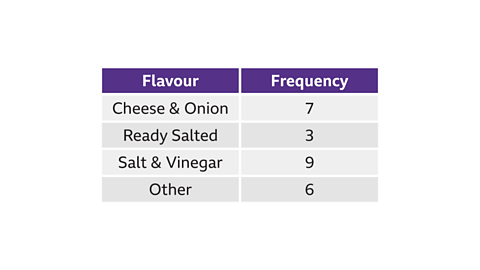
To produce a chart or graph, a set of data is required. The data is often provided in a frequency table.
A pictogram is a type of chart used to represent a non-numerical or Data that takes specific values, often whole numbers, eg, the number of siblings, shoe sizes. set of data.
A pictogram uses pictures, or icons, to represent the frequency of each category. The total frequency is dependent on the number of icons used.
A A table used to display the frequency distribution of data for two different similar variables at the same time. is another common representation of data. They show the frequency of two variables. The table might include totals for the columns and rows.
Follow the worked example below
GCSE exam-style questions
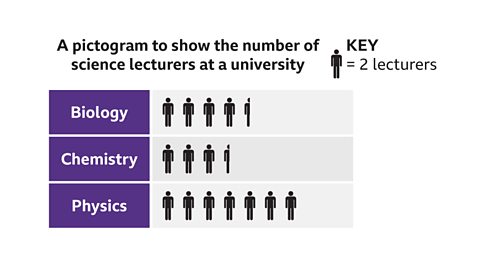
- The pictogram shows information about the number of science lecturers at a university.
How many more physics than biology lecturers were at the university?
5 lecturers
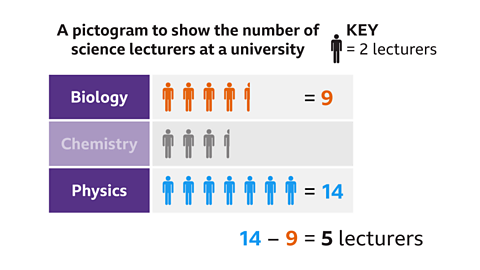
The biology department has 9 lecturers.
The physics department has 14 lecturers.
Difference = 14 – 9 = 5 lecturers.
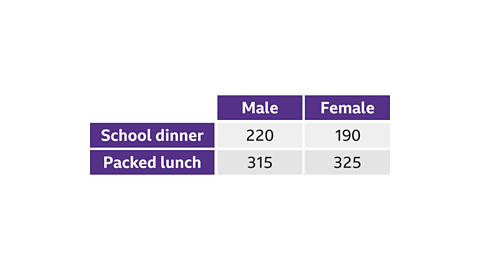
- The two-way table shows which type of food students consume during a lunch time at a secondary school.
Altogether, how many students eat a school dinner?
410 students
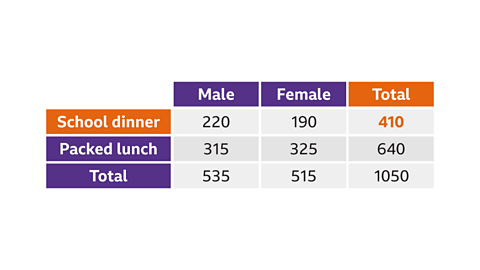
Add together the number of males and females choosing school dinners.
220 + 190 = 410
How to construct and interpret bar charts
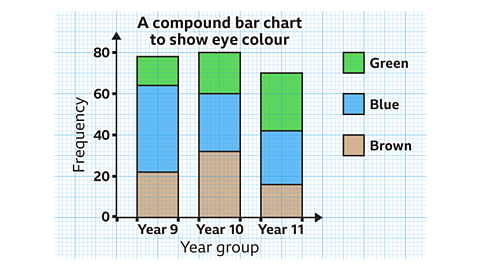
The height of each bar in a bar chart shows the The number of times something occurs. of events occurring.
A dual bar chart or compound bar chart is used to compare sets of similar data, eg a comparison of children and adults.
In a dual bar chart, the bars are placed next to each other. In a compound bar chart, the bars are placed on top of each other.
A An illustration that explains the colours or symbols on a graph. is provided to show which bar represents which set of data.
Creating a bar chart
Look for the largest frequency in your table.
Draw a The line on a graph that runs vertically (up-down) from the origin. on your graph paper.
Choose an appropriate scale for this axis and label your axis up to the largest frequency.
Look at how many categories are needed for the The line on a graph that runs horizontally (left-right) from the origin. .
Draw and label the horizontal axis, remembering to leave spaces for the gaps between the bars.
Draw each bar the correct height, based on the frequencies.
Check you have labelled each axis correctly and give your bar chart a title.
Find out more below, along with worked examples
GCSE exam-style questions
- The compound bar chart shows the eye colours of people surveyed across 3 groups.
How many people altogether have brown eyes?
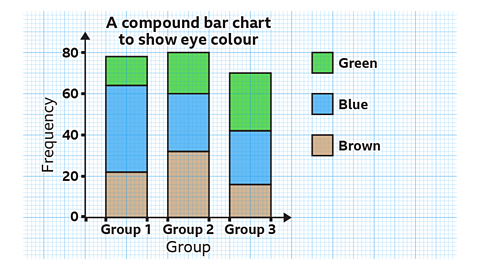
70 people
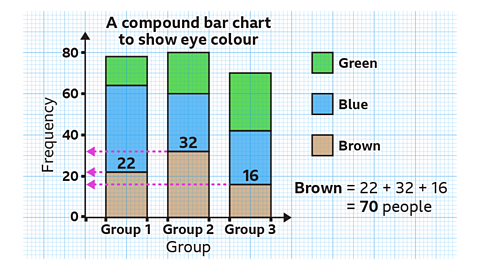
The vertical scale is increasing in increments of twenty. Each small square is equal to a frequency of two.
Group 1 has 22 people with brown eyes.
Group 2 has 32 people with brown eyes.
Group 3 has 16 people with brown eyes.
22 + 32 + 16 = 70
Altogether, 70 people have brown eyes.
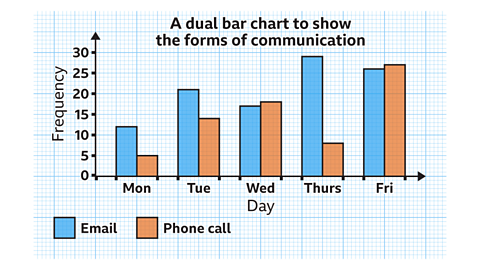
- The dual bar chart represents the forms of communication Noah had during a working week.
What fraction of Tuesday’s communications were emails? Give the answer in its simplest form.
Email = ⅗
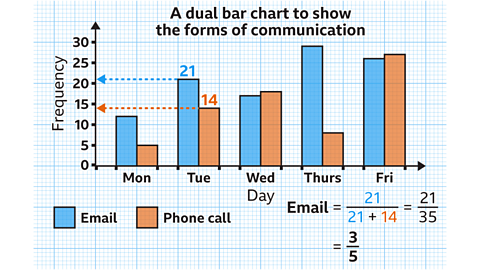
The vertical scale is increasing in increments of five. Each small square is equal to a frequency of one. On Tuesday, Noah receives 21 emails and 14 phone calls. Altogether this amounts to 35 pieces of communication.
To work out the fraction of emails, the numerator is the number of emails, 21, and the denominator is the total number of pieces of communication, 35.
The fraction ²¹⁄₃₅ can be simplified by dividing the numerator and denominator by the highest common factor, 7.
The fraction in its simplest form is ⅗.
How to construct and interpret pie charts
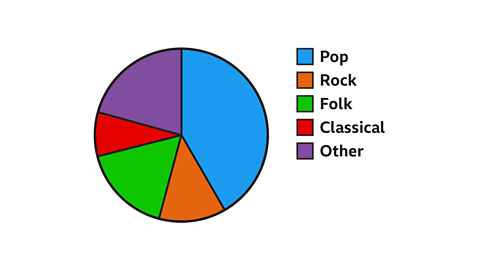
A pie chart is a type of graph used to show A part-to-whole comparison. Where each part of a ratio is considered as a fraction of the whole. Eg, in the ratio 3 : 5, the first part is 3/8 of the whole. This is a proportion of the whole. in a set of data.
A pie chart resembles a circle which has been split into sectors. The angle of each A portion of a circle with a perimeter made up of two radii and an arc. is representative of the proportions of the categories in the set of data.
It is possible to interpret a pie chart by looking at the proportions of the sectors. The sectors of the pie chart can also be expressed as percentages.
To create a pie chart, the size of the angles for each sector must be calculated.
Add the total frequency in the table.
Divided 360° by the total frequency.
Multiply each frequency by this value. These are the angles for each sector.
Construct a circle and draw a vertical line from the top to the centre.
In a clockwise direction, use a protractor to measure each angle, making a small mark at the edge of the circle and drawing a line from the centre to that mark.
Label each sector or use a key to colour code each.
Give your pie chart a title.
Find out more below
GCSE exam-style questions
- The pie chart shows some information about the numbers of medals won by Japan at the 2024 Summer Olympics in Paris.
Japan won 13 bronze medals. How many gold medals did Japan win?
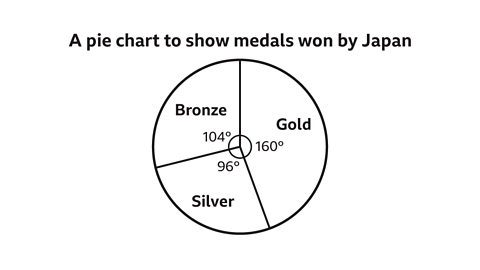
20 gold medals
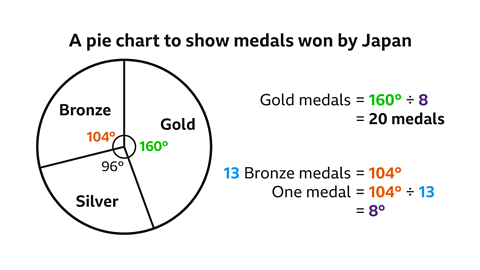
- The sector with angle of 104° is equivalent to 13 bronze medals.
The angle that represents one medal can be calculated by dividing 104 by 13.
One medal = 104 ÷ 13 = 8°
- The sector with angle of 160° represents the gold medals.
160 ÷ 8 = 20
Japan won 20 gold medals.
- Orla recorded the musical instruments played by each of 30 members of her orchestra. The table shows her results.
Calculate the angles of each sector required to construct a pie chart accurately.
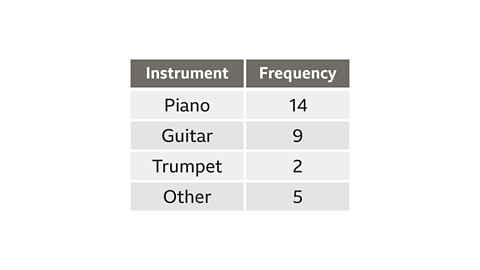
Piano = 168°, Guitar = 108°, Trumpet = 24° and Other = 60°.
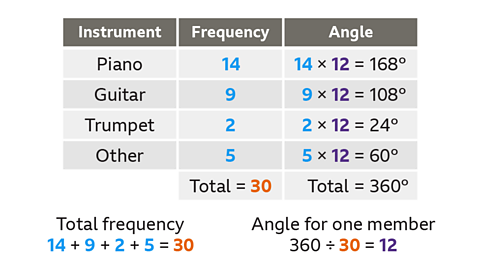
- First, add the frequencies. In this table the frequencies total 30.
Divide 360° by this value. 360 ÷ 30 = 12°.
This means each student is equivalent to 12° in the pie chart.
- Multiply each frequency by 12 to calculate the angles required.
Piano = 14 × 12 = 168
Guitar = 9 × 12 = 108
Trumpet = 2 × 12 = 24
Other = 5 × 12 = 60
These angles add up to 360°.
Check your understanding
Quiz – Frequency tables, charts and diagrams
Practise what you've learned about frequency tables, charts and diagrams with this quiz.
Now you've revised frequency tables, charts and diagrams, why not look at showing outcomes?
More on Statistics
Find out more by working through a topic
- count4 of 7

- count5 of 7

- count6 of 7