Form
Paddy Clarke Ha Ha Ha is written in the form of a novel, which is a fictional Ordinary language both spoken or written; different from poetry (which does not reflect everyday speech patterns).Narrative is another word for story.:
- fictional – something imagined or untrue
- prose – writing that is not in verse
- narrative – a written account of something
The novel is humorous at times because of the scrapes Paddy finds himself in and also his innocent narrative voice.
However, it is also tragic at times because of the breakdown of Paddy’s family and his dawning realisation that his parents are separating.
So, despite the frequent comic episodes in Paddy’s narrative, much of the tragedy in the novel lies in the fact that it is the study of a child’s observations as his family breaks up.
The novel could then be seen as a A literary style or situation that blends serious, sorrowful themes with humour, forcing the audience to experience both pity and amusement.. It is also an example of a A 'coming of age' story, describing a character’s emotional growth as they move from childhood to adulthood. (a coming-of-age story), as it traces the events of a young boy’s life that lead him to maturity and see him growing up.
When analysing form in Paddy Clarke Ha Ha Ha you can refer to:
- the type of text
- the style of writing
Structure
The The way the poet has organised the poem on the page eg number of stanzas, lines per stanza, breaks in between lines and stanzas. of a text refers to the way in which events are organised inside the work as a whole.
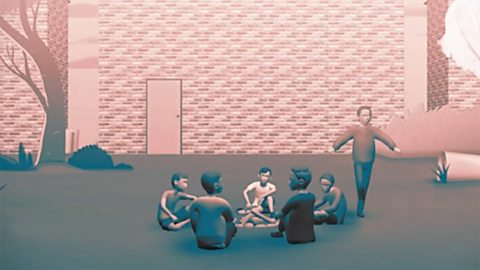
As Paddy Clarke Ha Ha Ha is written from the point of view of a 10-year-old child it does not have a plot as such, but is a series of episodes recounted by Paddy. We meet his family and friends through a variety of events retold one after another. The narration is episodic, and many events seem unrelated to those that come before or after them.
These A conclusion or statement that does not logically or correctly follow from the meaning of the statements that led to it. are typical of a child’s way of seeing the world and telling stories. Paddy’s recounting of important events is often interrupted by asides about earlier memories, comments on things he is reading and conversations he has had with his father.
Here is an example of one extract which comes between a description of how much he likes peas and a short account of his parents telling Paddy and Sinbad to go back to bed when they get up too early:
My da spoke.
- Where was Moses when the lights went out?
I answered.
- Under the bed looking for matches.- Good man, he said.
I didn’t understand it but it made me laugh.
As the novel is all written in this style, the reader gets to experience exactly what kind of disjointed thoughts and ponderings go through the head of a child. This style of describing random thoughts as they occur is sometimes called A narrative technique that captures a character’s continuous, unedited flow of internal thoughts, feelings, and memories exactly as they occur in their mind.
The novel can very loosely be divided into three different sections:
- An introduction to Paddy’s family and gang with details of the mischiefs and scrapes he gets involved in
- An introduction of the problems between Mr and Mrs Clarke
- The final section where Paddy’s family break up and he falls out with his friends
Even though Paddy seems to have developed a new maturity by the end of the novel, there is a tragic note in his grown up and rather formal final conversation with his father. He has lost the innocence and freedom from grown up concerns that he had when the reader first met him.
When writing about structure, think about:
- How is the text put together?
- What is the significance of this?
- How does the structure reflect the themes of the text?
- What is the overall effect of the structure?
Literary devices and narrative techniques
Language refers to the choices of style and vocabulary made by the writer. When analysing the language Doyle uses you should think about:
- what – the author’s choice of specific words and dramatic devices
- where/how – the way in which the writer uses them
- why – the effect on the reader
Many of the effects mentioned when discussing character, themes, form and structure are created through Doyle’s innovative use of language and other narrative methods. You will be expected to discuss these throughout your essay and analyse how they are used in every point that you make.
This section contains examples of some specific devices used by Doyle and some of the effects they may have on the reader. You can refer to our pages on example questions, characters and themes to see how discussion of these devices can be integrated into a clear argument in your exam.
Devices, uses and effects
| Device | How and why it is used |
|---|---|
| First person narrative voice | Doyle’s use of the The 'I' or 'we' used by a narrator who is a participant in a narrative, in contrast to the third person - 'he', 'she' or 'they' - of a narrator who is not directly involved.narrative voice allows us access into Paddy’s thoughts and feelings. The use of internal A speech delivered by a single character in which he or she is thinking out loud. allows us into Paddy’s private and often very jumbled thoughts. This is an effective narrative device as the narrator sees things first hand and reports to the reader what has happened. In some writing this can be a disadvantage as we only hear about events and people through the point of view of one person, which can mean that it is biased. However, this is solved by Doyle to some extent by his use of a child narrator. Paddy – in his childish manner – relates what he sees without comment or judgement. His observations are often innocent and matter-of-fact, allowing the adult reader to make their own judgement based on the facts that Paddy relates. |
| The words said by a character in a story or play. | Doyle is careful to present the characters’ Irish accent and Everyday language. accurately, thereby making the novel realistic and giving it a sense of Something that seems real and believable, has the appearance of truth.. Features of Irish language – Paddy learns Irish in school – and everyday speech are key elements in his writing. Doyle’s use of dialogue changes depending on character and situation. Most of the characters speak in Dublin The language or dialect spoken by the ordinary people of a country or region., but the language used by Paddy and his gang includes a lot more slang than the adult characters. Polite or neutral words or expressions used to refer to things which people may find upsetting or embarrassing to talk about. like “mickey” and “gee” for sexual body parts are typically used by children because of a lack of maturity or even much knowledge about such things. Paddy’s tendency to overuse simple evaluative terms like “brilliant” and “stupid” because of a lack of more sophisticated vocabulary is also typical. Other characters – such as Mr Hennessy and the headmaster for example – speak mostly in the A form of speech that lays claim to a grammatical 'correctness' and clear pronunciation, avoiding slang and valuing precision. of educated men. |
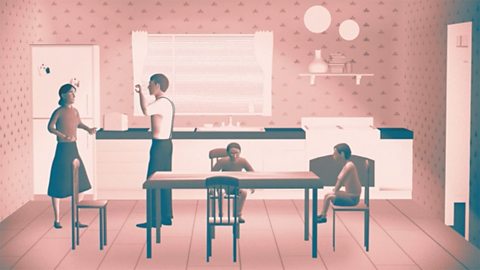
| Episodic events and flashback | Doyle has said in interviews that he wrote chunks of the novel in 20-minute gaps snatched during lunch breaks while he was still a teacher. This may help explain why much of the writing has a sense of intensity and pressure, and possibly why it is written in episodes of varying lengths. As the story is told in episodes from Paddy’s life as a 10-year-old, there is no real Chronological means following the time order in which events happened. Stories told chronologically start with the earliest event and end with the last. order – or at least we are not aware of a chronological order. All the detail seems to come from his ten-year-old perspective, but that is all the order we find. The main thread of the developing problems between Mr and Mrs Clarke seems to develop chronologically as the novel progresses. But around this the events described could be from any time in Paddy’s young life. There is one flashback. Paddy remembers a time when he was younger and created a fort under his kitchen table. This seems to suggest an end to innocent carefree existence and the beginning of a time of conflict in the Clarke family. The flashback seems to be used to show that we look back for better times. As the tension begins between his parents, perhaps Paddy is harking back to a simpler time. The fort in this memory could be symbolic, a representation of protection and safety from the problems of growing up. |
| Contrast | Doyle uses contrast a lot. Often he employs it to show that Paddy is fortunate to live in a family who encourage him educationally, provide him with nutritious meals and ensure he is clean and well clothed. There are many references to the problems in Liam and Aidan’s family, with Mr O’Connell letting them stay off school as a treat and giving them takeaways every night. In contrast to this we see Paddy’s mother providing a home cooked meal every evening – even when her marriage is falling apart – and both parents ensure that Paddy reads and does his homework. This is one example of how Doyle highlights the high standards of care Paddy receives, despite the Clarke’s working class status and family problems. This is reinforced when Paddy is in the medical room with Kevin. Paddy is initially embarrassed about the safety pin holding up his trousers. But then he reflects that at least he – unlike Kevin – has clean underwear. |
| A narrative technique that captures a character’s continuous, unedited flow of internal thoughts, feelings, and memories exactly as they occur in their mind | A lot of Paddy’s recounts (the act of giving an account of something that has taken place) and descriptions are fragments of stories. He tends to jump from one thing to another in the manner of a child whose concentration does not stay with one topic for long. Doyle uses a stream of consciousness for Paddy’s description of how the boys play ‘Grand National’. Liam breaks his teeth but, in the boys’ unforgiving world, “It was no one’s fault except his own.” Interwoven with the description of Liam’s broken teeth are A passage or section that deviates from the central theme in speech or writing. on explaining the game, the time Kevin broke Mrs Quigley’s window and the possible reasons for the Quigleys’ childlessness. These non sequiturs can be very comical at times, but the fragmented style of storytelling is also typical of a child’s speech patterns and therefore makes Paddy’s voice more realistic. Doyle also captures the childish desire to run and be carefree in his fast-paced description of the ‘Grand National’ game. |
| Understatement andOver-the-top exaggeration for effect. | As children often do, Paddy tends to gloss over some things the adult reader can see are serious. But he also exaggerates other things. When Paddy is injured by debris left by builders, his understated way of telling us the facts conveys a graphic intensity, “My foot was wet. My shoe was full of blood.” The short matter-of-fact style in which he speaks seems to be an understatement of what sounds like a terrible injury. This shows that Paddy is used to experiencing and seeing injuries and wounds during the often dangerous play with his gang. It may also portray how children very often don’t realise how serious injuries are, which leads to adult panic when they are discovered. Conversely, we see that Paddy exaggerates at times too. When he gets into trouble with his parents and they discipline him, he often describes their reaction using hyperbole (or exaggeration) – for example, “I got killed”. Obviously, this is not literal. It is an A series of words together or phrase that convey a certain meaning that does not reflect the meanings of the words separately. An example is "kicked the bucket". used by many people to emphasise the harshness of a punishment. |
| References to popular culture | References to popular culture make the novel and Paddy’s voice more real to us. Paddy’s favourite team is Manchester United: “My hot water bottle was red, Manchester United’s colour.” His hero is the Belfast-born player George Best, who played for Manchester United. It was common for Irish people to support Manchester United because of George Best, a famous footballer in his day. Details like this – alongside topical news stories – set the novel in a recognisable context for the reader, despite its fictional location. They also help to show how elements of the wider world encroach upon the smalltown life of Barrytown in both positive and negative ways, suggesting a time of change may be approaching. |
| The use of language to create images and pictures in the reader's mind. | Despite being a child, Paddy’s narrative is full of interesting imagery. In showing Paddy’s worries as his parents’ arguing intensifies, Doyle uses a A simile is a word or phrase used to make a comparison for dramatic effect, using 'like' or 'as'. when he describes how “Their fights were like a train that kept getting stuck at the corner tracks and you had to lean over and push it or straighten it.” This imagery effectively conveys how their fights seemed to go over the same things continuously, but the simile is also one that a child might realistically use as it is related to a toy train, something well within a child’s own experience. Part of Doyle’s skill is keeping the childish voice realistic, but also integrating colourful and engaging imagery into the narrative. In analysing particular passages, look out for imagery in the form of similes and A metaphor is a word or a phrase used for dramatic effect, to describe something as if it were something else., sensory descriptions and particular choices of verbs that may suggest a different scene to the one literally being described. |
Test yourself
Further study
Witness History: Roddy Doyle writes Paddy Clarke Ha Ha Ha. audio
Roddy tells Ben Henderson about his inspiration for Paddy Clarke, balancing work and fatherhood, and winning the Booker Prize.
Only Artists: Roddy Doyle meets Antony Gormley. audio
The Irish author of many acclaimed novels including the Booker Prize winning Paddy Clarke Ha Ha Ha, meets the British sculptor famed for works such as the Angel of the North and Another Place.
Bookclub: Roddy Doyle. audio
Roddy Doyle discusses Paddy Clarke Ha Ha Ha with James Naughtie (and readers), including how he attempted to access his own childhood memories to inform the novel.

More on Paddy Clarke Ha Ha Ha
Find out more by working through a topic
- count1 of 5
- count2 of 5
- count3 of 5