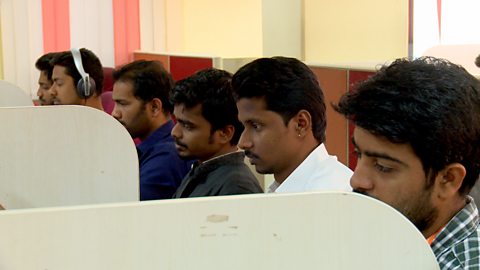
Introducing the physical and human geography of India - including its size and a typical city.
NARRATOR: It's late December. Three thirteen-year-olds from the UK are on their way to explore the geography of India. It's the trip of a lifetime, one that will challenge their preconceptions. Dua, Amalia and Nayan are on a ten hour flight through the night from London to New Delhi, the capital of India, a country of one and a quarter billion people, 20 times the population of the UK.
DUA: I think we probably will find out more about how India really is not just how you see it in pictures.
NARRATOR: Having arrived in Delhi they're taking a one and a half hour internal flight to the city of Patna in east India.
AMALIA: I hope to just find out more about what life is like there and what people … like people's views on their life and if it's really that different from life here.
NAYAN: I'd like to find out how India has actually changed over time.
NARRATOR: Nineteen hours after leaving London, Heathrow, they've finally reached their destination. It's 6 pm local time, five and a half hours ahead of the UK. They've come half way across the world and a huge adventure awaits them.
[CARS BEEP AS THE STUDENTS TRAVEL IN BUSY RUSH-HOUR TRAFFIC]
NARRATOR: Their first challenge is to get to their hotel but they've arrived in Patna during the evening rush hour.
DUA: So casual.
NAYAN: Wow!
DUA: I cannot believe this.
AMALIA: Wow.
DUA: Was that normal?
AMALIA: That was so close.
NAYAN: That was scary!
DUA: So scary!
AMALIA: There's like five people on the motorcycle.
DUA: That's like another problem with having a really high population.
AMALIA: That's like us just trotting down the A4.
DUA: So nineteen hours, that is the most I've travelled in my entire life. It's quite shocking like, it's just a little bit more than what I expected.
AMALIA: Yeah I think we're all really tired at this point. It's weird with the time difference trying to get used to it but hopefully by tomorrow we should be good to go.
NARRATOR: At noon the next day, with their body clocks at 6:30 am UK time they start exploring. Patna is the capital of Bihar state in north-eastern India and has a population of almost 2 million people. It might seem like total confusion buy Nayan is beginning to see a pattern.
NAYAN: It looks like there's no rules but there is some sort of order in this chaos. Like people know that we don't crash into each other and also this beeping tells you like, there's a car behind you, car in front of you so you literally know where the cars are so you can dodge them. It's almost like a game.
AMALIA: I hear there's loads of children down there literally sitting near the road.
NARRATOR: Although India is developing rapidly there is still a lot of poverty over 300 million people survive on less than £1 a day but that's only part of the picture. Dua and Amalia have noticed a large number of Scorpios India's most popular, home-produced, four-wheel-drive car.
AMALIA: Each of them are like £8000 to £13,000 I think and that's really quite a lot and there's so many of them on the roads so it's showing that as well as poverty…
DUA: There is wealth.
AMALIA: There is quite a lot of rich people.
NARRATOR: India is a huge country, more than ten times the size of the UK. Patna is the country's 19th biggest city despite its population being larger than Manchester and Birmingham combined. To get their bearings, the three visitors are meeting a group of Indian students.
INDIAN STUDENT #1: We are an eastern part of India and other parts have different cultures. That is why we consider Hindi as our mother tongue. Hindi can be understand and be spoken by everyone. In schools we use English, so we can do English and if we talk of myself and home we use Bengali, we can have Bengali and in Hindi with friends. So we have three languages.
NARRATOR: After six days in Patna the students travel more than 2500 km, nearly twice the length of the UK to Bangalore, In the southern state of Karnataka. Ten million people live and work in Bangalore which is also known as Bengaluru. It's one of the fastest growing cities in India and the centre of the country's hi-tech sector. It's also 10C warmer than Patna and feels very different.
AMALIA: Looks much more like London doesn't it?
DUA: Yeah.
AMALIA: That's like a proper shop, like Revlon and stuff
DUA: Ray Ban, no way!
AMALIA: Ray Ba…! Oh, yeah! Oh my god! Dunkin' Donuts! Oh my god!
NAYAN: Where? Oh my gosh!
AMALIA: Down there.
NAYAN: My perception of India was like, there are these small independent shops which only sell their own goods, they're homemade and things like that.
NAYAN: Part of my perception's right but there's also big super chains of stores like Samsung, Nokia. I didn't expect that.
NARRATOR: Amalia and Dua are meeting students from a local school. and discussing the length of India's coastline.
BHARATH: This coastline starts from here and ends over here. So, the distance between this and this is 7500km.
INDIAN STUDENT #2: Approx.
BHARATH: Approx.
AMALIA: That's actually the distance that it was from London to Delhi and that's like … we went through so many countries, so the fact that it's 7500 from just … in the same country it must be really really big.
INDIAN STUDENT #2: Big, yeah.
DUA: Since we've come to Bangalore we've noticed that it's developed a lot as … 'cause we went to Patna first and now we've seen like a major difference and it looks a lot like back home so what do you think of the development in Bangalore?
BHARATH: I would say it's a fast developing city, like about ten years before there were not as many buildings here as before so then it’s a fast developing city with more and more improvements every year.
DUA: And do you think that's a good thing?
BHARATH: Yeah I do think that's a good thing but that's … it even has a harmful effect on the environment like there's a lot of deforestation and stuff.
INDIAN STUDENT #2: People have migrated to Bangalore from you know, various parts of India so you get to see like a mixture of all the cultures from India.
NARRATOR: After travelling nearly 10,000km the visitors' first impressions of India are beginning to change.
DUA: Seeing how globalisation has really captured the entire country has been really eye-opening all the cultures and all the different experiences mixed together makes like a really interesting country to be in.
AMALIA: At first it feels threatening because it's somewhere completely different. Watching things on TV and stuff make you have an image in your brain that it's like a poor country, they haven't got much, there's not a lot of opportunities but it's completely different. You just notice that it's really alive.
NAYAN: If you come to India and you stay in one city, you would get a one-sided opinion of India. You have to talk to people, visit places, to actually get a proper conclusion.
Video summary
Download/print a transcript of the video.
Three 13-year-old pupils from the UK - Dua, Amalia and Nayan - are on a trip to explore the geography of India.
The pupils discover India is huge, more than ten times the size of the UK. They explore Patna, the capital of Bihar state, in north-eastern India. Patna has a population of nearly two million people, which is larger than Birmingham and Manchester combined. They also discover India is a country of contrasts as they witness both poverty and wealth.
They then travel 2500 kms south to Bangalore (Bengaluru). Bangalore is one of India’s fastest growing cities and the centre of India’s hi-tech industry. They meet some pupils from a local school and discuss the changes in Bangalore due to its growth. They discuss the length of India’s coastline and explore India’s scale further. After travelling over 10000 kms the three pupils’ preconceptions of India have been challenged.
This clip is from the series Exploration India.
Teacher Notes
Download/print the Teacher Notes for this episode (pdf).
Teacher Notes prepared in partnership with the Geographical Association.
Video summary
Three 13-year-old pupils from the UK - Dua, Amalia and Nayan - are on a trip to explore the geography of India.The pupils discover India is huge, more than ten times the size of the UK. They explore Patna, the capital of Bihar state, in north-eastern India. Patna has a population of nearly two million people, which is larger than Birmingham and Manchester combined. They also discover India is a country of contrasts as they witness both poverty and wealth.They then travel 2500 kms south to Bangalore (Bengaluru). Bangalore is one of India’s fastest growing cities and the centre of India’s hi-tech industry. They meet some pupils from a local school and discuss the changes in Bangalore due to its growth. They discuss the length of India’s coastline and explore India’s scale further. After travelling over 10000 kms the three pupils’ preconceptions of India have been challenged.
Before watching the video
Ask students what they already know about India. This could be done as a ‘Think-Pair-Share' activity to give time for students to think about what they know and to discuss this with their peers.
Using a world map, locate India. Ask students to write a locational description of where India is. A satellite image of India could also be looked at. Ask students what physical and human features they can see on the satellite image.
Introduce key terms such as:
Wealth: a large amount of money or valuable possessions.
Hi-tech industry: industries that use a high level of cutting-edge technology, for example, aerospace and robotics.
Globalisation: the way in which the world has become more interconnected.
During the video
You may wish to stop at relevant points during this short film to pose questions and check understanding or wait until the end. Useful questions might include:
- What is it like when they arrive in Patna?
- How many people live in Patna?
- What is a Scorpio?
- What is car ownership suggesting to the children?
- What languages do the Indian students speak?
- What is it like in Bangalore?
- What is migration?
- What impact is globalisation having on some cities in India?
After watching the video
Split the class into groups and give each a different area of India to research and to present back to the class. Students should research the key human and physical features of their given location. Challenge students to use a range of sources to avoid building a single story of that location.
When students present, the other students in the class should make notes about each of the locations so that they can compare and contrast the different parts of India.
After the presentations, discuss with students how their preconceptions of India have changed and what they have now learnt about India. You could also ask what else students wish to know about India.
Where next
Using GapMinder’s website Dollar Street investigate the lives of other families around the world. This website gives you an insight into their lives and looks at different products that families have in their homes.
Students could look at families across India and see how their lives differ, this could then branch out to other families around the world.
Links to Bitesize
Curriculum relevance
This clip will be relevant for teaching Geography at KS3 in England and Northern Ireland, 3rd Level in Scotland and Progression Step 4 in Wales.
Students and teachers over the age of 16 can create a free Financial Times account. For a Financial Times article about Bangalore's high-growth tech hub from 2022, click here.
Education - building the India of tomorrow. video
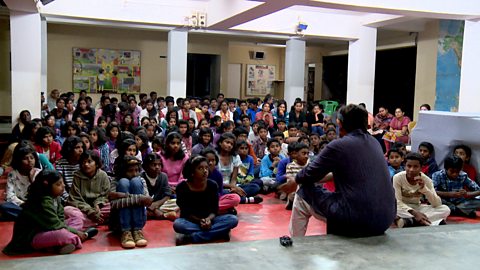
Dua, Amalia and Nayan meet Indian children who have been given the opportunity for a different life through education.
Rural life in India. video
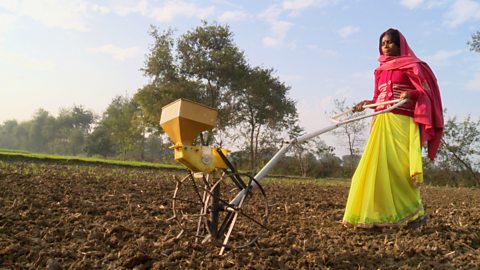
Dua and Nayan explore rural life in India and learn that the majority of India’s population work in farming and agriculture in the countryside.
Rivers: The Ganges. video
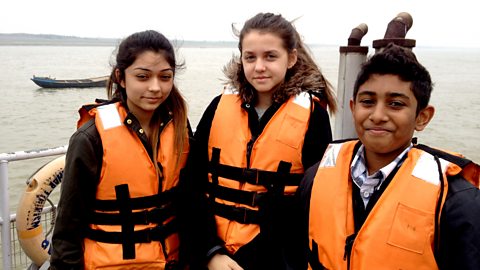
Dua, Amalia and Nayan explore the River Ganges in India and discover its significance to both physical and human geography.
Urbanisation in India. video
Dua, and Amalia learn about the impact of migration to the Indian city of Bangalore (Bengaluru) and its rapid urbanisation.
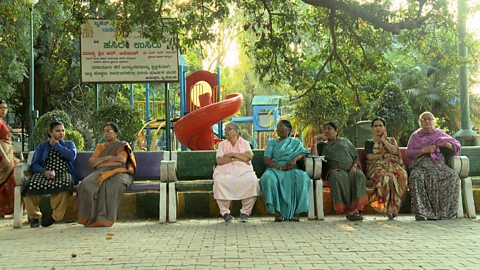
Working life and employment in Indian cities. video
Dua, Amalia and Nayan explore urban life in Bangalore, India - a city that attracts young Indians seeking work and careers.