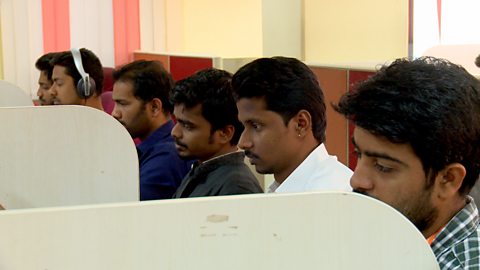
Dua, Amalia and Nayan meet children who have been given the opportunity to escape poverty through education.
NARRATOR: Three 13-year-olds from the UK are on their way to explore the geography of India. Dua, Amalia and Nayan are on a ten hour flight to India a country of one and a quarter billion people 20 times the population of the UK. Nineteen hours after leaving London, Heathrow, they've finally reached their destination.
They've come half way across the world and a huge adventure awaits them.
Dua, Amalia and Nayan are approaching the end of their trip to India but before they leave they're making one final visit. Having witnessed many instances of extreme poverty they've come to visit a school in the countryside, east of Bangalore. It takes children from families whose social circumstances would usually prevent them from getting an education.
TEACHERS: Welcome to Shanti Bhavan.
STUDENTS: Thank you.
MALE GUIDE: Shanti Bhavan takes children at the age of four and provides them with everything they need, right from - education to shelter to food and clothing. Everything, and that to free of cost.
NARRATOR: The children return home for just four weeks a year. As soon as they begin here, every lesson is taught in English which the school believes will provide greater opportunities.
MALE GUIDE: We have people we call aunties, they look after us and our dormitories. They are actually like our second mothers and they help us with everything we need. They make sure we are dressed properly for school and everything.
FEMALE GUIDE: You see this bunny? Yeah there, that teddy bear.
FEMALE GUIDE: Each person has a doll It's nice because we don't have it at home so we don't have teddies at home. We used to sleep on the floor and when we first came here we found it really hard sleeping in the bed and we were really scared that we would fall off.
AMALIA: Do you not miss your family?
FEMALE GUIDE: We miss our family but when we go home and we come back we are all like homesick but when-- like after a few days we just like completely forget our home 'cause we are like so into the school and–
FEMALE GUIDE: We are a family here. We think of friends as brothers and sisters so we don’t miss anybody at all.
NARRATOR: The school is a charitable foundation funded by private donations and based on the principle that all children have a right to an education whatever their background.
ABRAHAM GEORGE: You are brought up differently. You are not brought up the way it would be if you were living at home.
NARRATOR: Abraham George founded Shanti Bhavan to educate children who have experienced poverty and discrimination due to the Indian caste system.
DUA: What is caste and how does it affect the children?
ABRAHAM GEORGE: Right. The caste system originated almost 1500 years ago. The society at that time needed some people to do certain types of jobs. Everything from getting rid of the toilet waste or cleaning your house and so on. So they had the society broken into various groups of people, each one doing different things and then the quote/unquote lowest - I don't believe in all this stuff. A lowest is those people who don't belong to any caste. They are called 'the untouchables of India'. Today they have given them different names, they used to be called Dalits - 'Children of God' as they call them. So there are 300 million of that low - so-called low caste. And our children, 95% of them, belong to those castes and they also tend to be very poor. I've told you many times, caste doesn't exist in reality. It's a way to oppress others. You are a human being just like anyone else. You are decided by your character. Our mission is that with you the cycle of poverty is broken for good, for permanently.
NARRATOR: Each child is duty-bound to leave Shanti Bhavan with a mission to help at least 100 other people like themselves. Puneeth is seventeen and has been at Shanti Bhavan since he was four.
DUA: If you didn't get a chance to go to this school, what do you think your life would be like?
PUNEETH: My family have - they're good people but they don’t get the chances that other people get because they're not well connected or they don't have enough money and so I came here and it was lucky for me but the rest of my family went through a lot of hard times. Like, they didn't have a proper house to sleep in, they would sleep like on the roadside and stuff. If I hadn't come here then I'd probably have to go to work by like ten years of age or something so that we could support the family. Like, my mother, when I go home she tries not to show me that it's hard for her to get stuff at home. So if I need anything she just gets it without telling me how she got it that she had to borrow money or whatever. So, so that I stay happy but I know it's hard for her.
NARRATOR: Vijayalakshmi is seventeen and has also been here since she was four.
AMALIA: As a young child before you came to Shanti Bhavan, what was it like for you living in a village?
VIJIAYALAKSHMI: We were really poor and my mama passed away when I was three and my dad, my dad drinks a lot so I don't live with them and after I joined this school, I started living with my aunt She works as a housemaid, she goes to other people's house and does work and sometimes I can see when she's having problems like she has to pay the bills off and all that and she's like, she's depressed and all that. I can see those hardships. I study business in the 12th grade and I'm planning on doing more business in college and maybe I'll join a company and then, yeah, I wanna join a really big company and earn lots and help other people.
NARRATOR: Places at Shanti Bhavan are limited. Only one child per family is able to attend the school.
JAMES: Hi, my name is James, I'm…
NARRATOR: James is 13, he's the only member of his family to receive an education which upsets him.
NAYAN: How old are your brothers and sisters?
JAMES: My brother's one year younger than me so he's 12 and my sister's 15. My brother works as a carpenter and my sister works in a clothes factory she makes clothes.
NAYAN: Why do your brother and sister need to work?
JAMES: My brother and sister need to work because we don’t have enough money and my parents don't have any money to pay their school fees and all that so they go for work.
NAYAN: What does your mother do for a living?
JAMES: She goes to other people's houses and she works by cleaning the floors and the toilets and she earns like that. My father, he went up the roof and fell down and broke his hip so he can't go for work.
NAYAN: Do you think all of this is fair?
JAMES: I think it's not fair because most of them, they are rich most of the people near my house are very rich and then when they look at me they look weird because I look poor most of them make fun of me and my brother and sister.
NAYAN: It was really shocking, it was probably the saddest I've felt in my life because I kind of sympathised for him and what would happen if I was in that situation. And yeah, it was just really terrifying and shocking.
ABRAHAM GEORGE: The challenge is - can we take children from the poorest of poor and make them extremely successful. And that's what India needs, not just 1% at the very top. That is - that's not fair.
AMALIA: It's made me realise that there is like, a solution to all of the challenges that India's facing and that is a good education.
NAYAN: Schools like this can actually help poverty in India because all that people need to get rid of poverty is education. Education seems like a really powerful weapon in the world.
NARRATOR: Dua, Amalia and Nayan, have spent the last two weeks exploring the geography of India. They've cruised down the Ganges river, played cricket in an Indian village and been to work with young Indians. As they prepare to leave this country of 1.25 billion people, how would they sum up their experience?
AMALIA: There's so many different cultures and so many different aspects to it that it just makes it such a lively country and it's so vibrant and its full of colours and different lives and different people.
NAYAN: I thought India was like a rough, dirty place and now I've come here it's, I, I wouldn't say it's dirty, and I wouldn't say it's rough because people are just so friendly here and the landscape is so beautiful, even in Patna and places like that the independent stores just make up the city.
DUA: India's not what I expected it to be at all. I had this really bad stereotype of how it was, it's so not, at all, and like I think that's what I've learned the most out of this whole thing, that you can't judge something without actually exploring and looking more closely.
Video summary
Download/print a transcript of the video.
Three 13-year-old UK students - Dua, Amalia and Nayan - meet children who have been given a unique opportunity to escape poverty through education.
They meet Puneeth, Vijayalakshmi and James. These children have left their homes to receive an education through a charitable school near Bangalore. The school takes children from the poorest caste and provides them with an education. The children have a mission to help others when they leave school and have careers.
This clip is from the series Exploration India.
Teacher Notes
Download/print the Teacher Notes for this episode (pdf).
Teacher Notes prepared in partnership with the Geographical Association.
Video summary
Three 13-year-old UK students - Dua, Amalia and Nayan - meet children who have been given a unique opportunity to escape poverty through education. They meet Puneeth, Vijayalakshmi and James. These children have left their homes to receive an education through a charitable school near Bangalore. The school takes children from the poorest caste and provides them with an education. The children have a mission to help others when they leave school and have careers.
Before watching the film
Using a world map, locate India and the city of Bangalore. Ask students to write a locational description of where the city is within India.
Look at some photographs of Bangalore. Ask students to describe what the city looks like.
Discuss with students why education is important. Students could create a spider diagram or a list with all of the reasons on.
Introduce key terms such as:
Caste: the system of dividing people in a society into different social classes.
Poverty: not having enough money or resources to meet basic needs.
Discrimination: treating some people differently to others.
During the film
You may wish to stop at relevant points during this short film to pose questions and check understanding or wait until the end. Useful questions might include:
- Why are the children taught English?
- How is the school different to the children’s homes?
- What makes the school in the clip special?
- What is the caste system?
- What do the children have to do when they have left the school?
- Why do some children need to go to work?
- Why is education important?
After watching the film
Discuss with students what impact education is having on the Indian pupils in the video. The discussions could centre on what their lives could be like instead if they weren’t able to go to school. Literacy rate data from across the world could be investigated to see what inequalities exist around education. Maps such as equal area cartograms could also be viewed to look at data differently, for example.
This literacy map shows literacy rates for people over the age of 15 in 2015. The size of the country is equivalent to the size of the piece of data being represented.
Students could also create their own choropleth map of literacy rates around the world. Using this, students could then write a description of the pattern of literacy rates across the world.
Where next?
The UN developed 17 ‘Sustainable Development Goals’ in 2015. One of which is quality education for all.
Research Sustainable Development Goal 4. What are the aims and objectives of this goal and how much progress has been made across the world towards this goal. Is it likely that this goal will be met by 2030?
Links to Bitesize
Curriculum relevance
This clip will be relevant for teaching Geography at KS3 in England and Northern Ireland, 3rd Level in Scotland and Progression Step 4 in Wales.
Students and teachers over the age of 16 can create a free Financial Times account. For a Financial Times article about India’s drive for diversity from 2024, click here.
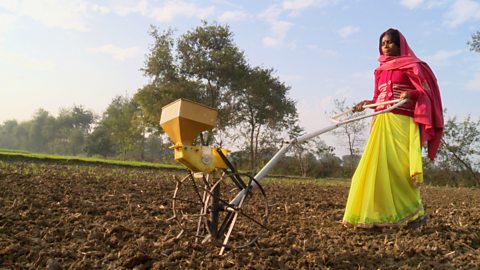
Rural life in India. video
Dua and Nayan explore rural life in India and learn that the majority of India’s population work in farming and agriculture in the countryside.
Introducing the physical and human geography of India. video
Dua, Amalia and Nayan begin their discovery of the geography of India, including its surface area. They visit Patna and Bangalore.
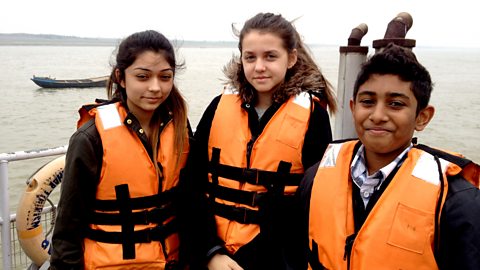
Rivers: The Ganges. video
Dua, Amalia and Nayan explore the River Ganges in India and discover its significance to both physical and human geography.
Urbanisation in India. video
Dua, and Amalia learn about the impact of migration to the Indian city of Bangalore (Bengaluru) and its rapid urbanisation.
Working life and employment in Indian cities. video
Dua, Amalia and Nayan explore urban life in Bangalore, India - a city that attracts young Indians seeking work and careers.