Exploring the impact of rapid urbanisation in the city of Bangalore (Bengaluru).
NARRATOR: Three 13-year-olds from the UK are on their way to explore the geography of India. Dua, Amalia and Nayan are on a ten-hour flight to India a country of one and a quarter billion people - twenty times the population of the UK. Nineteen hours after leaving London, Heathrow, they've finally reached their destination. They've come half way across the world and a huge adventure awaits them.
Today, Dua and Amalia are in Bangalore, one of India's most affluent cities. The Indian economy is booming. Economic growth has created opportunities for many, but not for everyone. They've come to a part of Bangalore that was once a village to find out how this area has changed and what life is now like for the people who live here. Dua and Amalia are meeting Chandra a geographer, who's lived in Bangalore his whole life.
CHANDRA: We can see pieces of things on the landscape that will remind you that it was a village once. So you can also see thehistory of the place. The historical geography. This again is typical, look at how narrow the streets are and how close the buildings are from one house to the next. There's not much of a gap. You can actually just jump across. There's just a very narrow passage. If there were a wall there, you could just walk over there if you had a balcony.
So if we turn and look at that house there, that's a very, very old house. You see this corrugated roof. Even the building is comingdown like this. So you see a lot of these kinds of old structures still around. This area has become much more built up to provide homes for all those who've come to Bangalore from other parts of India. The city's population has increased by half in the last decade as IT and other sectors have boomed.
DUA: If it's such a dense population, instead of building up and up and up, why can't they just spread out and build more out?
CHANDRA: You can't because this is the land you own. To maximise it, the only way to maximise it is to go up. You can't expand because it's somebody else's land over there. You see this element of the rural, in the form of a chicken coop where livestock is kept surrounded by an urban looking landscape. There are a lot of modern things. This building, this whole architecture is very modern. Whereas those houses that we saw were very old. The old architecture. In a way it looks contradictory, doesn't it? How can you have both together in the same landscape? You want to say this is the urban landscape, but then it isn't, it’s a rural landscape. You want to say a rural landscape but no, it is urban too. So they're not contradictions. They seem like contradictions but they're not. They're part of this process of change that has happened. It's just his pocket has not changed that much whereas these otherareas have.
AMALIA: I didn't think that there would be so many signs of the village still after like so long but it's quite shocking to see how many more buildings they've built and how close they are to each other.
DUA: There is obviously some signs of how the village was before but in the same way everything looks so different. So you can see the houses, you can see the one storey houses and you see like the three storey houses and you just see how life must have really changed.
NARRATOR: The growth of Bangalore has had a huge impact on the local environment. It was once known as India's garden city because of its many trees and lakes but most of the lakes have now disappeared.
CHANDRA: Bangalore had more than 100 lakes at one time … and in the recent decades we have come down to about twenty lakes now … fifteen to twenty lakes. We get a lot of rain water coming in here, storm water. It will flow in here. After this thing filled up it will flow out to the canal over there and go to another lake somewhere else. So that network kept Bangalore from getting flooded. But now, because we have lost so many of the lakes, and the canals that routed the water around, we have a lot more flooding in Bangalore now. Just a little bit of rain and there are floods on the roads.
NARRATOR: Dua and Amalia are keen to find out when the urbanisation began.
DUA: What changed in the village that all these developments have taken place and when did it start taking place?
CHANDRA: After the 1980s, what had happened was India's economy was a very closed economy which meant we didn’t have much by way of international trade and in the 1990s the economy was opened up because India was about to go bankrupt if we didn’t do it. Credit became more easily available. Cement was a big issue. We could actually not get cement easily. So that became very easily available. Commodities became very easily available and people also saw something else happening and that is more and more of the IT sector was beginning to come up. So a lot of people started moving into Bangalore. It is a huge migration that has happened because the economic opportunities opened up. This kind of change is not unique here. This is happening throughout India since the economy opened up.
NARRATOR: As they've become more affluent, the lives of the people in this area have changed too.
CHANDRA: If you look inside the houses you will always find a refrigerator, a gas stove, an electric stove, a washing machine, a super-duper television. You'll also look at the kinds of clothes I see around here now. These are all much more westerns clothes.
NARRATOR: Bangalore is seeing a building surge with the construction of many new luxury apartments. Although many people are benefitting from the growth in Bangalore there is still extensive poverty. The students are meeting Aneeth who was born in one of the city's slums.
ANEETH: Well I do not think India is developing the way it should be.
DUA: Yes.
ANEETH: There are select few areas where the government has invested its money for the development to happen. For example, you can see the stark difference. You go down here, you'll know that there is a slum and there's an apartment or a luxury apartment.
NARRATOR: There have been some improvements in the area. There used to be an open sewer here.
ANEETH: The pathway we are walking on is actually a drainage. It's a drain, which took about five to six years for it to be closed by the government. My dad and his friends, they got together and they struggled for five years. For five years they struggled to get this drain closed so that people could walk normally and children do not fall into the drain when it rains.
NARRATOR: Bangalore has around 600 slums where a fifth of its population lives. These are typically very crowded areas with poor facilities and limited access to education and healthcare.
AMALIA: How many people live in this area?
ANEETH: I think about, more than 200 families in this very small area and in each family there are about … the grandparents, the parents and the kids, so there are about three to four kids in each house. So it's very difficult, it's very small and it's not comfortable. A student who's going for class everyday - for example, my sister - she studies in … she's in her 12th grade right now. It's very difficult for her to come back home, study without electricity or study with the power cuts and with no proper water supply, there's no sense of comfort in the head.
NARRATOR: Aneeth was fortunate to have his education paid for by a charity and now works as a tax analyst for a multinational company. He's paying off his family's debts and helping the other families in his community, many of whom he's related to.
ANEETH: I'm gonna request you guys to remove your footwear and that's because at home in the living room and that's where we remove our footwear. It's a sign of respect.
AMALIA: That's OK.
ANEETH: Thank you.
AMALIA: Namaste.
DUA: Namaste.
ANEETH: Please.
DUA: Thank you.
NARRATOR: Aneeth lives with is brother, sister and parents all sleeping in this one room. His father is a builder but struggles to find work. His mother works in the kitchen of a local school.
MUM: [SPEAKING IN MOTHER TONGUE] We used to live in a small wooden hut. There were no roads and no buses. It's much better now, houses are being built. The houses have better roofs. Back then we were struggling for food and work. Now we're doing better.
DAD: [SPEAKING IN MOTHER TONGUE] When they're building houses around here, we have work for a week or two, and then for a week or two, we won't have any work.
DUA: So I wanted to ask all of you if they're happy with their life and how it's changed.
MUM: [SPEAKING IN MOTHER TONGUE] I'm much happier compared to those days. Now we have regular work. We eat three meals a day. The children have grown up and they've started earning. If Bangalore is to develop, the government needs to make changes here too. They need to look at our area and see that it's in bad condition. Are they going to leave our place like this, when there are such modern buildings around us?
DUA: It was a tough day. I guess I'd only seen the one side to Bangalore which was more of the richer side and then to see that, it was hard because I didn't expect it.
AMALIA: When we first arrived at the airport everything was like really posh and I thought it was like a very rich city. But once I saw the slum it reminded me that actually more places need to be developed so that everyone can have a fair share of the changes in India.
DUA: You see all this construction work and all this buildings and really nice hotels are just like cover up and what's really there is like people living in really hard conditions and it's like, I feel like they're not getting the attention and they're not getting the things that they need.
Video summary
Download/print a transcript of the video.
13-year-old UK students Dua, Nayan and Amalia are in the Indian city of Bangalore (Bengaluru) to explore the impact of urbanisation.
They meet Chandra, a local geographer, who guides them through a typical urban region of the city. The pupils see how urbanisation has engulfed villages and created narrow streets of densely built housing, to accommodate the rapidly growing population who migrate to Bangalore from the surrounding areas seeking work - particularly in the IT industry.
Bangalore includes slum areas where people lack sanitation, healthcare and access to education. Aneeth takes the pupils to his home to meet his family, who all live together in a single room. Aneeth's parents describe how their living standard has actually improved over recent years.
This clip is from the series Exploration India.
Teacher Notes
Download/print the Teacher Notes for this episode (pdf).
Teacher Notes prepared in partnership with the Geographical Association.
Video summary
13-year-old UK students Dua, Nayan and Amalia are in the Indian city of Bangalore (Bengaluru) to explore the impact of urbanisation. They meet Chandra, a local geographer, who guides them through a typical urban region of the city. The pupils see how urbanisation has engulfed villages and created narrow streets of densely built housing, to accommodate the rapidly growing population who migrate to Bangalore from the surrounding areas seeking work - particularly in the IT industry.
Bangalore includes informal settlements where people lack sanitation, healthcare and access to education. Aneeth takes the pupils to his home to meet his family, who all live together in a single room. Aneeth’s parents describe how their living standard has actually improved over recent years.
Note: Whilst the term ‘slum’ is used in the clip, this is no longer an acceptable term and it carries a strong negative bias. Terminology such as ‘informal settlement’ is considered more appropriate.
Before watching the film
Using a world map, locate India and the city of Bangalore. Ask students to write a locational description of where the city is within India.
Look at some photographs of Bangalore (Bengaluru). Ask students to describe what the city looks like. Also ask students what they think is missing from the photographs - what can’t they describe about Bangalore?
What similarities and differences can students see between the photos and the different locations in Bangalore?
Introduce key terms such as:
Affluent: having a lot of money or possessions.
Urbanisation: the growth of urban areas.
Multinational company: a company with offices and factories in more than one country.
During the film
You may wish to stop at relevant points during this short film to pose questions and check understanding or wait until the end. Useful questions might include:
- What is a ‘dense population’?
- How has Bangalore grown over time?
- What are the impacts of growth on Bangalore?
- What is ‘urbanisation’?
- When did the urbanisation of Bangalore begin?
- How has life changed for people in Bangalore?
- What is an informal settlement?
- What is Bangalore likely to be like in the future?
After watching the film
Discuss with students what they saw in the clip. How did the different locations show compare and contrast to each other? Explain what an informal settlement is and the characteristics that they have. Ask students why they think some people live in informal settlements and link this to rural to urban migration.
Using maps look at the growth of cities across the world. Is there a pattern to which areas of the world are experiencing urbanisation. Students could use the maps to look at megacities and global cities to see if there is a pattern to their location.
Using online maps, look at the locations of the informal settlements around Bangalore. Where is their location in relation to the Central Business District of the city?
Where next?
Using GapMinder’s website Dollar Street investigate the lives of other families around the world. This website gives you an insight into their lives and looks at different products that families have in their homes.
Students could look at families across India and see how their lives differ, this could then branch out to other families around the world.
Links to Bitesize
Curriculum relevance
This clip will be relevant for teaching Geography at KS3 in England and Northern Ireland, 3rd Level in Scotland and Progression Step 4 in Wales.
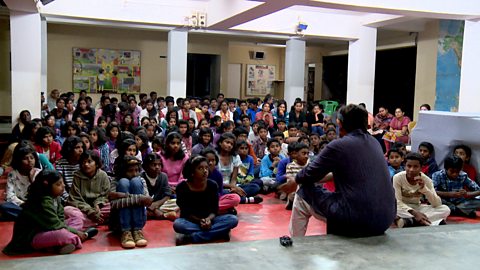
Education - building the India of tomorrow. video
Dua, Amalia and Nayan meet Indian children who have been given the opportunity for a different life through education.
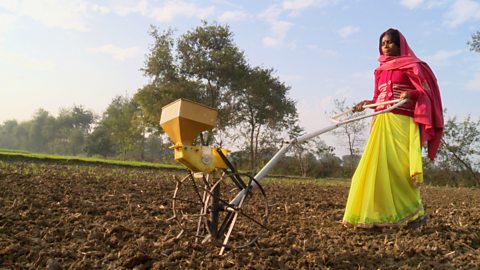
Rural life in India. video
Dua and Nayan explore rural life in India and learn that the majority of India’s population work in farming and agriculture in the countryside.
Introducing the physical and human geography of India. video
Dua, Amalia and Nayan begin their discovery of the geography of India, including its surface area. They visit Patna and Bangalore.
Rivers: The Ganges. video
Dua, Amalia and Nayan explore the River Ganges in India and discover its significance to both physical and human geography.
Working life and employment in Indian cities. video
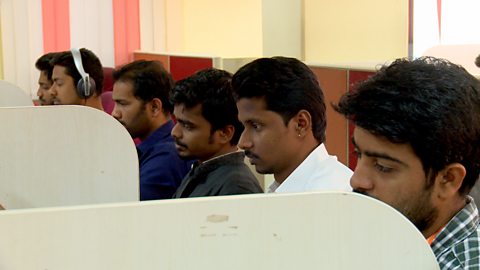
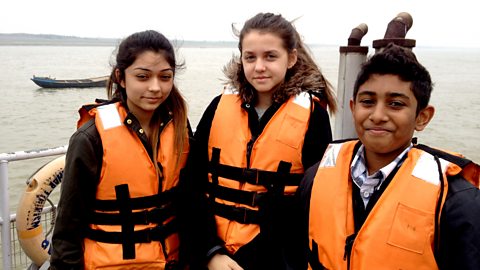
Dua, Amalia and Nayan explore urban life in Bangalore, India - a city that attracts young Indians seeking work and careers.