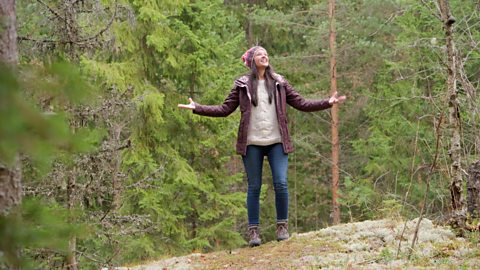
Exploring how people, plants and animals have adapted to live in the desert biome of the Arabian Peninsula.
Video
Many of us may know Dubai as a holiday destination. But what do we really know about the desert ecosystem in this part of the United Arab Emirates? I’m here in one of the world’s largest hot deserts - the Arabian Desert. It’s located between about 12 to 34 degrees north of the equator and it occupies most of the Arabian Peninsula.
Hot, arid deserts like this are found on almost every continent. They cover around one-fifth of the Earth’s land area and are home to one-sixth of the world’s population, with almost 1.2 billion people inhabiting them.
The world’s largest hot desert is the Sahara and it’s almost as big as the United States of America! But did you know there are also cold deserts, like the Arctic and Antarctic? The common feature with all deserts is that they’re extremely dry, or arid. The rainfall is less than 250mm a year and many deserts have hardly any rain fall.
Average summer temperatures here in the Arabian Desert are around 40C, but they can soar as high as 50 degrees in the daytime and drop as low as 0 degrees at night.
It’s these conditions which make it very difficult for plants to flourish. However, some do, like ghaf trees, salt bushes and this species of able.
Plants in arid environments tend to have short growing cycles, often only lasting a couple of days. Other plants will flourish when near an oasis and this is due to the presence of water. An oasis is an isolated area of water that’s formed either from a sub-surface stream, or an aquifer that is trapped in the sand above impermeable bedrock. Occasional rainfall will keep this water source topped up.
At first glance the desert environment might look barren and uninhabitable. But in between the sand dunes is a hidden world of wildlife that flourishes due to a very special set of amazing adaptations.
One of the most active forms of wildlife are invertebrates - like locusts, scorpions and dung beetles.
The nocturnal Arabian death scorpion has adapted to it’s environment: it doesn’t drink, but instead it absorbs moisture from the small insects that it eats. It avoids daylight sun to conserve this moisture. It’s exoskeleton is hard to crush and this helps to prevent moisture loss. It burrows in the sand and hides under rocks to protect itself and to stalk it’s prey. And in times when food is scarce it can slow down its metabolism and limit the amount of oxygen it takes in. Because of this it can survive on only one or two insects a year. I would be starving!
This desert is also home to the fennec fox, which has adapted to survive the heat. It’s the smallest fox in the world and it hunts from dusk until dawn. Its big ears help to cool its blood down and fur on its feet help to protect it from the hot sand. Its sand-coloured fur also provides camouflage and its small, pointed nose reduces water loss.
Camels are known as the ‘ships of the desert’ and they are made for this environment. They have two sets of eyelashes to protect their eyes from the sand, nostrils that they can close, humps to store fat, thick leathery pads at the bottom of their feet, and long legs - the list of adaptations is endless! Even their poo can be used as fuel for fires!
So who are the humans that can survive in these desert conditions? Bedouin people live a semi-nomadic lifestyle, moving around with their animals - grazing, foraging and searching for water. They herd and eat sheep, goats and the occasional camel. Traditionally they would wear a thobe - which is a long white shirt-dress, a white headdress called a ghutra - which is held down by a rope, called an agal. This is to protect them from the sun and sandstorms.
People, plants and animals have adapted and learnt to live in this arid environment and there are certainly no shortages of creatures here. In fact, Alex, I think that could be a scorpion on your camera, just there! No! No! No! Come back! I was only joking!
Video summary
Download/print a transcript of the video.
A close look at how people plants and animals adapt to live in the Arabian desert.
Ferne Corrigan locates hot deserts around the world describing their location and climatic conditions before investigating the Arabian desert in Dubai.
Focussing on the Arabian desert she looks at adaptations made by bushes and trees that allow them to survive in these extreme conditions.
Ferne explains how the Arabian death scorpion has adapted to survive in the desert and how the fennec fox has adapted to thrive in the arid environment.
The adaptations of the camel demonstrate why they are nicknamed the ship of the desert and Ferne explains how Bedouin people have adapted to live in desert conditions.
This clip is from the series Ecosystems and Biomes.
Teacher notes
Download/print a transcript of the video.
Before watching the video
Look at a map of the Arabian desert. Ask students to give a locational description of the desert and to identify the countries found within the desert.
Ask students about the types of animals that they think might live in the Arabian desert and what type of climate they live in. Students could make predictions, which they could then add to once they have watched the film.
Introduce key terms such as:
Peninsula: A piece of land almost surrounded by water or projecting out into a body of water.
Impermeable: Doesn’t allow water to pass through it.
Nocturnal: Something that sleeps during the day and is more active at night.
Nomadic: Moving around, for example the Bedouin move around with their herds for the best grazing lands and water.
Metabolism: The body’s process of converting food and water into energy.
During the video
You may wish to stop at relevant points during this short film to pose questions and check understanding or wait until the end. Useful questions might include:
- Where is the Arabian desert?
- What is the climate like in the Arabian desert?
- How are plants adapted to living in the Arabian desert?
- Where can water be found in a desert?
- What animals live in the Arabian desert?
- How is the Arabian death scorpion adapted to living in the Arabian desert?
- How is the Fennec Fox adapted to living in the Arabian desert?
- How are camels adapted to living in the Arabian desert?
- Who are the Bedouin?
- How do humans use the Arabian desert?
After watching the video
Ask students to look back at their predictions, were they right about what they thought they would see in the Arabian desert? Students could complete a spider diagram to note down the basic information about each of the Arabian desert: vegetation, climate, animals and human uses.
Give students an image of the Arabian death scorpion and ask them to annotate it with the adaptation, for example not needing to drink water. Discuss with students how the adaptations enable it to survive in the climate of the Arabian desert. Students could carry out the same activity with the Fennec Fox. This could then lead students to designing their own plant or animal that could live in the Arabian desert.
Discuss the human uses of the Arabian desert. Ask students whether they think those uses are good for the biome or if they will cause issues. Students could then rank the uses from most damaging to least damaging using their opinion and then writing up their decision.
Where next?
Compare the Arabian desert to a contrasting ecosystem such Amazon Rainforest.
Students could compare:
- Animals
- Vegetation
- Climate
- Human uses
A case study could be built for the Arabian Desert. This could form a research task which students could then present to the class.
Curriculum notes
More videos from this series
How animals have adapted to live in the polar biome. video
How animals have adapted to survive the freezing conditions of the polar ecosystem.
The different layers of a deciduous forest. video
Exploring the layers of a deciduous forest and how plants and animals have adapted to live there.
Investigating the coniferous (taiga/boreal) forest biome. video
Exploring the coniferous (taiga/boreal) forest biome to see how plants and animals have adapted to living there.