Exploring how life has adapted to the harsh conditions of the Arctic tundra biome.
Video
Lapland is a place many of us dream of visiting.
There’s plenty to do here: husky rides, visit the grottos and, if you’re lucky, see the spectacular northern lights.
But how has the environment shaped the landscape and this biome?
Lapland is a region of northern Scandinavia - part of the Arctic tundra.
In Finnish the word ‘tundra’ means ‘treeless plain’. The arctic tundra encircles the North Pole, extending from the frozen Arctic in the north to the coniferous forest - also known as the taiga - in the south.
Countries across the world such as Canada, Iceland, Norway, Russia, and parts of the USA have tundra biomes.
The climate in the tundra biomes is extremely cold - I mean seriously cold! You wouldn’t want to forget your winter woollies. The average winter temperatures can be below -30C.
A domestic freezer is usually -18C.
Even in the short summers the average temperature is usually only between 3C and 12C. There is very little rainfall, with yearly precipitation being around 150-250mm which is about a third of London’s annual rainfall.
The freezing conditions mean that one of the main features of the environment is permafrost which, as the name suggests, means permanently frozen ground, although the surface layer - being only a few centimetres - may melt during the summer months, leaving muddy pools of water.
Some plants and vegetation do grow here. The bearberry plant has had to evolve to survive the harsh and freezing conditions and the long, dark winters. So it’s root system is shallow to cope with the thin and frozen soil and the plants grow closely together to provide warmth and shelter from the strong winds.
This is the Arctic fox. They are extremely well adapted to the freezing conditions. Their thick coat provides insulation and hair on the pads of their feet stops them slipping on the ice. They can curl their thick bushy tails round their nose and face to keep warm.
In winter, their white fur acts as camouflage to help hide them from their prey. They survive by eating a varied diet, including dead seals and birds’ eggs.
This handsome looking mammal is a musk ox, common in North America. Its adaptations include two layers of fur - one short and one long - to trap the heat and protect it from the weather. They have large and hard hooves so that they can break ice to find water to drink. In the winter they huddle together in groups to retain heat.
Tundra environments aren’t hugely inhabited by humans, but there are groups of people who call this ecosystem home.
The Sami people inhabit the far north of Scandinavia where they rear reindeer, sheep and are experts at fishing. About 10% of the Sami - mostly those involved with reindeer - move their animals across the tundra coniferous forest biomes in response to the seasons.
So whilst at first this may seem like a bleak, inhospitable landscape, if you know where to look it is teaming with wildlife, with amazing adaptations to help them not only to survive but thrive in one of the world’s most extreme environments.
Video summary
Download/print a transcript of the video.
Wildlife presenter Ferne Corrigan takes a look at the Arctic tundra and how plants and animals have adapted to live in this biome.
Ferne describes the location of the tundra biomes around the world before describing the climate of the biome.
She then explains how the barberry plant has adapted to survive the harsh weather before explaining how the Arctic fox and the Musk ox have adapted to survive in the Tundra ecosystem.
Ferne then changes focus to the Sami people of the tundra biome and how they use the changing seasons to survive.
This clip is from the series Ecosystems and Biomes.
Teacher notes
Download/print the Teacher Notes for this episode (pdf).
Before watching the video
Look at a map of the Arctic tundra. Ask students to give a locational description of the Arctic tundra. What countries and continents are found within the Arctic tundra?
Ask students about the types of animals that they think might live in the Arctic tundra and what type of climate they live in. Students could make predictions, which they could then add to once they have watched the film.
Introduce key terms such as:
Permafrost: Ground that remains frozen for at least two years in a row.
Insulation: A way of trapping heat, for example fur acts as an insulator.
Tundra: A treeless landscape in the Arctic.
During the video
You may wish to stop at relevant points during this short film to pose questions and check understanding or wait until the end. Useful questions might include:
- Where is the Arctic tundra located?
- What is the climate like in the Arctic tundra?
- What is permafrost?
- How is the Arctic fox adapted to living in the Arctic tundra?
- How is the musk ox adapted to living in the Arctic tundra?
- Who are the Sami?
- How do humans use the Arctic tundra?
After watching
Ask students to look back at their predictions, were they right about what they thought they would see in the Arctic tundra? Students could complete a spider diagram to note down the basic information about each of the Arctic tundra: vegetation, climate, animals and human uses.
Give students an image of the Arctic Fox and ask them to annotate it with the adaptation, for example its thicky bushy tail. Discuss with students how the adaptations enable it to survive in the climate of the Arctic tundra. Students could carry out the same activity with the musk ox. This could then lead students to designing their own plant or animal that could live in the Arctic tundra.
Discuss the human uses of the Arctic tundra. Ask students whether they think those uses are good for the biome or if they will cause issues. Students could then rank the uses from most damaging to least damaging using their opinion and then writing up their decision.
Where next?
Compare the Arctic tundra to a contrasting biome such hot deserts.
Students could compare:
- Animals
- Vegetation
- Climate
- Human uses
Further research could be carried out into the Sami people. Their lifestyle could be compared to the students own.
Students and teachers over the age of 16 can create a free Financial Times account. For a Financial Times article about the ancient subarctic forests from 2022, click here.
Curriculum notes
This clip will be relevant for teaching Geography at KS3 and GCSE.
This topic appears in OCR, Edexcel, AQA, WJEC KS4/GCSE in England, CCEA GCSE in Northern Ireland, Progression Step 4/5/GCSE in Wales, and SQA National 4/5 in Scotland.
More videos from this series
The different layers of a deciduous forest. video
Exploring the layers of a deciduous forest and how plants and animals have adapted to live there.
Wildlife adaptations of the Mediterranean biome. video
How people, plants and animals have adapted to the conditions of the Mediterranean biome.
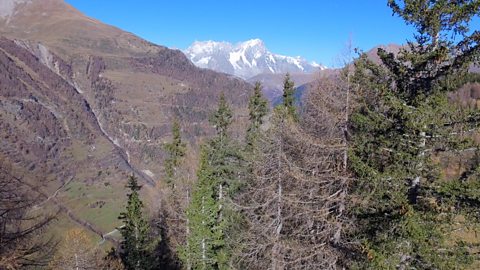
How animals have adapted to live in the Italian Alps. video
How plants, animals and people have adapted to an Alpine mountain region of Italy.