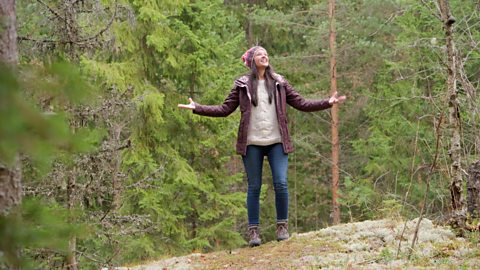
Exploring how plants, animals and people have adapted to live in the Mediterranean biome.
Video
When you think of the Mediterranean you might think of holidays involving sandy beaches, crystal clear seas and glorious sunshine. And as idyllic as this is for tourists it does make very difficult living conditions for the plants and animals here. So how do they cope with the long, hot, dry summers?
I’m here in the beautiful sunny province of Malaga in Spain. It’s in a climatic region and biome called the Mediterranean. This biome gets its name from the nearby Mediterranean Sea, but it can also be found in other places around the world like South Africa, Western Australia and California. Other European Mediterranean countries include Italy, Croatia and Greece.
As you can see, the sun is quite high in the sky even though it’s winter. This, coupled with the prevailing winds, means that the weather is warm but often stormy. The prevailing winds means the summer months are hot and dry, with little cloud cover.
With this climate you get very little grass growing, due to the dry, long, hot summers. Instead you get bushes and scrubland made up of lavender, thyme, juniper and rosemary. Many of these plants have waxy leaves to help retain moisture and extensive root systems to help reach underground water supplies. While other plants have a fine network of hair-like roots that grow horizontally, close to the surface, to obtain water as it falls on the ground. But these are not the only plants that have adapted to live in this region.
Olive groves, almond trees and citrus fruits are grown by farmers in the mountains and around this region - and this is an olive tree. The leaves feel waxy and this helps to retain water during periods of drought. And their stout, little trunks enable them to tolerate strong winds. The long, hot growing season is ideal for ripening fruits and olives are a very important part of industry here in Malaga and elsewhere in the Mediterranean. And olives, from farms like this one, are used to make olive oil.
The availability of natural resources - such as olives and cork oak trees - have helped to shape settlement and economic activity. The demand for these resources, coupled with the growth in the tourist industry, have created interdependence amongst the inhabitants. Tourism is needed to boost the local economy but at the same time growth of resorts and hotels have created problems for the natural environment, by reducing local water resources for crops and by deforestation.
The bark of the cork oak trees has an important commercial function: it can be stripped from the trees and used to make corks, that act as stoppers in bottles of wine. This process does not harm the tree as the bark re-grows and is harvested again after 9 to 12 years later. Cork oak trees can live from 150 and 250 years! The bark is really thick and helps to protect it from wildfires that can breakout during the hot, summer months. If a wildfire does breakout it can be very destructive to wildlife.
Speaking of animals and wildlife… This is a gecko - a small reptile with a relatively large surface area, that’s well adapted to losing heat. It has light colouration, so it doesn’t absorb too much sunlight and overheat. They’re adapted to live in scrublands, so they’re very agile and great at burrowing. They spend the hottest parts of the day underground and come out to feed at night.
Settlements in the countryside of Spain tend to be on the hillsides, as opposed to the valley floor, as this is because the hillsides tend to have more fertile soils. You often get terracing along the hillsides and this creates flat land for people to farm.
Another way that people have adapted to the hot Mediterranean climate is to avoid working during the hottest part of the day by taking a little afternoon siesta and then working late into the evening as it’s cool. And on that note - I’m off to take a little siesta myself!
Video summary
Download/print a transcript of the video.
Investigating the characteristics of the Mediterranean biome in Spain.
Presenter Ferne Corrigan locates the biome on a world map and describes its climate. She identifies plant species found in the biome and how their root systems have adapted to the short supply of water.
Ferne then explores the cork oak tree and how farming and tourism are interdependent. She explains cork oak farming and the adaptations made by the tree to enable it survive the frequent forest fires.
The animals studied include geckos - another example of adaptation - while the human geography explains why Mediterranean villages are often found on hillsides.
This clip is from the series Ecosystems and Biomes.
Teacher notes
Download/print the Teacher Notes for this episode (pdf).
Before watching the video
Look at a map of the distribution of the Mediterranean biome. Ask students to look for a pattern in the distribution and discuss why the Mediterranean biome is located where it is.
Ask students about the types of animals that they think might live in the Mediterranean biome and what type of climate they live in. Students could make predictions, which they could then add to once they have watched the film.
Introduce key terms such as:
Prevailing winds: The most common wind direction.
Drought: A prolonged period without rainfall.
Interdependence: When two or more things are reliant on each other.
Scrublands: Land consisting of scrub vegetation such as lavender, thyme, juniper and rosemary.
During the video
You may wish to stop at relevant points during this short film to pose questions and check understanding or wait until the end. Useful questions might include:
- Where is the Mediterranean biome found?
- What is the climate like in the Mediterranean biome?
- What types of plants grow in the Mediterranean biome?
- What adaptations do the plants have in the Mediterranean biome?
- How do humans use the Mediterranean biome?
- How is the gecko adapted to living in the Mediterranean biome?
- Why do people live on the hillsides?
- What is a siesta?
After watching the video
Ask students to look back at their predictions, were they right about what they thought they would see in the Mediterranean biome? Students could complete a spider diagram to note down the basic information about each of the Mediterranean characteristics: vegetation, climate, animals and human uses.
Give students an image of the cork oak tree and ask them to annotate it with the adaptation, for example the thick bark helping to protect it from wildfires. Discuss with students how those adaptations enable the trees to survive in the climate of the Mediterranean biome. Students could carry out the same activity with the gecko. This could then lead students to designing their own plant or animal that could live in the Mediterranean biome.
Discuss the human uses of the Mediterranean biome. Ask students whether they think those uses are good for the biome or if they will cause issues. Students could then rank the uses from most damaging to least damaging using their opinion and then writing up their decision.
Where next?
Compare the Mediterranean biome to a contrasting biome such as the tundra or the boreal forest.
Students could compare:
- Animals
- Vegetation
- Climate
- Human uses
A case study could be built for the Mediterranean biome using a real-life example. This could form a research task which students could then present to the class.
Curriculum notes
This clip will be relevant for teaching Geography at KS3 and GCSE.
This topic appears in OCR, Edexcel, AQA, WJEC KS4/GCSE in England, CCEA GCSE in Northern Ireland, Progression Step 4/5/GCSE in Wales, and SQA National 4/5 in Scotland.
More videos from this series
The different layers of a deciduous forest. video
Exploring the layers of a deciduous forest and how plants and animals have adapted to live there.
The wildlife and ecosystem of temperate savannas. video
Exploring grasslands to discover how plants, animals and people have adapted to the temperate savanna biome.
Investigating the coniferous (taiga/boreal) forest biome. video
Exploring the coniferous (taiga/boreal) forest biome to see how plants and animals have adapted to living there.