

Wednesday 24 Sep 2014
Programme Information
Network TV BBC Week 10: New this week
BBC TWO New this week
www.bbc.co.uk/bbctwowww.bbc.co.uk/bbchd
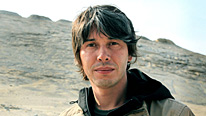
Having explored the wonders of the Solar System, Professor Brian Cox steps boldly onto an even bigger stage – the Universe.
Who are we? Where do we come from? For thousands of years humanity has turned to religion and myth for answers to these enduring questions. But in this new series, Brian presents a different set of answers – answers provided by science – and they are more beautiful and more profound than ever imagined.
In this episode, Brian seeks to understand the nature of time and its role in creating both the universe and ourselves. From an extraordinary calendar built into the landscape of Peru to the beaches of Costa Rica, Brian explores the cycles of time which define our experience of life on Earth. But even the most epic cycles of life can't begin to compare to the vast expanse of cosmic time.
For instance, just as the Earth orbits the Sun, the Solar System orbits the entire Milky Way Galaxy. This orbit takes a staggering 250 million years to complete.
Ultimately, Brian discovers that time is not characterised by repetition but by irreversible change. From the relentless march of a glacier, to the decay of an old mining town, the ravaging effects of time are all around us. The vast Universe is subject to these same laws of change. As we look out to the cosmos, we can see the story of its evolution unfold, from the death of the first stars to the birth of the youngest. This journey from birth to death will ultimately lead to the destruction not just of our planet, but also the entire universe, and with it the end of time itself.
Yet without this inevitable destruction, the Universe would be without what is perhaps the greatest wonder of all; the brief moment in time in which life can exist.
KS3
The British At Work – We Can Make It 1945-65 Ep 1/4

9.00-10.00pm BBC TWO
In a major four-part series, Kirsty Young explores the post-war British workplace covering seven decades of turbulent change. The British At Work uses a blend of intimate testimony from ordinary workers, vibrant archive from documentary, television and film, and Kirsty's trademark engaging, warm and inquisitive presence to examine the place which, like it or not, dominates the bulk of our time on this Earth.
Throughout the series, Kirsty meets people who have vivid recollections of how work has changed. Through these testimonies, viewers see how the tussle for control in the workplace has animated the big picture in the post-war years as unions, management and governments battled for control of the way people work.
In the opening programme, Kirsty looks at the British workplace after the Second World War, when a better Britain was emerging after years of sacrifice, loss of life and livelihood. With many parts of the country still dominated by the smokestacks and factories of the industrial revolution, great effort was put into making work feel like a shared endeavour, and British workers were pulling together to make the country an industrial nation again.
These years opened with a commitment to full employment and nationalisation of industries. Trade unions flourished while the gentleman managers of British companies organised staff days out and sports tournaments for their workforce.
With the majority of the British working population labouring on manual jobs, this was a time in which people's jobs were simply something they did and would often rather limit expectations and horizons.
During the programme, Kirsty also observes how the optimism of the post-war years was sadly undermined by poor industrial productivity, stagnant management styles and bickering workplaces. British workers saw pay increase but working hours went into decline and so did productivity. A combination of management resistance to change and emerging competition from recovering economies changed the mood throughout the country. In the period between 1945 and 1965, the number of days lost to strike action doubled and the souring of relations and conflict in the workplace inspired caustic films such as The Battle Of The Workplace, The Angry Silence and I'm Alright Jack.
Kirsty highlights how the face of the British worker started to change as women and immigrant labour joined the workforce, confronting antiquated opinions and attitudes. The programme also looks at how ground-breaking technologies made their debut in the mid-Fifties, offering the vision of a life in which people would all work a lot less.
FS
Programme information
Network TV
Network TV – Days
- Highlights of the week
- Royal Upstairs Downstairs feature –
Programme facts and trivia - Royal Upstairs Downstairs feature –
Q&A with Tim Wonnacott - Royal Upstairs Downstairs feature –
Q&A with Rosemary Shrager - New this week
- Saturday 5 March 2011
- Sunday 6 March 2011
- Monday 7 March 2011
- Tuesday 8 March 2011
- Wednesday 9 March 2011
- Thursday 10 March 2011
- Friday 11 March 2011
Key
- New

- Live event/outside broadcast

- Interactive programme

- High Definition programme
BBC iD
BBC iDBBC navigation
BBC links

BBC © 2014The BBC is not responsible for the content of external sites. Read more.
This page is best viewed in an up-to-date web browser with style sheets (CSS) enabled. While you will be able to view the content of this page in your current browser, you will not be able to get the full visual experience. Please consider upgrading your browser software or enabling style sheets (CSS) if you are able to do so.
