

Wednesday 29 Oct 2014
Programme Information
Network TV BBC Week 10: Friday 11 March 2011
BBC ONE and BBC ONE HD
Friday 11 March 2011
www.bbc.co.uk/bbconewww.bbc.co.uk/bbchd
As the nation's most famous foster kid, Tracy Beaker introduced thousands of children to life in care with her colourful adventures.
Now, in a special half-hour programme, actress Dani Harmer has teamed up with CBBC's Newsround to explore what life is like for some of the 70,000 Real Tracy Beakers across the country.
Following the stories of 10-year-old Jerome, twins Laura and Charlotte, teenagers Layla, Glen and their carers, Dani is heartened to learn that they don't dwell on the past but have real high hopes for their futures. As the children share how they coped, their worries about what their friends would think and the sadness of leaving their families, Dani finds out what being a "looked-after" child really means.
Using the show's own engaging animation by illustrator Nick Sharratt, footage from Tracy's regular adventures and contributions from creator Jacqueline Wilson, The Real Tracy Beaker tells the stories of the children who are growing up in their own Dumping Grounds with sensitivity and a sense of reassurance.
The Real Tracy Beaker is the latest in Newsround's award-winning Specials series. From living with alcohol to bereavement, and from knife crime to online grooming, the programmes tackle difficult subjects in a sensitive and accessible way.
HD
Everyone is waiting for Shirley's decision, in the week's last visit to Albert Square.
Meanwhile, Jane makes a decision about her marriage and Kat finally admits to Alfie that she is sad that Shenice has left.
Shirley is played by Linda Henry, Jane by Laurie Brett, Kat by Jessie Wallace and Alfie by Shane Richie.
EastEnders is simulcast in HD on BBC One HD on Freesat channel 108, Freeview channel 50, Sky channel 143 and Virgin Media channel 108.
AB3
BBC TWO Friday 11 March 2011
www.bbc.co.uk/bbctwowww.bbc.co.uk/bbchd
Tim Wonnacott and Rosemary Shrager head to a dazzling seaside palace, as they continue to explore just what went on behind the scenes of Queen Victoria's many Royal visits – both upstairs and down.
In this week's final programme, they are at the Brighton Pavilion. Built by her uncle, King George IV, the Indo-Chinese Royal retreat was where Victoria chose to spend her first Christmas as Monarch, in December 1838, when she was just 19.
The journey down from London took 76 hours and involved five sets of horses and the household staff was increased from 25 to more than 200 for the Royal visit. Downstairs in the spectacular Pavilion kitchen, Rosemary joins food historian Ivan Day to prepare a Champagne jelly dessert – a favourite at 19th-century high society banquets.
Upstairs, Tim reveals that more than £4,000 was spent on improvements to the palace for the visit, the equivalent of £150,000 today. From Victoria's diaries, he learns that the Queen thought that, following its overhaul, the Pavilion was "very fresh and pretty".
Rosemary also explores a "downstairs" part of the Pavilion usually off-limits to the visiting public: the servants' quarters, which are actually based right at the top of the building. Untouched since the palace's heyday, the rooms act almost as a time capsule. Their furnishings have been left to grow old naturally, unlike the main areas of the building, which have been restored and refurbished to accommodate 21st-century tourists. There is even a message scribbled on one of its walls which dates back to 1879.
EB
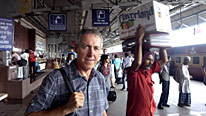
Griff Rhys Jones heads to India, for centuries the home of exquisite textiles, as he concludes his search for the traditional and often hidden arts still flourishing around the world today.
Griff's journey is triggered by a stunning, hand-embroidered, 18th-century floor cloth, kept at Hardwick Hall in Derbyshire. Little is known about the cloth, apart from the fact that it came from the Gujarat Province. Griff hopes to find out who made it and how, and whether the skills that produced such a work still exist in India today.
His quest begins in the multicultural melting-pot that is Ahmadabad, the capital of Gujarat and India's fastest-growing city. Here, in the poorer districts, Griff finds surprising evidence that some ancient skills have survived, such as the hand-painting of shrine cloths. When he sees them put to use at a ceremony for the Hindu Festival of Navaratri, it becomes clear that these textiles are still imbued with great value and significance.
To uncover the true riches of this region's textiles, Griff travels to Kutch, one of the most remote and least visited parts of Gujarat. The market place of the town of Bhuj is awash with beautiful and colourful textiles, each person's attire giving a clue to their caste, status and family. In the magnificent Moghal Palace of Mirrors, Griff is shown a floor cloth even more stunning than the one at Hardwick Hall and made by the same technique. But when he meets the descendant of the last Mochi embroiderer, he learns that the skills needed to create such a piece have been lost.
However, the practice of hand-printing, dyeing and embroidering has not died out altogether and Griff discovers that textiles are still the glue that binds disparate communities together. Some of the centuries-old techniques are introduced to children as young as three, and artistic traditions have been kept alive by the custom of dowry gifts. A young girl must come to marriage with hand-embroidered textiles which can take decades to sew and Griff is allowed to see the contents of one villager's precious dowry chest. Although these people are some of the poorest in India, their embroidered textiles are highly prized across the world.
Finally, Griff travels further into the desert to meet the Rabari people – one of the toughest and most fiercely independent castes in India. Formerly nomads, they are also famed for their exquisite embroidery. Griff is privileged to witness a traditional Rabari wedding, where textiles and dowry gifts made of cloth are at the heart of the ceremony. It is a three-day spectacle of colour and tradition. There are, however, moves afoot to put an end to the customs that bind young girls to the needle when they could be getting an education. The impact of this on the Rabari, their traditional culture and sense of identity remains to be seen.
JP
BBC FOUR Friday 11 March 2011
www.bbc.co.uk/bbcfourwww.bbc.co.uk/bbchd
The fifth film in BBC Four's major Tony Palmer retrospective season explores the career of composer and pianist André Previn.
Previn was born in Berlin in 1929 and emigrated in 1938 to the United States, where his family settled in Hollywood. The four-time Oscar winner's career reached a climax in 1998 with the world première of his first opera, A Streetcar Named Desire, at the San Francisco Opera. Previn talks openly about himself during the backstage trials and tribulations, from first rehearsals to opening night, as the film offers insights into his remarkable international life and career.
The New York Times described The Kindness Of Strangers as "a profoundly disquieting study of loneliness and the frailty of human relationships".
RK2
CBBC Friday 11 March 2011
www.bbc.co.uk/cbbcwww.bbc.co.uk/bbchd
Elektra faces a dilemma when her past catches up with her, as the Bafta-winning drama about the kids and carers in a children's home continues.
When Kali, the leader of Elektra's old gang, The Snakes, visits the Dumping Ground, she manages to persuade Elektra to run away with her. Toby sees what's happening and follows the girls but, when the gang tries to mug him, Elektra has to decide whose side she's really on.
Back at the Dumping Ground, Mike's efforts to help Gina learn to dance for a Rotary Club dinner end in disaster when she sees Carmen and Liam making fun of her. The question is whether they can help her get her confidence back.
Elektra is played by Jessica Revell, Kali by Holli Dempsey, Mike by Connor Byrne, Gina by Kay Purcell, Carmen by Amy-Leigh Hickman and Liam by Richard Wisker.
In a Newsround Special, (BBC One, 4.30pm), Dani Harmer explores what life is like for some of the 70,000 Real Tracy Beakers across the country.
VT
Programme information
Network TV
Network TV – Days
- Highlights of the week
- Royal Upstairs Downstairs feature –
Programme facts and trivia - Royal Upstairs Downstairs feature –
Q&A with Tim Wonnacott - Royal Upstairs Downstairs feature –
Q&A with Rosemary Shrager - New this week
- Saturday 5 March 2011
- Sunday 6 March 2011
- Monday 7 March 2011
- Tuesday 8 March 2011
- Wednesday 9 March 2011
- Thursday 10 March 2011
- Friday 11 March 2011
Key

- New

- Live event/outside broadcast

- Interactive programme

- High Definition programme
BBC iD
BBC iDBBC navigation
BBC links

BBC © 2014The BBC is not responsible for the content of external sites. Read more.
This page is best viewed in an up-to-date web browser with style sheets (CSS) enabled. While you will be able to view the content of this page in your current browser, you will not be able to get the full visual experience. Please consider upgrading your browser software or enabling style sheets (CSS) if you are able to do so.
