Sunscreen - what you need to knowpublished at 14:38 BST
 Image source, Getty Images
As the weather heats up you might find yourself reaching for your sunscreen.
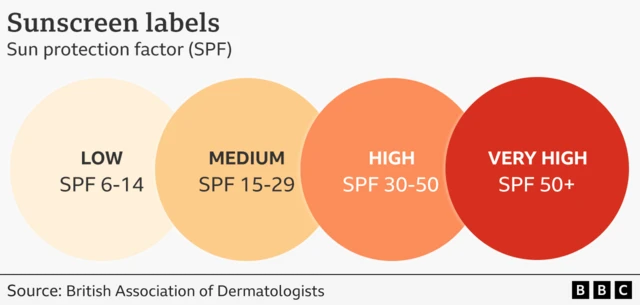
The most prominent number on sunscreen bottles is the sun protection factor or SPF. The larger the number, the greater the protection.
According to the British Skin Foundation,, external the SPF rating tells you how much protection your sunscreen provides from ultraviolet B rays.
For instance, correctly applying sunscreen with an SPF of 30 it means that it would take your skin 30 times longer to go red than if you used none.
Many sunscreen brands also carry a star rating from one to five.
The NHS says, external the star rating measures the amount of ultraviolet A protection, with more stars denoting increased protection. It recommends using sunscreen with at least four stars.
If the letters "UVA" appear inside a circle on the sunscreen bottle, the product meets EU safety standards.
Ideally, your sunscreen should have both a high SPF rating and a high star rating. The NHS recommends that adults use around six to eight teaspoons of sunscreen if they are covering their entire body.
- If you're wondering exactly how often to reapply, then take a look at our news article