Summary

  1. Want the latest forecasts at your fingertips? Download the BBC Weather apppublished at 13:58 BST
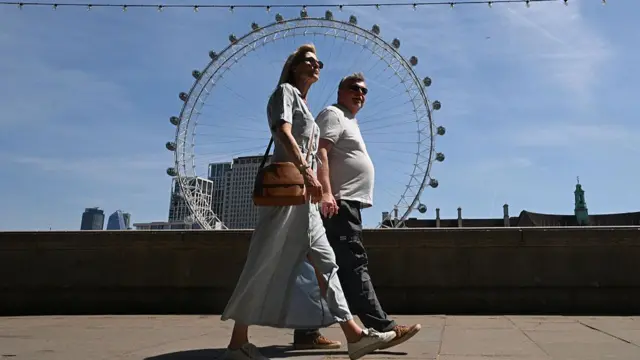
    A couple stroll along the Victoria Embankment on May 22, 2026 in London, England.Image source, Getty Images

    For the latest forecasts on the conditions outside, download the BBC Weather app.

    It's easy to do - just follow the relevant link for your device:

    The app is only available to download in the UK.

    You can also check out the weather in your area by entering your UK town, city or postcode on the BBC Weather website.

  2. Heat exhaustion and heatstroke - how to spot the signspublished at 13:49 BST

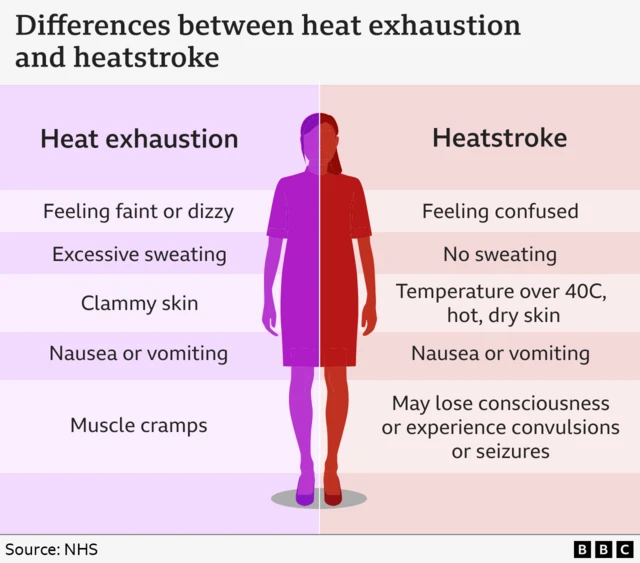
    Heat exhaustion happens when your body becomes too hot and struggles to regulate its temperature.

    An obvious sign is excessive sweating, as well as feeling very hot and unwell - which is your body's way of warning you to cool down, fast.

    Other symptoms include headache, dizziness and cramps, but it is not usually serious as long as you can cool yourself down.

    Heat exhaustion can turn into heatstroke, which is a medical emergency. It means your body can no longer manage the heat and your core temperature is rising too high. You should get urgent medical help.

    The signs to watch for and quickly act on include not sweating even while feeling too hot, a temperature of 40C or above, a seizure and lack of consciousness.

    Graphic showing a person's body with symptoms of heat exhaustion on the left side and symptoms of heatstroke on the other
  3. How unusual is this heat?published at 13:37 BST

    Mark Poynting
    Climate reporter

    A hand holds an ice cream in sunny weatherImage source, SunshineDan/BBC Weather Watchers

    It can be easy to forget just how quickly the UK’s climate is changing.

    Days exceeding 30C - known as "very hot" days by the Met Office - might feel normal, but they used to be much rarer.

    As a reminder, Heathrow reached 26.9C earlier, making it the warmest day of the year so far. Temperatures are forecast to reach up to 33C in parts of the UK over the bank holiday weekend.

    During the last decade, the number of these "very hot" days more than trebled compared with the 1961-1990 average, according to the Met Office.

    And these temperatures are especially rare in May.

    The Met Office says that 30C has been reached in May in only a handful of years since 1900.

    And forecasts suggest that the current May record of 32.8C could be beaten over the upcoming bank holiday weekend.

    The UK’s weather varies a lot naturally, but this early season heat is consistent with the long-term trend of rising temperatures because of human-caused climate change.

  4. The signs your dog is too warm, and what RSPCA says to do if they're in troublepublished at 13:25 BST

    Sean Dilley
    BBC News correspondent

    Sean pets his guide dog next to a statue of a rabbit.Image source, LISA SINNOTT/BBC

    As a guide dog handler of 27 years, my heart falls every time I hear the fatigued pants of dogs in heatwave weather.

    Animal welfare charity the RSPCA says that dogs are 10 times more likely to suffer heat-related illnesses from exercising in hot weather than from overheating in cars. Both are tremendously bad for your dog.

    Canines have a very limited ability to regulate their temperature. They don't sweat like humans - only perspiring a small amount through the pads on their paws.

    Heavy panting, difficulty breathing, excessive drooling, lethargy and drowsiness are all key signs that your dog is too hot. In extreme cases, dogs vomit and finally lose consciousness.

    If your dog is in trouble, the RSPCA says, external you should move the dog to a shaded and cool area and immediately pour cool, but not very cold, water over the dog, avoiding their head.

  5. Shake, paddle and shade: Dogs keeping cool during sunny weatherpublished at 13:19 BST

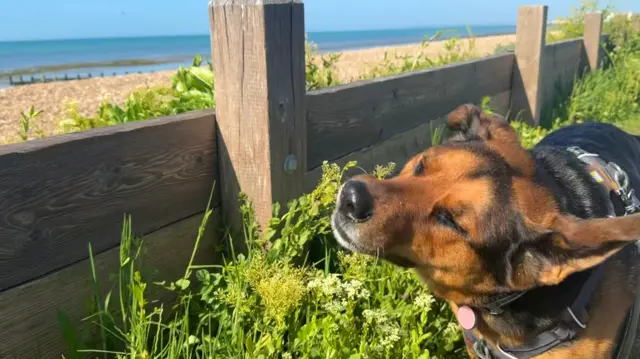
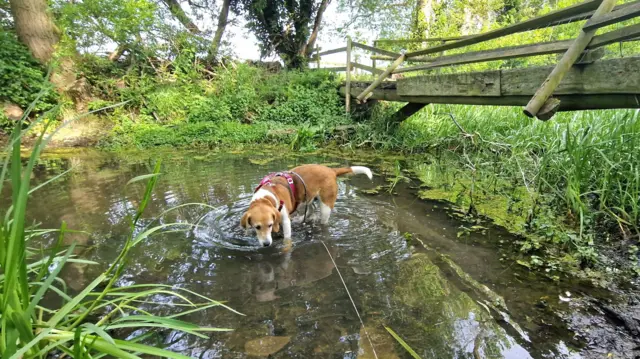
    For these dogs, a walk by the water has been a key part of the day.

    Whether it's by the beach, river or canal these pictures from BBC Weather Watchers show the pooches basking in, or finding shade from, the sun.

    Keeping cool is essential for dogs in the warm weather. Remember, start with shorter walks and don't push your dog if they are panting heavily.

    In our next post, we'll bring you information from the BBC's Sean Dilley on the RSPCA's guidance on keeping dogs safe in the warm weather.

    Dog sniffing plants beside wooden fence by beach.Image source, Claire and Bella/BBC Weather Watchers
    Image caption,

    A walk on the coast in Middleton-on-Sea, West Sussex, for this four-legged friend

    Dog standing in shallow stream beneath wooden bridge.Image source, Helen Earth/BBC Weather Watchers
    Image caption,

    It's a paddle in the river for this dog in Cropwell Bishop, Nottinghamshire

    Black and white dog beside weathered stone bench in park.Image source, littleacorns/BBC Weather Watchers
    Image caption,

    This pooch in Southam, Warwickshire, has found a shady patch to cool down

  6. It's not all sunshine, parts of the UK remain cloudy and downcastpublished at 13:00 BST

    Simon King
    Lead weather presenter, BBC Weather

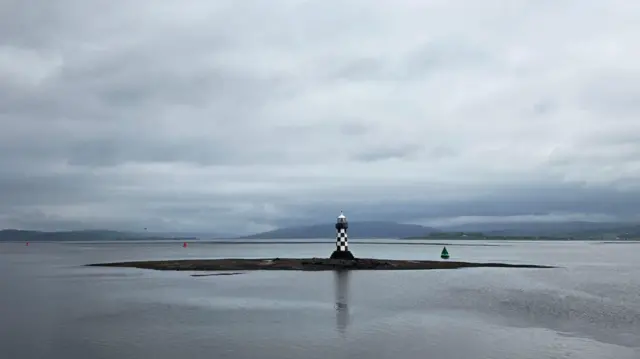
    A lighthouse in the middle of a big water way. It's grey outside in the water and the skies, which have heavy cloudImage source, Rusty Sam/ BBC Weather Watchers
    Image caption,

    Cloudy skies in Port Glasgow, Inverclyde, just before midday

    Heathrow has recorded the warmest temperature of the year so far, but not all parts of the UK are experiencing the warm weather.

    While a heatwave is expected in parts of the country this weekend, cloudier skies across Scotland and Northern Ireland mean temperatures will only get between 17 to 22C at best.

    This will fall well short of the threshold needed to declare an official heatwave - 25C for three days in a row.

    But spare a thought for those in the Northern Isles, Scotland, where it’s even cooler. The maximum temperature today and over the weekend is only going to be 11 or 12 degrees.

  7. Heat warnings in place on warmest day of the year - what's the latest?published at 12:52 BST

    Nabiha Ahmed
    Live reporter

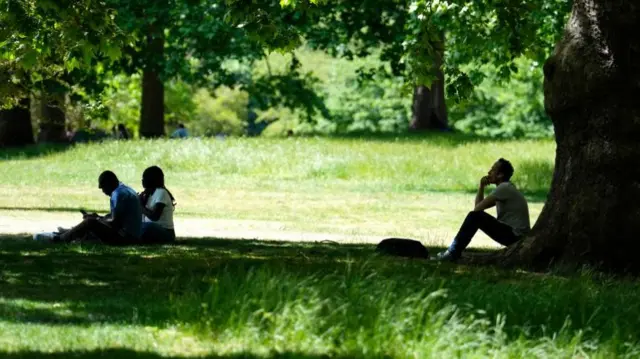
    People sat under the tree in shade.Image source, PA Media

    It's the warmest day of 2026 so far, and temperatures are likely to rise even further throughout today.

    In Heathrow, temperatures ticked up to 26.9C, slightly above the previous record of 26.6C in London's Kew Gardens on 8 April.

    Here's what you need to know:

    Heat warnings

    The UK Health Security Agency (UKHSA) has upgraded their heat health warnings covering large parts of England.

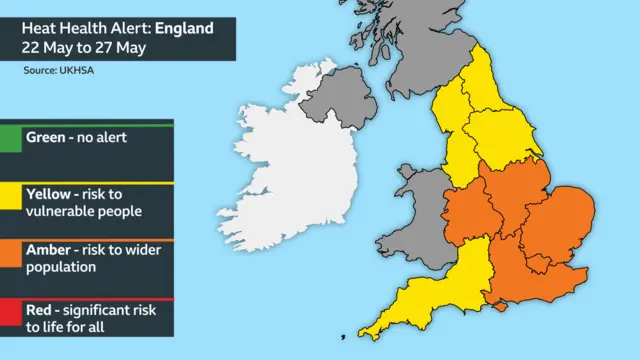
    Amber warnings have been issued in the East and West Midlands, London, East England and South East England - which means the conditions could impact the whole population in these regions, as well as the NHS and likely travel disruption.

    Yellow heat warnings are in force in North East England, North West England, Yorkshire and Humber and South West England. A yellow warning indicates adverse weather likely to affect vulnerable groups.

    All warnings are in place until Wednesday 27 May at 17:00 BST.

    How can I stay cool?

    We've put together a handy guide on how to stay cool in the coming days.

    There's also some specific advice on how to tackle hot temperatures depending on your plans: whether it be staying at home, travelling on the train, or catching the football this weekend.

    The forecast:

    Bank holiday Monday could see the UK's hottest day in May ever, as there is increasing confidence that the maximum temperature could reach 33C.

    Over the next five days, the country will be hotter and drier than parts of the Mediterranean and North Africa.

    And, here's a fuller forecast of the days to come.

  8. Temperatures are the highest they've been this year - let's look at the picture across the UKpublished at 12:33 BST

    Simon King
    Lead weather presenter, BBC Weather

    It’s getting very warm out there this lunchtime.

    With 26.9C just recorded at Heathrow, it is now the warmest day of the year so far.

    We’re expecting temperatures to rise even further so we’ll be able to let you know how hot it eventually gets later this afternoon.

    Elsewhere across the UK, temperatures have been rising into the twenties.

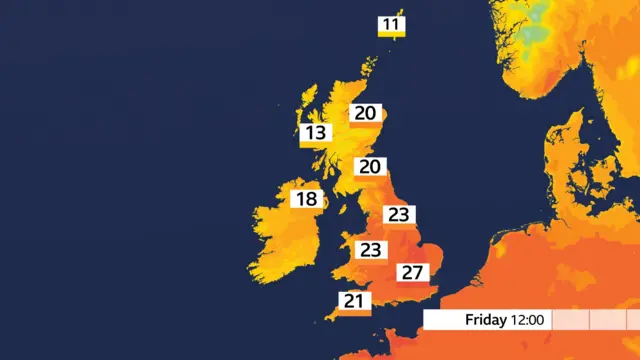
    But with more cloud around the far west of south-west England, west Wales and northern Scotland, temperatures are much lower at 11-14C. Northern Ireland is also cloudy, but seeing slightly higher temperatures.

    A map of the UK showing the temperatures with 27 down in London and 20 in Inverness, 11 in Shetland and 21 in Cornwall
  9. Warmest day of 2026 so far in UK as temperatures hit 26.9C in Heathrowpublished at 12:20 BST
    Breaking

    It is officially the warmest day of the year so far in the UK, the Met Office has confirmed, as temperatures hit 26.9C in Heathrow.

    Previously, the warmest day of 2026 was on 8 April, when heat of 26.6C was recorded in London's Kew Gardens.

  10. Analysis

    How climate change makes hot weather more likelypublished at 12:15 BST

    Mark Poynting
    Climate reporter

    Let's step away from the UK for a moment, to understand why we are seeing such high temperatures.

    It’s well established that human-caused climate change is making hot weather more likely and more intense.

    As humans burn coal, oil and gas and cut down forests, carbon dioxide and other greenhouse gases are released into the atmosphere.

    These gases act like a blanket, causing the planet to heat up.

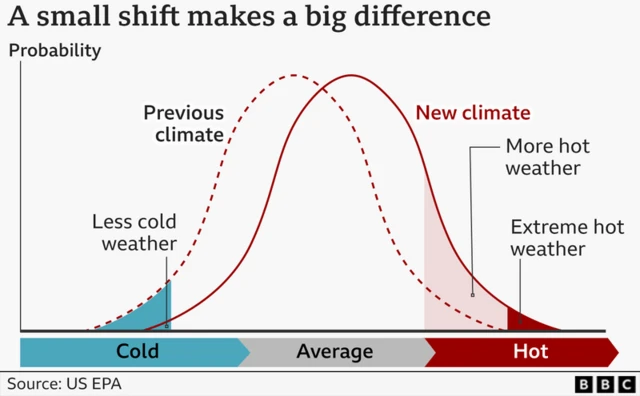
    And even a small increase in average temperatures makes a big difference to heat extremes.

    As the range of daily temperatures shifts to warmer levels, hotter days become more likely and more intense.

    Illustrative graph showing the difference between the previous climate and new climate, as two bell-curves. The new climate has a warmer average temperature, meaning cold weather is less frequent and less intense, while hot weather is more frequent and more intense.

    Since the 1980s, the UK has been warming at about 0.25C per decade – and 2025 was the UK’s hottest year ever recorded, the Met Office says.

  11. Avoid 'very real' wildfire risk by not using disposable barbecues, says London Fire Brigadepublished at 12:01 BST

    Person plates up chicken from a barbecue.Image source, Getty Images

    The London Fire Brigade (LFB) says that risk of wildfire in the English capital is "very real", and is advising people against using disposable barbecues over the bank holiday weekend.

    Assistant commissioner Paul McCourt says there will be a heightened risk of wildfires in London over the weekend, according to an assessment from the Met Office's Natural Hazards Partnership.

    The LFB says people can prevent wildfires by "not using disposable barbecues", along with "being careful about how they dispose of cigarettes".

    The heightened risk is due to the "wetter-than-usual" weather, which has allowed vegetation to grow, followed by "one of the driest Aprils on record", says McCourt.

  12. UK will see hotter temperatures than parts of Africa and Mediterraneanpublished at 11:49 BST

    Sarah Keith-Lucas
    Lead weather presenter, BBC Weather

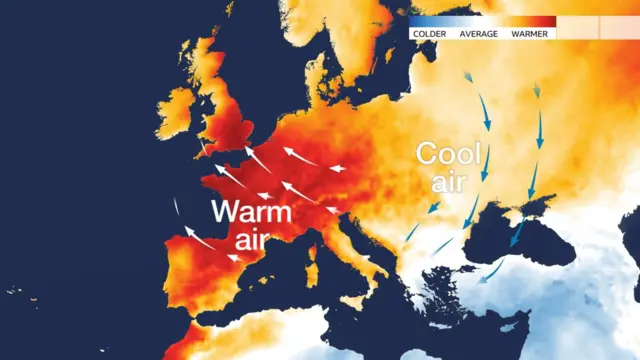
    The UK will be hotter and drier than parts of the Mediterranean and North Africa over the next five days.

    Whilst hot, humid air is pushing across north-west Europe, colder air is affecting the south-east of Europe, including Greece and Turkey - popular summer holiday destinations.

    Heat map showing UK, Europe and parts of Asia and North Africa. Arrows point toward the UK, to show warm air travelling toward itImage source, BBCrnl
  13. Friday's weather in pictures: Cows enjoy the English sun but greyer scenes in Scotlandpublished at 11:38 BST

    Your pictures are continuing to come into us from all across the UK via BBC Weather Watchers.

    So far we've seen various four-legged animals, bodies of water, boats and the odd grey sky - let's take a look.

    Fareham in HampshireImage source, Yen Milne/ Weather Watchers
    Image caption,

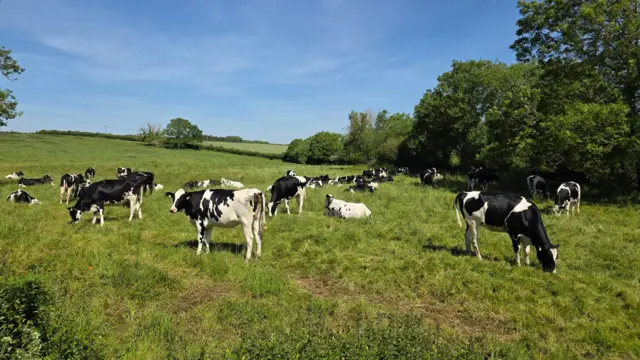
    Milking it? Some cows were snapped enjoying a lie down in Fareham, Hampshire, where temperatures have now hit 22C

    A dog stands on some sand dunes and looks out at the seaImage source, Dave/ Weather Watchers
    Image caption,

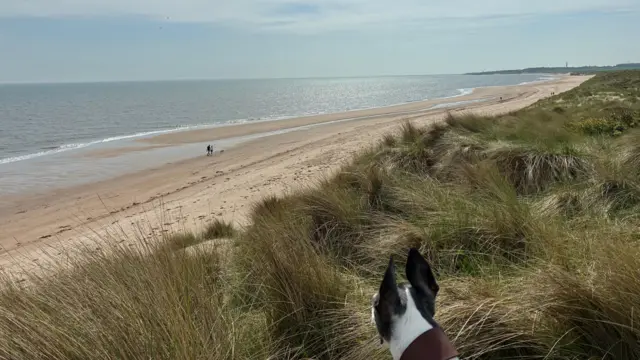
    It's now 21C in East Chevington, Northumberland - where Dave's dog is eyeing up a swim

    A few punt boats go down the backs on the River Cam in CambridgeImage source, Wendy Windblows/ Weather Watchers
    Image caption,

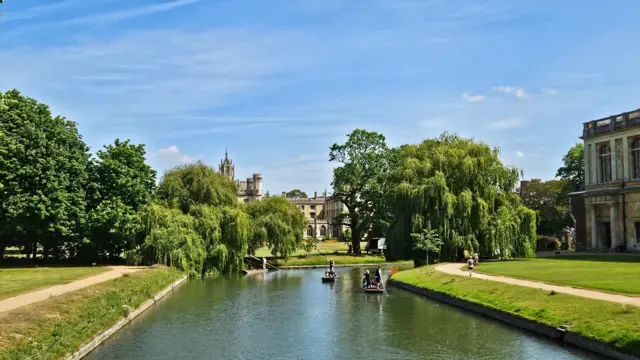
    Taking a punt: Some early-morning river goers in Cambridge enjoy the 23C sunshine

    A small town by the side of a loch in grey weatherImage source, pewitt/ Weather Watchers
    Image caption,

    But it's not all sunshine and rainbows - for people in Inverlochy, in the Highlands, there are grey skies and 16C

  14. Wembley issues hot weather advice ahead of big weekend of footballpublished at 11:25 BST

    Sam Harrison
    BBC News

    Fans walk along Wembley Way outside the stadiumImage source, Getty Images

    It’s a huge weekend coming up for football fans, who are being urged to stay safe in the warm temperatures.

    It's the last day of the Premier League on Sunday with games planned across England, and Wembley will be hosting the EFL final play-offs with around 170,000 fans expected across three days.

    Supporters of the clubs involved - Hull City, Middlesbrough, Stockport County, Bolton Wanderers, Notts County and Salford City - have been told by Wembley to take extra care.

    They've been advised to plan ahead, dress accordingly, and stay hydrated throughout the day, according to a statement seen by the BBC.

  15. A quick guide on how to keep your home coolpublished at 11:11 BST

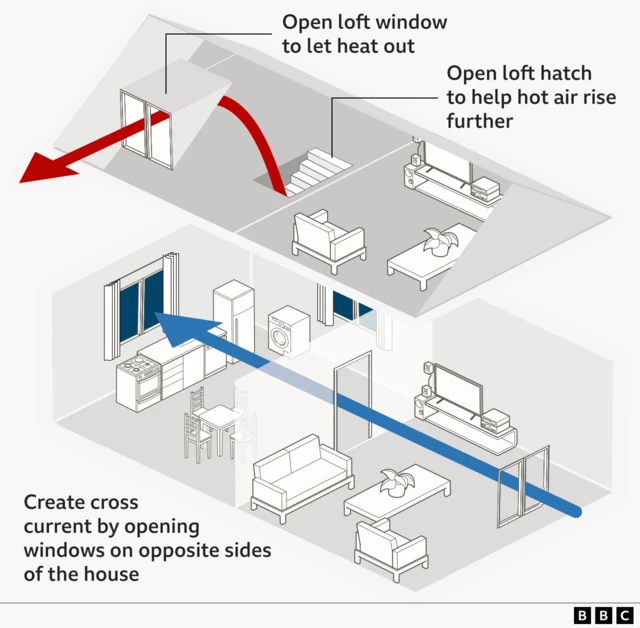
    Let in cool air: Open windows on opposite sides of the home to encourage air flow. Do this when the air temperature outside is cooler than inside, which tends to be overnight or in the early part of the day.

    Keep warm air out: During the peak heat of the day, keep your windows shut and blinds or curtains closed - especially on the side of your home where the sun is shining.

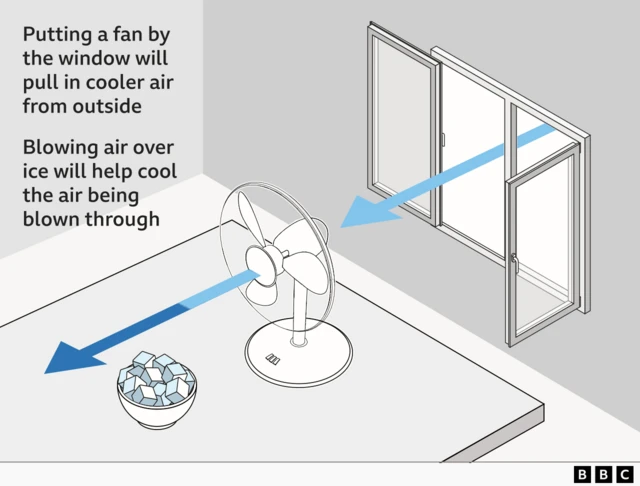
    Use a fan: Putting the fan in front of an open window can encourage the fresh air from outside to be blown throughout the room - as long as it is cooler outside.

    Infographic illustrating cooling tips using a fan near an open window. A table fan is positioned facing into a room, with blue arrows showing airflow entering from an open window and passing through the fan. A bowl of ice sits in front of the fan, indicating an additional cooling method. Text on the image reads: “Putting a fan by the window will pull in cooler air from outside” and “Blowing air over ice will help cool the air being blown through.” A BBC logo appears at the bottom.

    Limit hot activities: Ovens and cookers emit a lot of heat into the home during and after their use. Sticking to cold foods, such as salads, that don't require cooking can stop unnecessary heat being generated.

    Cool yourself down: Tepid showers, wearing natural fibres like linen and cotton and using a cold water bottle on your body can help.

    Find an alternative space: If your home is too warm, air-conditioned public buildings such as libraries, leisure centres and shopping centres can provide relief.

    Infographic showing how to ventilate a home to keep it cool. A cutaway house diagram illustrates airflow with arrows: a blue arrow shows cooler air entering through an open ground-floor window, while a red arrow shows warm air rising and exiting through an open loft window. Text explains: “Open loft window to let heat out,” “Open loft hatch to help hot air rise further,” and “Create cross current by opening windows on opposite sides of the house.” The rooms include a kitchen and living area with furniture and appliances. A BBC logo appears at the bottom.
  16. Rail companies issue warnings as weather heats uppublished at 10:51 BST

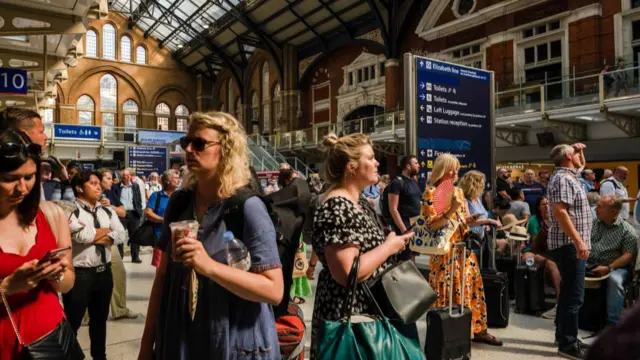
    Travelers wait at Liverpool Street railway station during hot weatherImage source, Getty Images

    Network Rail, which manages many of the railways in Britain, has published some advice for those travelling by train in areas seeing warm weather.

    They ask that, in hot weather, travellers:

    • Check before travelling and allow more time for journeys
    • Carry water bottles, which can be filled up at fountains at big stations
    • Avoid boarding trains if feeling unwell, and ask staff for assistance at a help point if needed

    Also with a warning is Southern Railway, which says trains are likely to be busier than usual, "particularly on routes to coastal destinations".

  17. The latest weather forecast for the bank holiday weekendpublished at 10:42 BST

    As a potential heatwave approaches parts of England, here's a look at how the weather across the UK will be over the bank holiday weekend.

    Media caption,

    Forecast for bank holiday weekend

  18. Remind me, what's the difference between a yellow and an amber health alert?published at 10:34 BST

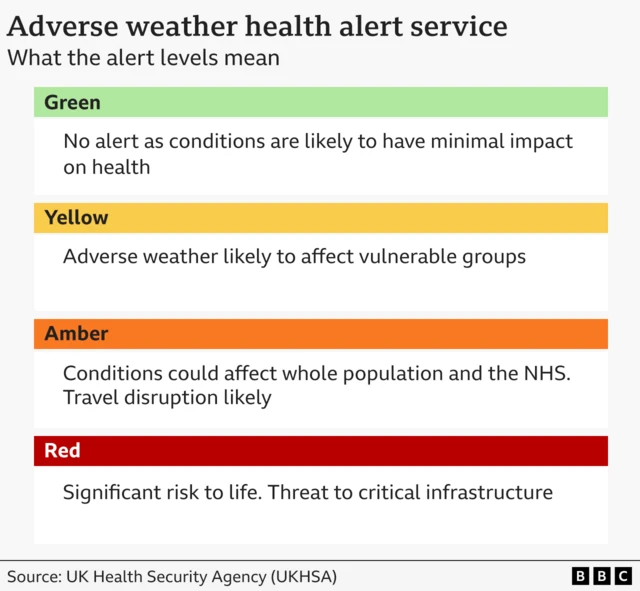
    Yellow vs amber

    A yellow health alert means that adverse weather is likely to affect vulnerable groups.

    An amber alert is issued when weather conditions could affect the whole population or the NHS, with travel disruption likely.

    What are the risks?

    TheUK's Health Security Agency (UKHSA) is warning that "significant impacts" are likely across health and social care services.

    For places subject to yellow warnings:

    These include a rise in deaths - particularly among those aged 65 and over or with health conditions - increased demand on health and social care services, and heat affecting the ability of the workforce to deliver services.

    For places subject to amber warnings:

    The same risks as above stand for places under amber alerts, but the UKHSA gives additional warnings that there could be issues managing medicines, an increased demand for power that exceeds capacity and that other sectors might start to notice issues, such as travel delays.

    The amber alerts currently in place have been given a risk of 12, which means there is a 60-89% likelihood of these impacts.

    It's worth noting that these heat warnings only cover England, and are not issued for other parts of the UK. Our earlier post covers which places are currently under warnings.

    Graphic showing what the adverse weather health alert levels mean in the UK. Green: No alert as conditions are likely to have minimal impact on heath. Yellow: adverse weather likely to affect vulnerable groups. Amber: Conditions could affect whole population and the NHS. Travel disruption likely. Red: Significant risk to life. Threat to critical infrastructure.
  19. A closer look at the upgraded heat health alertspublished at 10:22 BST

    A few moments ago, the UK's Health Security Agency upgraded their heat health alerts in England, and issued new ones to previously unaffected regions.

    Regions that have been upgraded from yellow to amber warnings are:

    • East Midlands
    • West Midlands
    • East England
    • London
    • South East England

    Regions upgraded from no alerts to yellow warnings are:

    • North East England
    • North West England
    • Yorkshire and Humber
    • South West England

    All warnings are in place until Wednesday 27 May at 17:00 BST.

    In our next post, we'll bring you more on what these alerts mean.

  20. Amber heat health alerts issued for Midlands, eastern and south-east Englandpublished at 10:07 BST
    Breaking

    Simon King
    Lead weather presenter, BBC Weather

    The UK Health Security Agency (UKHSA) has just upgraded the heat health alert to amber for the Midlands, eastern and south-east England.

    Yellow alerts have also come into force for south-west England and across northern England.

    The alerts are in place from now until 17:00 BST on Wednesday.

    We'll bring you a more detailed look on what areas are affected shortly.

    A map of England, orange covering London, East and south-east England, yellow elsewhere.