Aim
To learn how people use British Sign Language (BSL), which is an official language in the UK. To learn that deaf children communicate in lots of different ways, including speech, sign language and a mixture of the two.
The video
This film includes BSL translation and subtitles as standard.
Narrator:
This school is just like any other.
A place to learn, make friends and have fun!
But here, English isn’t their first language. These children are deaf, so they use British Sign Language.
Headteacher:
BSL - British Sign Language is a recognised language in the UK. How does it work?
Well, you use your hands (handshapes), your body, and even facial expressions to communicate.
For example, if I raise my eyebrow like this at the end of what I've signed to you, it means I'm asking you a question.
Lots of people who sign have something called a sign name.
This means we don't need to fingerspell our name, but one creative and special sign is assigned to the person.
For example, I am Lesley "hairclips."
Lena:
Hello, I'm Lena, my sign name is "earrings."
Narrator:
BSL is more than just a language, it is also an important part of a shared deaf cultural identity.
It is much more likely for deaf children to have hearing parents.
Child 1:
I prefer signing because I can see the additional parts of what is being communicated to me.
Where there is a lot of detailed information being given in spoken English, we have the detailed information found in facial expressions, handshapes, the lip pattern, so it's easier for me, and we can extend what we want to say as this is my natural language.
Lena:
I love it because you're the only deaf people anywhere where there are hearing people. You can have your own conversation away from everyone else and no-one would know what you're saying!
My family are fully deaf.
Child 1:
My family are fully deaf.
Shiv:
My family are hearing.
Narrator:
It is much more likely for deaf children to have hearing parents.
Shiv's mum:
So, Shiv is the first deaf person in our family, on my husband’s side or my side. We’ve never met a deaf person in our lives.
So when Shiv was born, I was shocked and didn’t know what to do. But then we learnt signing and it’s the best thing we did for him.
I feel that deafness is not a disability, I always say that.
It’s just like a different way of communication and he can do all the things he wants.
Shiv:
I am proud to be deaf because I can communicate with any other deaf person.
Hearing people who don't sign do not understand us.
Also, when I'm asleep, there can be a lot of noise and cacophony around but I won't hear it. I sleep soundly!
Narrator:
After years of campaigning, the deaf community celebrated when in 2022, BSL was recognised as an official language in the UK.
Headteacher:
The deaf community has been campaigning over a number of years to have BSL taught in schools, which means evertyne can learn BSL as part of the curriculum.
Remember, deaf people cannot easily hear, lipread, or speak.
However everyone (deaf or hearing) can learn to sign.
Narrator:
You might be learning French or Spanish at school.
BSL is now an official language, so would you like to learn British Sign Language too?
Students and teachers:
Thank you for visiting. Bye-bye.
Deaf Awareness Week is an event held every year during the first full week of May. It is an opportunity to raise awareness, celebrate deaf identity and learn more about the deaf community’s language, culture and history.
Deaf Awareness Week is a celebration of all deaf children, honouring those who communicate through oral language or British Sign Language.
There are four levels of deafness: mild, moderate, severe and profound.
This video explores the following:
- A school where students have British Sign Language (BSL) as their first language
- The co-headteacher explains how BSL works and how each person has a sign name, so they do not need to fingerspell their name.
- Three students explain, using BSL, the reasons why they love signing. They also say whether their families are deaf or hearing
- How BSL became an official language in the UK in 2022
- The deaf community continuing to campaign for BSL to be part of the curriculum, so that everyone can have a chance to learn the language.
Video questions
- What is the name of the students’ first language that they use at their school?
- The co-headteacher said that BSL utilises your hands and your body, but what was the third thing she mentioned?
- One student says that BSL is his ‘natural language’. What do you think he means when he says that?
- Can you name any of the reasons that Shiv gives for why he’s proud to be deaf?
- What happened in 2022 that was so important for the deaf community?
- Is it only deaf people that can communicate using BSL or can anyone learn it?
- Can you think of ways to support and include people from the deaf community (subtitles, learn basic BSL, not talking while facing away, good lighting, quiet places)?
Key terminology
- BSL: British Sign Language (BSL) is a full, natural language with its own grammar and syntax. It is central to deaf identity and culture
- Deaf: The term 'deaf' is used to describe all levels of hearing loss in children. There are 4 levels of deafness: mild, moderate, severe and profound. Children can be deaf in one or both ears and their deafness may be permanent or temporary (like glue ear).
- Sign language: A language that uses hand movements to communicate rather than spoken words and is often used by deaf people
- Communicate: To share or exchange information, news, ideas, feelings, etc
- Fingerspelling: The use of specific hand movements, each one representing a letter of the alphabet, to spell out the letters of words
- Sign name: one illustrative or representative sign that is assigned to a person (rather than using fingerspelling) A sign name is usually given to someone by a deaf person or by members of the deaf community
- Lip-reading: A way of understanding what someone is saying by watching the movements of their mouth (explain that this is difficult and often unreliable). Only about 30- to 40% of spoken English can be lip-read, even by skilled lip-readers.
- Hearing: The ability to hear sounds
- Hearing loss: The loss of some or all of the ability to hear sounds. Note that some people prefer “deaf” or use phrases like “hard of hearing”)
- Language: A system of communication by speaking, writing or making signs in a way that can be understood.
Inclusion reminder
Ensure deaf pupils have clear sightlines, good lighting and appropriate seating during assemblies. This supports access to signing, lip patterns, facial expressions and visual cues. If deaf pupils are present, adapt the activity so the deaf pupils are aware of what is happening (perhaps explain beforehand).
Dos and don’ts for communicating with deaf people
Dos:
- Face the person
- Make sure your mouth is visible
- Use natural gesture
- Use facial expression
- Get attention gently (wave/tap table).
Don’ts:
- Shout
- Talk while turning away
- Cover your mouth
- Assume all deaf people use sign language.
This advice was provided in partnership with The National Deaf Children's Society. For more resources linked to Deaf Awareness click here
After watching the video
Discussion questions
- Why is it important that we respect all different ways of communicating?
- Can you think of any ways that we can support and include deaf people in everyday life and in school activities?
Activity ideas
Students first learn some colours in BSL. Show a selection of images of clothes, for example a red coat or a green hat. The students need to show the correct BSL sign to match the colour. Repeat with more images and see if the students can answer more quickly. Teachers can use The School of Signs resources for support.
Show the video of a familiar story, such as a fairy tale. The story should have a BSL interpreter demonstrating the sign language. The video should also have subtitles. Choose a small section of the story and learn the BSL signs as a class. Teachers can use these BSL signed stories from the Royal Association for Deaf People.
Students learn the numbers from 0 to 10 or 0 to 20 in BSL. The whole class could play a maths game where answers need to be given in BSL, rather than saying them out loud.
In a different game, a grid with numbers from 0 to 10 or 0 to 20 could be marked out on the hall floor or in the playground. One student could sign a number, and the other student has to jump on the number in the grid.
The BBC cannot be held responsible for the content or reliability of external links.
Resources
Suggested framework
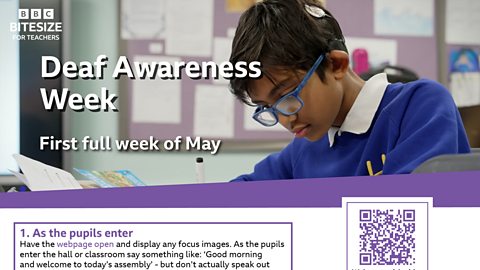
1. As pupils enter
Have the webpage open and display any focus images.As the pupils enter the hall or classroom say something like: ‘Good morning and welcome to today’s assembly’ - but don’t actually speak out loud. Pupils will then only be able to tell what you are saying by lip-reading.
2. Introduction
Potential starting questions:
- Did you know the exact words that I said to you even though I didn’t make a sound? How did you know? [Ask for responses.]
- If we didn’t use lip-reading, is there another form of communication we could use that doesn’t rely on making sounds? [Ask for responses.]
- Do you know when Deaf Awareness Week is this year? [Ask for responses.]
- Visual communication helps everyone, but it is especially important for all deaf learners. Why might that be?
3. Play the video
Duration: 3’ 33”. Final words: ‘…Thanks for visiting. Bye! Bye!’
You may wish to stop at relevant points during the video to pose questions and check understanding, or wait until the end.
4. After the video - Time to talk
Lead a discussion by asking some or all of the following questions:
- What is the name of the students’ first language that they use at their school?
- The co-headteacher said that BSL utilises your hands and your body. But what was the third thing she mentioned?
- One student says that BSL is his ‘natural language’. What do you think he means when he says that?
- Can you recall any of the reasons that Shiv gives for why he’s proud to be deaf?
- What happened in 2022 that was so important for the deaf community?
- Is it only deaf people that can communicate using BSL or can anyone learn it?
- Can you think of ways to support and include people from the deaf community? (Subtitles, learn basic BSL, not talking while facingaway, good lighting, quiet places)?
5. Opportunity to sing
If your assembly includes a song this is an opportunity to sing it.
6. Closing the assembly
Some reflections on Deaf Awareness Week and raising awareness of BSL
- How could we celebrate Deaf Awareness Week at school this year or next year? [Ask for responses.]
- How can we make our school more deaf friendly? [Ask for responses.]
Useful links
The following links could be used as research or provided to students after the assembly.
The BBC cannot be held responsible for the content or reliability of external links.
National Deaf Children’s Society deaf awareness resources and advice
BBC Bitesize article: ‘What is it like to be a deaf musician?’
BBC Bitesize article: ‘World Book Day celebrations for deaf and blind children’
BBC Bitesize: 1st level (Science) - ‘Experiencing music through sound vibrations’
BBC Bitesize: 1st level (Social wellbeing: Video playlist) – ‘Communicating with sign language’
BBC Bitesize (Learn and Revise) – ‘How sign language changed my life’
Related links
Same But Different. collection
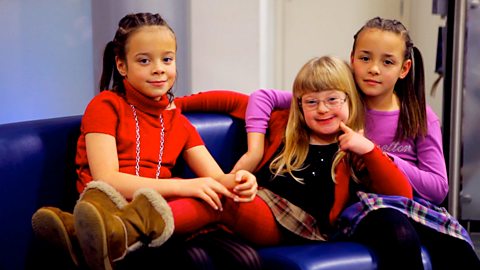
A collection of short films looking at primary children with a range of disabilities, learning differences and medical conditions, that aims to encourage understanding and inclusion, both at school and in the wider world.
Moodboosters. collection
Fun, simple, curriculum-linked resources to inspire primary-aged children to get moving for mental health and wellbeing. These videos require no extra equipment and can be used flexibly during the school day in a classroom with minimal space.
Newsround
The latest news stories from Newsround to share in the classroom.