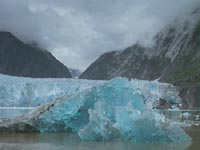
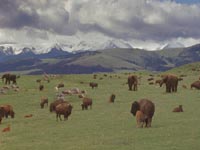
| Glacial worldWhat sort of place did the first American ancestors walk into? When people first arrived in North America 13,000 years ago, the final stages of the last ice age still gripped much of the continent. What is an ice age?Popular belief holds that ice ages were bitterly cold. However, the reality was actually a more even climate. The phrase ice age actually describes two things. One is the long period during which the Earth experiences a generally cooler climate (glacial ages) lasting many millions of years. The other is a shorter, much colder period (or glaciation) when extensive ice sheets cover the continental land masses. It was the last period of glaciation, which took place between 70,000 and 10,000 years ago, which Wild New World recreates. CausesThe causes of ice ages are complex but in simple terms they result from cyclical variations in both the Earth's tilt and its orbit around the Sun which in turn affect summer and winter temperatures. Through certain periods, summer temperatures are sufficiently low that much of the ice and snow formed the previous winter doesn't melt, even though the winter may itself be no colder than usual. If this continues for centuries, huge ice sheets form resulting in an ice age. EffectsAt the peak of the last ice age, almost a third of the globe was covered in ice. The North American ice sheets stretched over a staggering 6 million square miles and were up to two miles thick in places. So much water was locked within the vast glaciers that sea levels were lower by as much as 90m (300ft), considerably altering the shape of the coastlines. North America and Siberia were joined by a bridge of land and 'Florida' was almost double its present size. Much of North America was a few degrees cooler and, in places, wetter, but overall the weather was less extreme. This lack of extremity encouraged the rich, varied natural environment in which such spectacular wildlife as mammoths, glyptodonts and sabre-tooth tigers lived. Next - American ancestors
| |