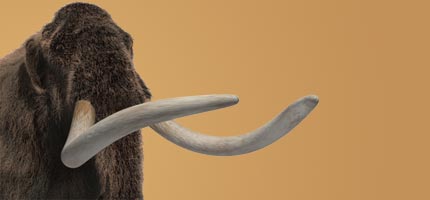
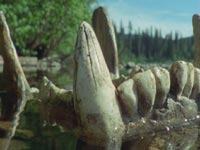
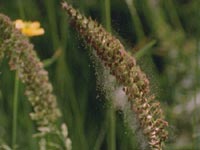
EvidenceHow do we know about the long-extinct animals of ice age North America? What enables us to reconstruct the landscapes they inhabited? The honest answer is a little educated guesswork combined with a lot of scientific evidence. BonesBones have been discovered throughout North America, preserved in dry caves or buried in sediments laid down thousands of years ago. In Alaska and the Yukon, a wealth of bones has been unearthed from the permafrost, stored perfectly in deep-freeze conditions. Many of these have been found along rivers where the erosive forces of the water eat into the banks to reveal the remains. Sometimes whole skeletons are found, and on occasion the entire 'mummified' carcass. One of the most unusual finds was made by a gold miner in Alaska. He unearthed the almost complete body of an extinct species of bison, slightly larger and longer horned that those found in North America today. Post mortem revealed that the bison was a male in its prime that had been hunted down by two or more American lions. After two days' feasting the carcass was left to the elements where it froze and was buried during the spring thaw. Hair and skinThere are rare instances of preserved hair from some of these ice age beasts. A cave in South America has several pieces of ground sloth skin complete with hair. But the best clues are for the woolly mammoth. Not only are there a few well-preserved mammoths from the permafrost of the arctic north, there are also cave paintings in Europe. From these, it's possible to make several remarkable and quite specific deductions. For example, they had longer hair on the sides of their trunks than on the front or back. DungIn the drier parts of North America, especially the South-west, many caves have yielded deposits of dried dung, from animals as varied as Columbian mammoths, Shasta's ground sloths and Harrington's mountain goats. By studying this dung, scientists have been able to investigate the diet of these animals in some detail. Pollen grainsThe landscape itself has been reconstructed based on many sources of evidence, most of it microscopic. One of the most important sources is pollen. Palynology is the study of pollen and by painstaking analysis of the pollen remains in lake sediments, scientists can piece together the region's vegetation in past times. Next - Then and now
|