Reform UK and Labour candidates go head-to-head in second countpublished at 19:05 BSTBreaking
Sian Astley of Reform UK and Labour's Bev Craig are the two candidates being counted in the second preference vote.
There's been a lengthy delay ahead of the announcement of the first round result in the Greater Manchester mayoral by-election
No one knows what is going on but counting assistants have been called into huddles and briefed by their team leaders, according to our producer there
Voters in all 10 boroughs of the ceremonial county took to the polls on Thursday to decide who will replace now-Prime Minister Andy Burnham, who stood down from the role following his election as an MP last month
It represents the first electoral test for Labour under Burnham - and in the prime minister's own back yard, our reporter at the count writes
Voter turnout for this by-election is just over 25% - the lowest since Burnham became the first mayor elected to the role in 2017
Seven candidates are standing in the contest - whoever wins will become the second person ever elected to the role, one of the most powerful in English politics
Sian Astley of Reform UK and Labour's Bev Craig are the two candidates being counted in the second preference vote.
None of the candidates standing to be the next mayor of Greater Manchester have received more than 50% of the vote on first preferences.
That means that under the supplementary voting system, the top two candidates will go into a run-off, in which second preference votes from the eliminated candidates are counted.
 Michaela Howard
North of England senior producer, at the count
The waiting continues here at the Co-op Live Arena.
No one knows what is going on but counting assistants have been called into huddles and briefed by their team leaders.
Could it be a recount here for the Manchester City borough?
The candidates how now been called into the consultation room.
 Dan Woodland
Live reporter
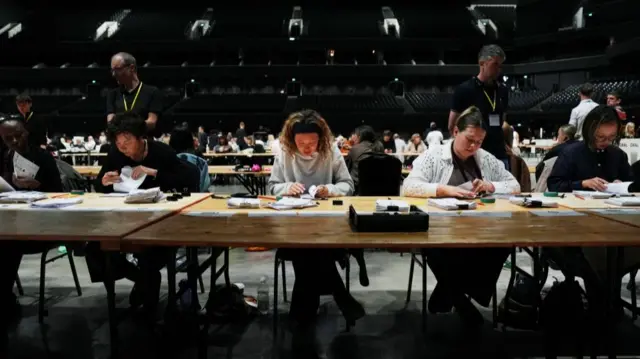 Image source, pa
We are still waiting for the results from the Greater Manchester mayoral by-election, but that's not to say there's been any shortage of excitement. Let's get you up to speed.
Voting begins
Residents began casting their votes for who would replace the now-Prime Minister Andy Burnham at 07:00 BST on Thursday, with polls closing at 22:00 yesterday evening.
There were seven candidates on the ballot paper - here's a reminder of who they all are.
Counting underway
The verification of ballot papers began early this morning and revealed this year's turnout was the lowest of the four Greater Manchester mayoral elections since the role of an elected mayor for the region was created in 2017.
Voting fatigue and people's awareness of the by-election are among the factors that could have been in play, our North of England reporter Rowan Bridge writes.
An anxious wait
People inside the Co-op Live Arena have been scrolling on phones, turning pages of books and even knitting to pass the time. And of course, there are also plenty of snacks on offer.
Among those waiting patiently is Liberal Democrat candidate, Richard Kilpatrick, who says he doesn't think he's won but is happy with his campaign.
Meanwhile, Labour MP for Stretford and Urmston, Andrew Western, is more optimistic about his party's chances. He says he’s confident their candidate, Bev Craig, will be in the top two when the first round of counting is complete.
As a reminder, voters have been able to select a first and second choice in this election, meaning there could be a second round of counting if an outright winner is not declared in the first round - find out more about the voting system here in our previous post.
The mayoral candidates have been called to gather ahead of a first-round result declaration.
Under the supplementary voting system being used in this by-election, if no one receives more than 50%, the top two candidates will go into a run-off, in which second preference votes from the eliminated candidates are counted.
We will bring you the result of the first count as it comes.
 Rowan Bridge
North of England reporter at Manchester's Co-op Live arena
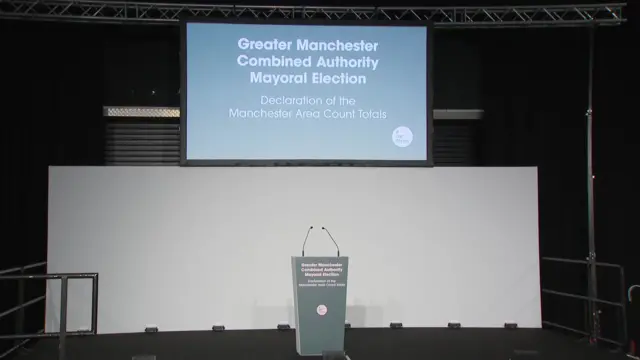 Image source, Pool
There’s a delay at the moment, but then we’re told the candidates will all be called in and given the results of the first round of voting.
If they are happy then we’ll hear who has won, (if someone has more than 50% of the vote) or who the top two candidates are (if no one reaches that threshold).
It’s possible they could query the result - if the count is close for example. That could potentially lead to a recount.
We’ll all just have to wait and see.
We're still waiting on a result to be declared after the first round of counting.
Tom Stannard, the chief executive of Manchester City Council, has just taken to the stage, apologising for "delays in the process".
He says they're still waiting for final approval to carry out a consultation on the provisional results, and asks staff, candidates and agents for "forbearance".
When the first round of counting is ultimately declared, you'll be able to watch live at the top of the page.
As we've reported, indications are this contest will go to a second round of counting because it’s not expected that any one candidate will get more than 50% of the vote.
Under the supplementary voting system, the top two candidates will go into a run-off, in which second preference votes from the eliminated candidates are counted.
Michaela Howard
North of England senior producer
The candidates in the Greater Manchester mayoral election have been called to a room here at the Co-op Live arena.
The mood here is that this election will go to a second round of vote counting.
This election has used supplementary voting meaning people could chose a first and second preference on the ballot paper.
What happens next? An announcement will be made on stage of the names of the two candidates who are going through to the next round of counting.
Its unclear how long it will take to count the second round of votes.
 Kevin Fitzpatrick
Political reporter for Greater Manchester
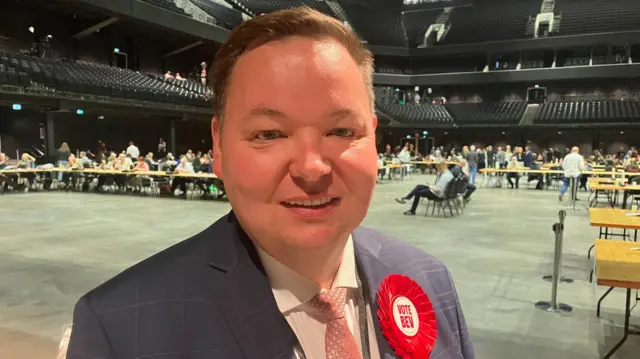
Labour MP for Stretford and Urmston, Andrew Western, says he’s confident their candidate, Bev Craig, will be in the top two when the first round of counting is complete.
“We’re still on the first round of counting so quite a way to go yet but it looks really positive for Bev so far, we're really pleased with what we're seeing," he tells me.
He adds that Craig has run "a really positive campaign" and is "head and above" the other candidates with her experience as leader of Manchester City Council and working as Deputy Mayor with Andy Burnham.
Michaela Howard
North of England senior producer
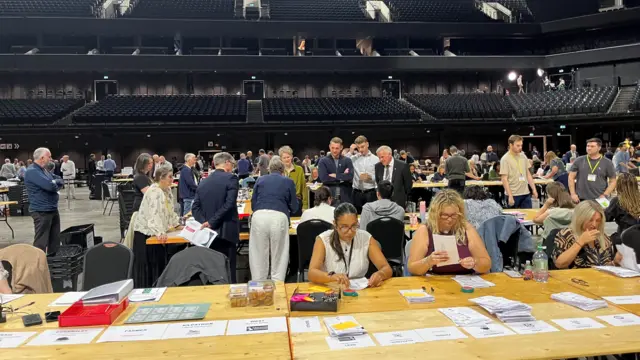
Counting of the ballots has finished here at the Co-op Live Arena where the results of the Greater Manchester mayoral by-election are expected to be announced at some point today.
But there are still a few boroughs that haven't finished counting.
Here they've been totting up votes for the Manchester City region.
There's lots of chatting on the floor between those who have been counting the votes, some are scrolling on phones, while others are turning pages of books.
Snacks are still being consumed - the punnet of mini muffins and flapjacks is slowly going down.
While we wait for the first declaration to be announced, here are the full turnout results for each of the 10 councils in Greater Manchester:
 Prof Andrew Russell
University of Liverpool
Only the prime minister and the mayor of London have more power in English politics than the mayor of Greater Manchester.
Labour's candidate to replace Andy Burnham is the current leader of Manchester City Council, Bev Craig.
While Craig is relatively well known in the city, she faces a tougher task in the other nine boroughs of Greater Manchester.
While Labour has often won elections across the city region, the party's level of support has varied.
For instance, at a time when Labour held 95 of 96 council seats on Manchester City Council, eight of the 10 Greater Manchester boroughs voted leave in the 2016 Brexit referendum.
This may well give hope to Reform UK, for example.
Craig, who has led the city council since 2021, has filled big shoes before. Her predecessor, Sir Richard Leese, was in charge for more than a quarter of a century, taking in an era including Britpop, the 2002 Commonwealth Games and the soaring city skyscape.
 Annabel Tiffin
At Manchester's Co-op Live Arena
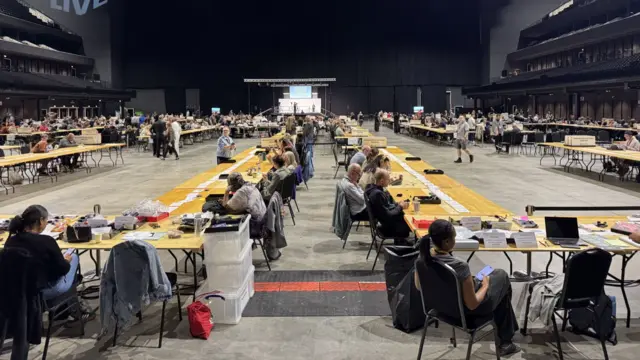
I’ve certainly watched more interesting events at the Co-op live Arena.
While we await the declaration of the first-choice vote there are just a lot of people standing around looking a bit bored.
There doesn’t even seem to be a lot of counting going on.
But things could be about to get exciting. There are rumours that the first declaration will come at 16:00 BST.
So, could we know who the new Mayor of Greater Manchester is then?
Probably not.
All indications are this contest will go to a second round of counting because it’s not expected that any one candidate will get more than 50% of the vote.
Stay with us, this looks likely to be a long one.
In Greater Manchester, the mayor automatically exercises the functions of the police and crime commissioner (PCC) for the region, which is why they can't also be an MP.
The mayor is also responsible for the fire and rescue service and has oversight over local transport plans, responsibility for some skills and adult education and governance of a number of local health commissioning budgets.
They are paid an annual salary of £118,267, which is higher than other regional mayors owing to the PCC responsibilities.
What powers does the Greater Manchester mayor have?
We've just reported on the turnout being the lowest since Andy Burnham became the first elected Greater Manchester Mayor in 2017. The role of an elected mayor of the Greater Manchester region was announced in 2014 by then Chancellor George Osborne.
The announcement came two years after people in the city of Manchester voted against having an elected mayor, with the decision to have a regional or metropolitan mayor being directly negotiated between the government and the 10 Greater Manchester councils.
The role was ultimately created as part of a law passed in 2016, one of a number of big pieces of devolution legislation brought in by the Conservatives after taking power in 2010.
Andy Burnham, who left Parliament to stand for the role, was chosen as Labour's candidate for the first mayoral election in 2017 and won, taking 63.4% of the vote.
He went on to fight and win two more mayoral election contests - in 2021 and 2024. He increased his vote to 67.3% in 2021, and polled 63.4% in 2024.
Kevin Fitzpatrick
Political reporter for Greater Manchester
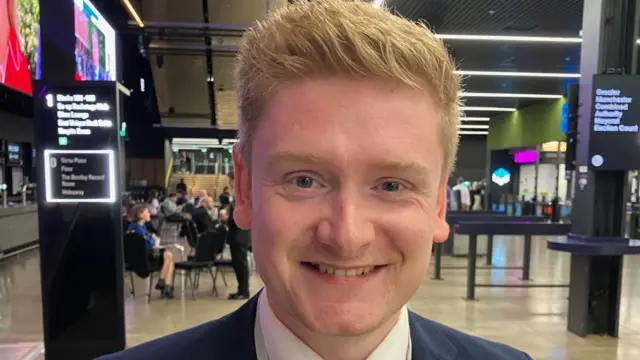
Liberal Democrat candidate, Richard Kilpatrick, says he doesn't think he's won but is happy with the campaign he ran. The Manchester city councillor doesn’t expect to be in the top two, should the contest go to a second round of voting.
"Where we have a strong base, where we have strong local champions and campaigners in our communities, it's very clear that we've done really well in those areas," he says.
"Affordability was the number-one issue that came across to us on the doorstep, so we need to make sure that we, regardless of the result of this election, that we're there leading the charge and holding the next mayor to account.”

Rowan Bridge
North of England reporter at Manchester's Co-op Live arena
There are any number of factors that could have been in play.
First, voter fatigue may have set in. For some places - Gorton and Denton, the Makerfield constituency - it’s the third time they’ve been asked to vote this year when you add in May’s local elections too.
There is also the question of how much people were aware - or cared - about the election itself. Some of the mayors powers, like strategic planning, aren’t the sort of areas Joe and Jane Average get excited about.
If you don’t really care about, or understand, the issues in hand, why bother?
And it could be that people just didn’t find the candidates inspiring. None of them had the profile and name recognition of Andy Burnham when he first ran for the job, nor the sort of profile he built in the role.
This year's turnout is the lowest of the four Greater Manchester mayoral elections since the role of an elected mayor for the region was created.
The second lowest came in 2017's election, when the turnout was 29%, and when Andy Burnham voted in as mayor for the first time.
We’ve just got the figures through for the number of people who turned out to vote in the election.
There were 538,659 verified ballots cast across Greater Manchester, that's out of 2,142,779 eligible to take part.
That works out at just over one in four people voting - 25.14%.
The last mayoral election in 2024 had a turnout of almost one in three - 32.05%. So turnout is down by about seven percentage points.
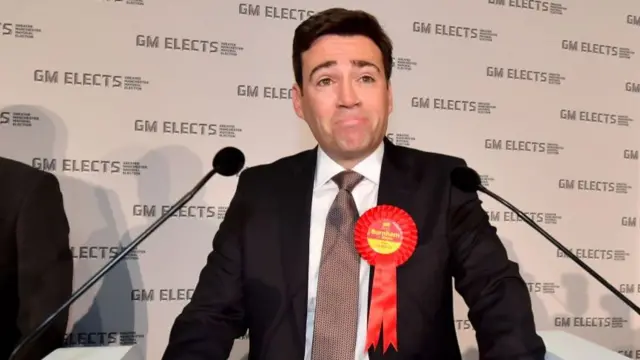 Image source, get
Andy Burnham speaks after winning the Greater Manchester mayoral election in 2017
Whoever is elected today will only be the second person to have been voted in as the mayor of Greater Manchester.
Andy Burnham was voted in as mayor in 2017, and then again in 2021 and 2024.
The role was announced in 2014 as part of the then Conservative-Liberal Democrats coalition government, which said it would help to "create a Northern Powerhouse to maximise the economic potential of the north".
Before Burnham was elected, the role was held by ex-Labour MP Tony Lloyd, who was appointed to the job on an interim basis after it was first created in 2015.
