Summary

Are you affected?

  1. More than 17,000 children need urgent humanitarian assistance - UNICEFpublished at 16:24 BST
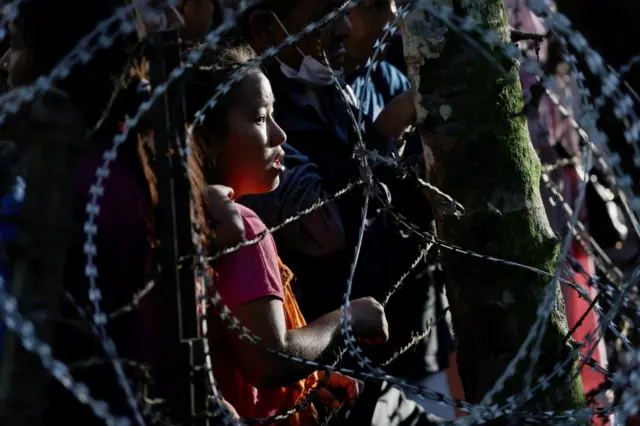
    A young girl looks to the right while standing on next to a barbed wire fence. The girl is seen in the photo encircled by rings of barbed, which appear in the foregroundImage source, Reuters
    Image caption,

    A child at an army training centre in Nuwakot district, which has become a base for emergency operatons

    The flash floods in Nepal have left more than 17,000 children in need of urgent humanitarian assistance, according to children's charity UNICEF.

    Its representative to Nepal, Alice Akunga, says children in the affected areas "saw their lives being literally washed away", while "too many lost their lives and loved ones".

    "Children who have survived the floods now face heightened risks of disease, malnutrition, violence and exploitation," she adds.

    Akunga says UNICEF is offering support on the ground, but "urgently" needs more resources "to reach every child in need".

    The charity is appealing for $17.2m USD (£12.6m) to sustain its early response "until the full extent of needs are assessed", warning its services to children and women will be "severely constrained" without funding.
  2. Army training centre becomes rescue hub in Nepalpublished at 16:15 BST

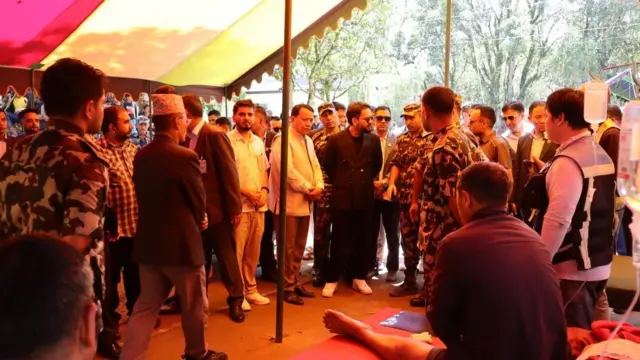
    As search and rescue efforts continue following the floods and landslides in Nepal, Maithali Barrack, an army training centre in Nuwakot district, has become a key base for emergency operations.

    Helicopters are airlifting survivors from affected areas, while rescue teams work to reach communities cut off by the disaster.

    Here are some of today's pictures:

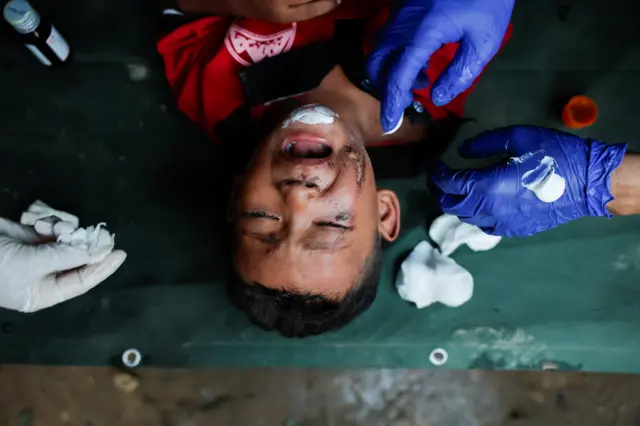
    A child screams in pain as he receives treatment for injuries following flash floods and mudslides in Nepal.Image source, Reuters
    Image caption,

    A child airlifted from Rasuwa district receives first aid at the mobile hospital inside Maithali Barrack

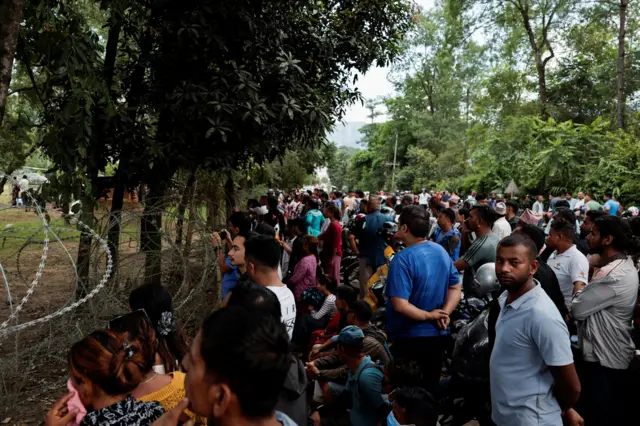
    A large group of people stand behind barbed-wire.Image source, Reuters
    Image caption,

    A large group of people gather as survivors are brought to Maithali Barrack

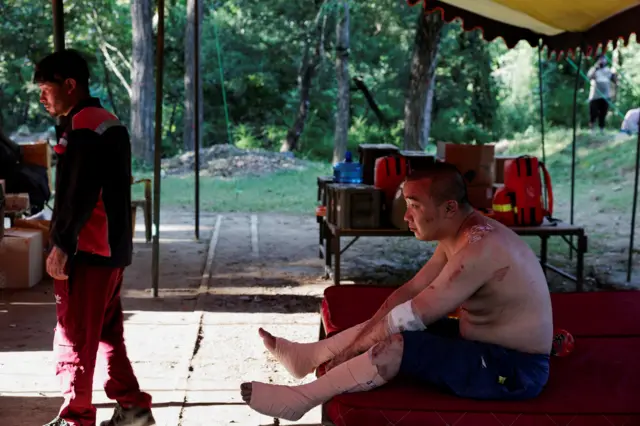
    A man sits on a medical bed after receiving treatment. He has bandages wraped around both of his legs.Image source, Reuters
    Image caption,

    A Chinese national sits on a medical bed after receiving first aid at a mobile hospital inside Maithali Barrack

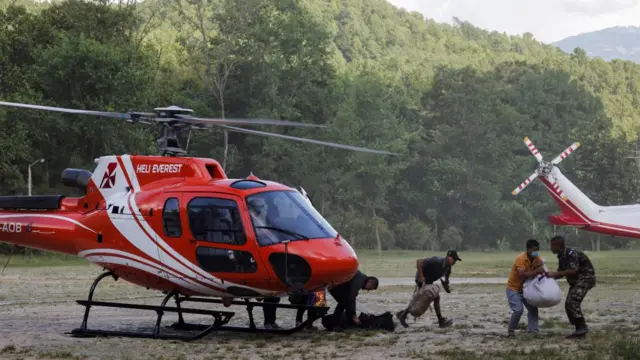
    A red helicopter with a white stripe sits in the middle of a muddy area with trees in the background at Maithali Barrack, an army training centre, which serves as a primary base to airlift survivors following flash floods and mudslide.Image source, Reuters
    Image caption,

    Maithali Barrack is being used as a primary base to air lift survivors of the disaster

  3. Chinese Communist Party calls on members to help maintain stability in Tibetpublished at 15:47 BST

    Laura Bicker
    China correspondent

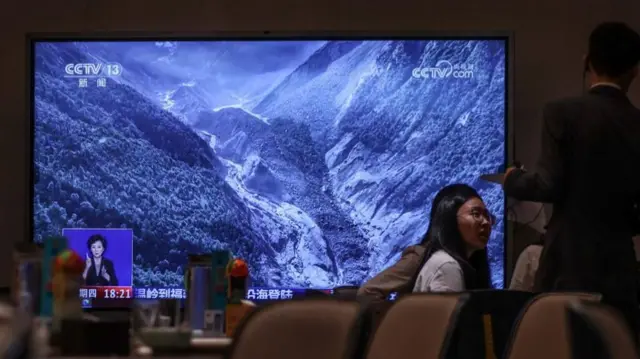
    A woman sits in front of a news screen talking to a man whose back is to the canmera. The screen broadcasts news footage of a flash flood and mudslide on the border of the Tibet and NepalImage source, Reuters

    The Communist Party in Chinese-controlled Tibet is calling on grassroots members to help maintain stability in the region in the wake of the mudslide.

    The party is wary of any anger or instability in a fragile region, which has a history of resistance to Beijing's rule.

    They are urging members to help in disaster relief efforts in their area and provide emotional guidance or psychological support to affected residents - especially those who have lost loved ones.

    The emergency notice by the Organisation Department also offers incentives saying those who perform badly or are found guilty of dereliction of duty will be held accountable.

  4. Missing tour group sent video nine minutes before floods hitpublished at 15:36 BST

    Archana Shukla
    India business correspondent

    The last video from a tour group was sent just nine minutes before the floods hit, says the owner of a travel company.

    Roshan Pandey, of Fishtail Tours and Travels, says he's heard nothing from the group of 20 tourists since then.

    Two Americans, one Briton and 17 Malaysians, all bound for Mount Kailash, along with seven Nepali staff guiding them are missing.

    They were near Timur, a Nepali border town close to the Tibet crossing, where they had stopped to wait for a small landslide, which are common in the region, to clear.

    The group had just sent a video showing it was under control, and that they were about to cross into Tibet.

    "Not a single piece of brick is visible in that area, everything is under mud," Pandey said.

    This Flourish post cannot be displayed in your browser. Please enable Javascript or try a different browser.

  5. Officials warn of possible blockage and secondary flood risk from Bhote Koshi riverpublished at 15:22 BST

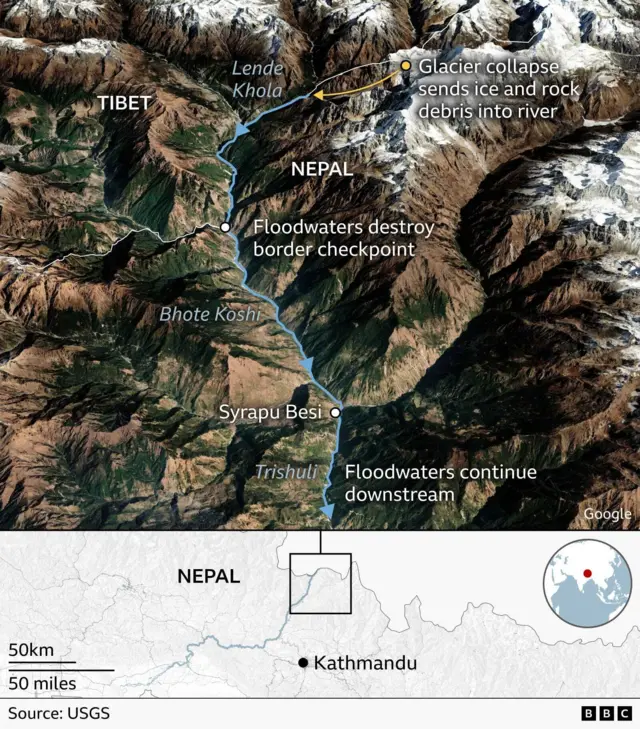
    Map showing the path of floodwaters along the Lende Khola, Bhote Koshi and Trishuli rivers in northern Nepal after a glacier collapse near the Tibet border. The collapse sent ice and rock debris into the river, triggering flooding that destroyed a border checkpoint and continued downstream past Syrapu Besi. An inset map locates the affected area north of Kathmandu.

    As we reported earlier, officials in Nepal are warning of a possible secondary flood risk near the Bhote Koshi river.

    The National Disaster Risk Reduction and Management Authority says satellite information from China suggests the river has been "blocked" and that a "lake" has formed near the site of yesterday's flash flood.

    In a social media post, it says the information suggests "the lake is in the process of rising and there is a risk of bursting".

    It warns residents and rescuers in the lower bank area to "exercise special caution" and stay in safe places away from the river banks.

  6. Analysis

    Why is it so hard to know what is happening in Tibet?published at 15:12 BST

    Laura Bicker
    China correspondent

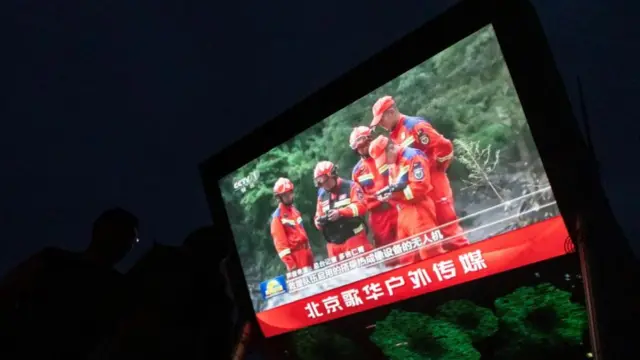
    A large screen is shown at night-time, with five rescue workers in orange overalls clustered in an outdoor area in front of vegetation.Image source, Reuters
    Image caption,

    A giant screen in Beijing broadcasts news footage of the flood recovery effort in Tibet

    Tibet, which China annexed in the 1950s, is one of the most strictly controlled regions in the country.

    It has long demanded greater autonomy and is heavily monitored because Beijing fears any signs of instability such as protests.

    That is why orders are now coming personally from the top leader Xi Jinping, and Premier Li Qiang is on site today. It is rare for him to make a visit so soon after a major disaster.

    To get into Tibet requires a special visa and it is difficult, if not impossible, for foreign media to gain entry. Trying to contact people there is just as hard.

    This makes it very difficult for us to know what is happening and we are relying heavily on reports from Chinese state media.

    Pilgrims making their way from Nepal through Tibet to the sacred mountain of Mount Kailash need four separate permits, which includes special permission from the Chinese military.

    The Chinese foreign ministry has said 260 of the 558 people missing are tourists or pilgrims. We don't know how many of the remaining are Tibetans, and how many are Chinese people who have moved there to run businesses or work on infrastructure projects.

  7. 'We hope he is alive' - family awaits news on missing Indian manpublished at 14:59 BST

    Moyurie Som
    BBC Bangla

    We are continuing to hear from families in India waiting for news of relatives caught up in the deadly flash floods.

    Among them is the family of Ranajit Kumar Howladar, 63, who is part of a group of 30 tourists and two tour assistants from West Bengal who have been unreachable since 25 August.

    Howladar was travelling to Kailash Mansarovar in Tibet, a major pilgrimage site sacred to Hindus and several other faiths.

    His wife Gayatri tells BBC Hindi she last spoke to him on Tuesday night. "We just hope he is alive," she says.

    Their daughter Sunanda, who has been seeking information from police and the tour operator, says the agency told her two women from the group had been rescued, but could not provide information about the others.

    Howladar, a retired railway employee, had waited until retirement to make what his wife described as a "dream" pilgrimage.

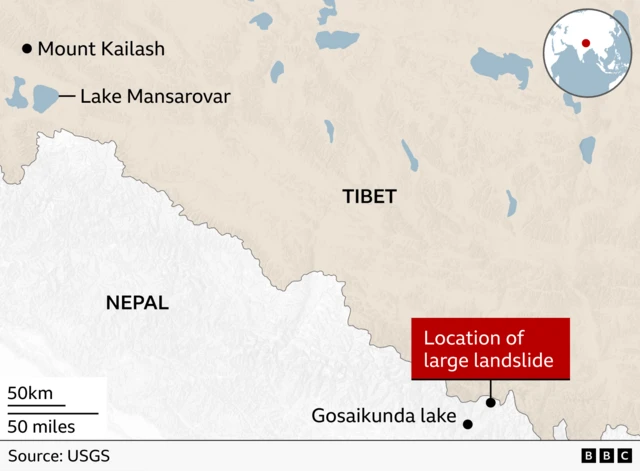
    Map of the Nepal-Tibet border region showing the location of a large landslide in Nepal. The map also highlights Mount Kailash and Lake Mansarovar, two major pilgrimage destinations in western Tibet, and Gosaikunda Lake, a pilgrimage site in Nepal. An inset map indicates the region's location in Asia.
  8. How did the floods spread, and which areas are most affected?published at 14:44 BST

    As we've been reporting, the US Geological Survey has said flash floods were sparked by a glacial collapse in the mountainous area close to the Nepal-Tibet border.

    This resulted in seismic activity and caused "catastrophic" impacts downstream of the Trishuli river, as floodwaters spread into several regions in Nepal.

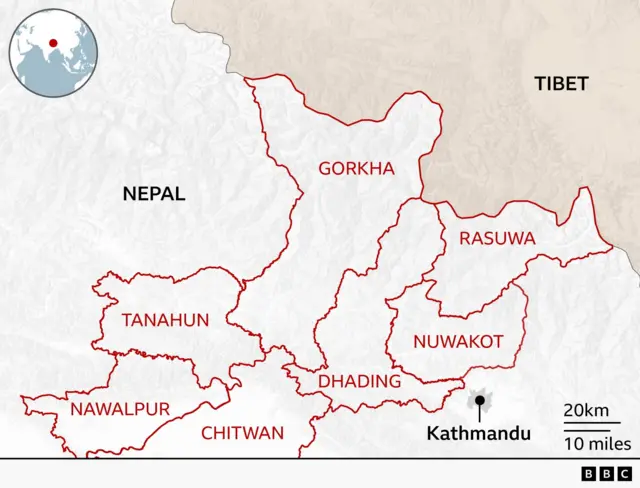
    The Rasuwa district is the closest to the origin of the floods, while the neighbouring Nuwakot district has also been severly impacted.

    In its latest update, Nepal police says of the 359 bodies recovered so far, 17 were recovered from Rasuwa and 28 in Nuwakot.

    It added that 132 bodies have been recovered in Chitwan, which is where the Trishuli runs its course and flows into the Seti Gandaki river.

    Map of central Nepal showing districts north-west of Kathmandu. District boundaries are outlined in red, with Gorkha at the centre, bordered by Rasuwa to the east, Nuwakot to the southeast, Dhading to the south, and Tanahun to the southwest. Chitwan and Nawalpur are shown further south. Kathmandu is marked by a black dot southeast of Nuwakot. Tibet lies to the north of the mapped area. An inset globe in the top-left indicates the location within Asia
  9. King Charles and Queen Camilla 'heartbroken' over Nepal flash floodspublished at 14:25 BST

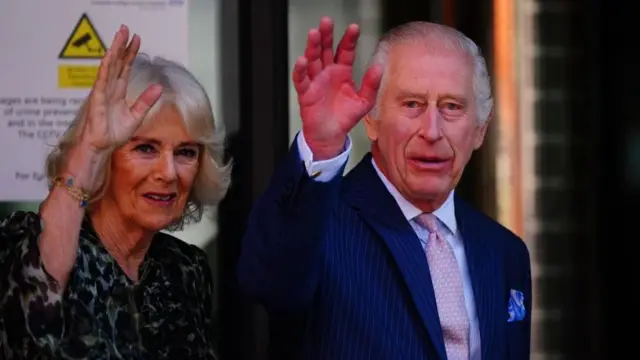
    King Charles and Queen Camilla are shown outside, waving as they arrive at an event.Image source, PA Media

    King Charles III says he and the Queen are “heartbroken” and send their “most profound sympathy” to those affected by the “devastating” flash floods in Nepal.

    “Many in the United Kingdom have strong, deep and personal ties to this part of the world," the British monarch says in a written message.

    “We send our most profound sympathy to all those who have so tragically lost their loved ones and we feel deeply for the many families awaiting anxiously the news of friends and relations."

    The King also pays tribute to "the police and Armed Forces personnel who lost their lives while carrying out their courageous duty in the service of others".

    He adds that "as always, the United Kingdom stands ready to help support those in need".

    This Flourish post cannot be displayed in your browser. Please enable Javascript or try a different browser.

  10. Families gather at airport in hope of informationpublished at 14:12 BST

    Azadeh Moshiri
    Reporting from Nepal

    Woman whose husband is missing speaks to BBC at Kathmandu's domestic airport

    Here at Kathmandu's domestic airport, we're seeing military support arriving - all part of the effort to find the hundreds who are missing right now.

    Families are gathering, waiting for any information they can find.

    We spoke to one woman who was in contact with her husband at 08:30 local time (02:45 GMT) yesterday but hasn’t heard from him since. She’s desperate for information.

    "My husband had taken the car to pick up a guest," she says, adding that she has come today because she heard that the injured are being brought here after being rescued.

  11. 'My wife, mum and uncle are missing,' says Sussex street food sellerpublished at 13:59 BST

    Hannah Roe
    BBC South East

    Pramod Poudel's family is shown outdoors on a deck
    Image caption,

    Pramod Poudel says friends have told him 90% of his village is gone

    In parts of the UK some people with relatives in Nepal are fearing the worst.

    "To be honest I believe that they’re not there anymore," says Pramod Poudel, whose wife, mum, uncle and brother have been reported missing.

    Poudel, who runs the Mo Mo Nepalese street food company in Sussex, says he knows his father is alive and will be flying to Nepal to meet him.

    “We’ve got to accept what happened because it’s obviously not only my family,” he adds.

    “When I talk with my friends they reckon about 90% of my village is not there and all of the people have gone as well."

    Media caption,

    Pramod Poudel from Uckfield hasn't heard from his wife, mum, brother or his uncle.

  12. Thousands from police, army deployed in Nepal search operationpublished at 13:49 BST

    A huge search and rescue operation is underway across Nepal following the devastating flash floods that struck several areas close to the country's border with Tibet.

    Nepal's National Disaster Risk Reduction and Management Authority says 9,260 members of the police, army and armed police force have been mobilised to help in the operation.

    Here are some of today's pictures from the across the country.

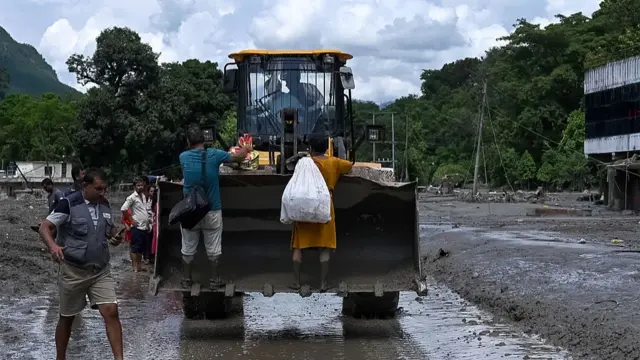
    Two people ride in the scoop of a bulldozer as it drives through a road covered in mud and debrisImage source, AFP via Getty Images
    Image caption,

    Rescuers transport stranded residents using a bulldozer in the Devighat area in Nepal's Nuwakot district

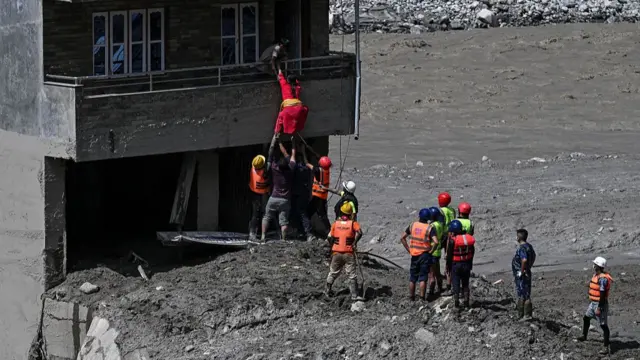
    A group of people wearing protective equipment stand on some rubble at the base of a house. The rescuers closest to the house are helping lower a person down from the balconyImage source, AFP via Getty Images
    Image caption,

    Police rescue stranded residents from a house buried in Nepal's Nuwakot district

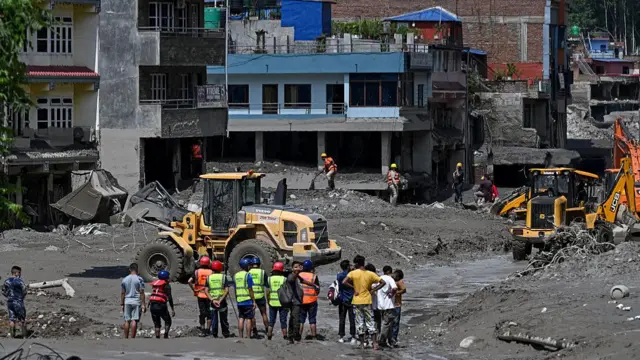
    A group of people wearing hard hats and hi-vis jackets watch on as several construction vehicles remove mud and debris from a residential areaImage source, AFP via Getty Images
    Image caption,

    Volunteers use bulldozers to clear mud and debris along a road in the Nuwakot region

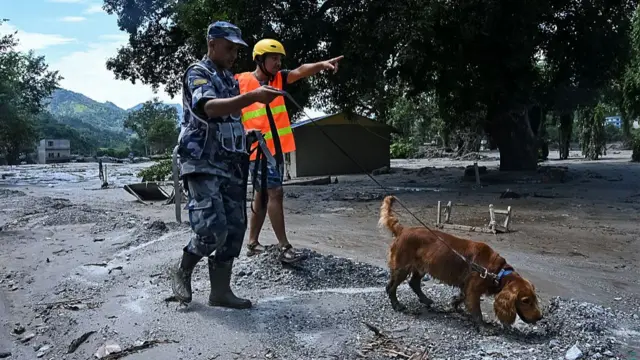
    A man clad in grey camouflage military uniform holds a spaniel-type looking dog on a lead, while wading through mud and debris. He is standing next to another man in a hi-vis jacket and helmet who is pointing towards something ahead of themImage source, AFP via Getty Images
    Image caption,

    A member of the security forces and his sniffer dog search for survivors in the Nuwakot region

  13. New lake of rising water in China could burst its bankspublished at 13:39 BST

    Laura Bicker
    China correspondent

    A lake of rising water has formed at a site along the China-Nepal border prompting fears that it could burst its banks - just as rescuers try to find survivors after yesterday’s landslide.

    Chinese search teams in Tibet have spent the day assessing the risk of flooding near Gyirong port after a lake formed near the confluence of Nepal’s Chochen river and the Puruchangpo Zangbo river.

    They told state media that stabilising this body of water was a priority to keep rescue personnel on the ground safe.

    China’s Ministry of Water Resources has used modelling techniques to estimate how much water is in the lake and now say that with continued rainfall, there is a high risk it could burst within the next three days.

    The ministry said it will prepare for a potential breach and provide support for emergency rescue efforts.

  14. Californian software engineer missing on pilgrimagepublished at 13:23 BST

    Gabriela Pomeroy
    Live reporter

    Prabhath Sajeepa is pictured wearing glasses and smiling against a colourful tent.Image source, Praneeth Sajeepa

    I've been speaking to Kavya Koulagi Jayatheertha, whose uncle Prabhath Sajeepa is missing on a journey to the Kailash Yathra, a sacred pilgrimage for Hindus.

    Sajeepa, a US citizen who works for a software company in California and has a wife and two children, was on his first pilgrimage with a group from the spiritual Isha Foundation organisation.

    “It has been the most devastating news," Kavya tells me.

    The family last had contact with Sajeepa on Monday. They’ve been told he was at the Gyirong border crossing when the flash flood hit the area.

    "It has been terrible. I hope he is somewhere safe," his niece says.

    "We are hoping for good news."

  15. Listen: What caused Nepal’s deadly flash floods?published at 13:07 BST

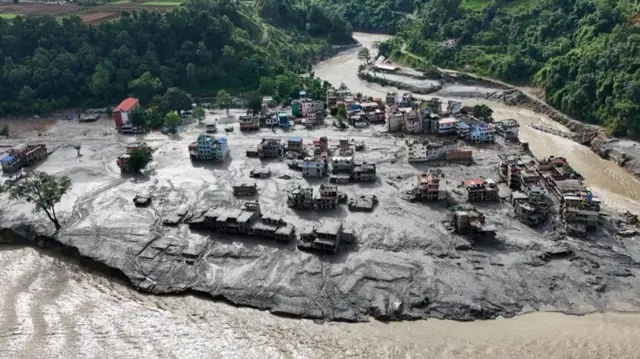
    A village is shown from the air in the bend of a river with buildings covered in mud.Image source, Reuters

    In the latest episode of the BBC's Asia Specific podcast, presenter Mariko Oi speaks to BBC Nepali journalist Sanjaya Dhakal in Kathmandu about the impact of the devastating floods and landslides that have struck Nepal and neighbouring Tibet.

    They discuss the search for survivors, the pressure on hospitals and rescue services, and the arrival of international aid as communities try to recover from the disaster.

    The programme also hears from Tom Robinson, a senior lecturer in disaster risk and resilience at the University of Canterbury in New Zealand, who has studied landslides and worked in Nepal.

    You can listen to the episode on BBC Sounds here.

  16. Nepal's PM visits areas devastated by flash floodspublished at 12:53 BST

    Prime Minister of Nepal, Balendra Shah is surrounded by people after visiting Bidur and surrounding areas of NuwakotImage source, PMO Nepal

    Nepal's Prime Minister Balendra Shah has visited some of the areas worst affected by the flash floods, including Bidur and nearby communities in the Nuwakot district.

    During the visit he met local officials, security agencies and community representatives to assess the scale of the damage and discuss the response effort.

    The prime minister is reported to have instructed authorities to provide immediate support to families displaced by the floods, reopen blocked roads and restore damaged infrastructure as quickly as possible.

    He later returned to the capital, Kathmandu, after inspecting affected settlements.

  17. Death toll rises to 359 - Nepal policepublished at 12:42 BST
    Breaking

    A Nepal police update says the death toll has risen to 359, as of 17:00 local time (12:15 BST).

    This comes about an hour after police announced the death toll was 332.

  18. BBC Verify

    How the BBC verified shocking flood videospublished at 12:34 BST

    By Yi Ma and Paul Brown

    Warning: This post contains distressing content

    Among the many verified videos of yesterday's flood, two stood out in particular for the sheer devastation they captured.

    Both showed a wall of water engulfing a valley near a border crossing between Nepal and China, as people attempted to escape the oncoming deluge.

    They were so shocking that some social media users wondered if they were made using AI.

    Media caption,

    Video shows scale of flash flood hitting Nepal-Tibet border

    One of BBC Verify’s main responsibilities is ensuring video and images in BBC News output are genuine - and the sharing of AI-generated footage during high-profile incidents is increasingly common.

    As part of the verification process, we do a detailed visual analysis. Even as AI-generation becomes more sophisticated, there are still elements it occasionally fails to render convincingly such as human movement, text on signs or basic physics.

    We found no such glitches in a frame by frame analysis. All the details matched and made sense when compared to older videos showing the same location - and a comparison of the terrain to satellite imagery confirmed the water was flowing downhill.

    We also systematically run all clips through AI-checking software. These tools are not foolproof but both videos returned results indicating no evidence of AI generation.

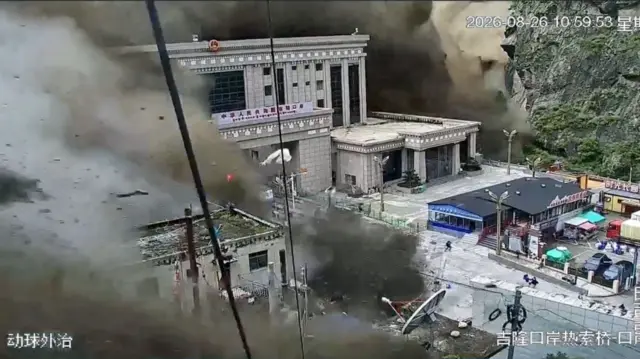
  19. Gyirong - the border crossing that was destroyed by the floodpublished at 12:22 BST

    Laura Bicker
    China correspondent

    A massive wall of mud and water is shown enveloping the border crossing buildings, which are at least six storeys high.Image source, Reuters

    Gyirong port has become the focal point of the disaster for rescue teams in China.

    Dramatic footage from surveillance cameras appeared to show the grand building marking the border being swept away by torrents of mud and water as hundreds of people ran for their lives.

    The building sat in the deepest of the five Himalayan valleys and had become a thriving hub after an earthquake in 2015 damaged other routes.

    It was the main passageway for tourists making their way between Nepal and Tibet. More than 100,000 people passed through in the first half of this year and it handled more than 30% of all Chinese-Nepali trade.

    Some social media users in China are questioning why the government decided to place such an important port in a deep valley in a geographically unstable region.

    Last year, 17 people were killed after severe rainfall led to a massive mudslide and triggered flash floods.

    However, history plays a part especially in a mountainous region where only valleys offer a passageway through the Himalayas between the two countries. For more than 1,300 years this port was used by nomadic herders, Nepali traders and local villagers.

  20. Race for survivors after violent flash flood kills at least 332 in Nepal, with hundreds still missingpublished at 12:04 BST

    Katie Williams
    Live reporter

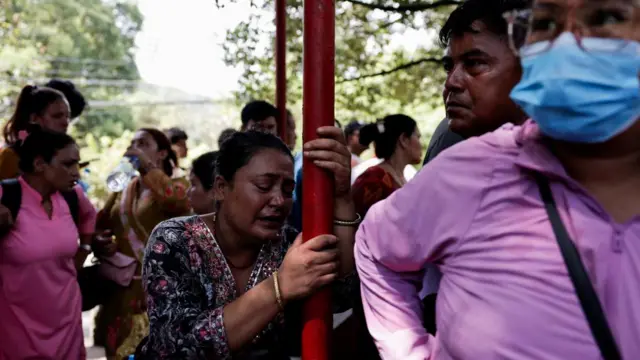
    A woman cries as she waits for updates on whereabouts of her missing family member, Nuwakot district, NepalImage source, Reuters

    Rescuers are in a race to find survivors after devastating flash floods hit the Nepal-Tibet border on Wednesday.

    The full scale of the disaster is still emerging, but officials say at least 332 people have died in Nepal while more than 900 are missing - the majority foreign citizens.

    In Tibet, three have been confirmed dead and at least 558 are missing, according to China's state broadcaster. It is unclear whether the missing figures overlap with Nepal's.

    An experienced mountaineer who has previously witnessed flash floods in Nepal tells the BBC he can't believe how "explosive" and "violent" the disaster was.

    Two sisters whose parents travelled to the region from Texas tell the BBC they "just love them a lot and want them to come home".

    Information on what triggered the flooding has been gradually emerging. Experts now believe "glacial collapse and debris flow" was the cause rather than an earthquake.

    And experts say there are concerns about possible "second and third waves", potentially caused by debris in rivers.