Summary

  • The Artemis II astronauts are preparing to return to Earth, bringing their 10-day mission to a close - watch live above

  • At 19:53 EDT (23:53 GMT) , the crew module will begin re-entering the atmosphere

  • The four astronauts are due to splash down in the Pacific Ocean, off the west coast of the US, at 20:07 EDT on Friday (00:07 GMT on Saturday)

  • On 6 April, the spacecraft reached its maximum distance from Earth - 406,771km (252,756 miles) - during the lunar flyby, breaking the previous record for the furthest humans have ever travelled into space

  1. 'This is almost miraculous': Space fans gather at watch partypublished at 00:03 BST

    Shaimaa Khalil
    LA Correspondent

    Sara Gomez brought her two daughters to the watch partyImage source, Shaimaa Khalil
    Image caption,

    Sara Gomez brought her two daughters to the watch party

    The seats and the big screen are all set as space enthusiasts start gathering at the Columbia Memorial Space Centre in Downey, southeast LA for the watch party of the return of the Artemis ll.

    One of the space center staff, Jared Head, is taking questions from space enthusiasts, about how long it’ll be for the spacecraft between entering the Earth’s atmosphere and splashdown; how hot the surface will be; and whether the team inside would feel any of the heat.

    “The astronauts won’t, the heat shield definitely will,” Mr Head said. Families are here with their children, including a mother who brought her three-month-old baby to “tell him he was here!”

    Sara Gomez, 42, brought her two daughters Lexi, 11, and Riley, 8. “This is something that doesn’t happen everyday,” Sara said.

    “This is almost miraculous - it’s taken a lot of people , a lot of time and a lot of money - and they can tell their kids when they get older that they experienced it live.”

  2. An iconic spacesuit designed for vital protectionpublished at 23:57 BST

    Rebecca Morelle
    Science editor

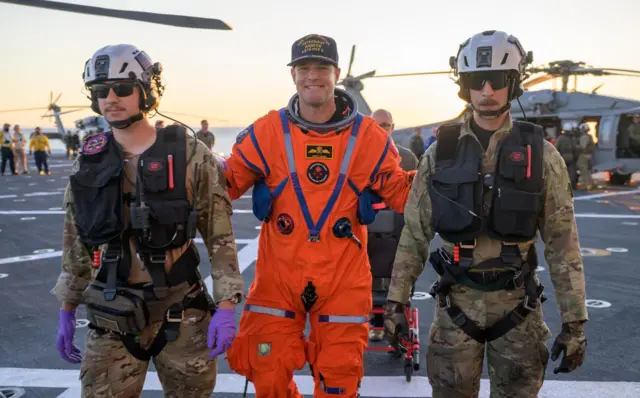
    The astronauts are now wearing their bright orange spacesuits, called the Orion Crew Survival System (OCSS).

    These suits are worn to protect the crew during launch and re-entry, and also act as vital protection if there is a problem with the capsule.

    The suit is pressurised with inbuilt life-support systems.

    The bright colour means the astronauts are easy to spot after landing - and equipped with a flashlight, mirror, whistle and light sticks in case the astronauts need to signal where they are after landing.

    A full-body image of a Nasa astronaut suit on a black background. The orange suit has a white helmet with a dark visor, blue straps, and black boots. Labels identify features: the helmet is described as light, strong, and easy to connect to communication systems; the suit is custom‑fitted and pressurised for emergencies; the life support system can supply air and remove carbon dioxide; a zip allows the suit to be put on quickly; gloves are durable and touchscreen‑capable; and the outer layer is fire‑resistant and bright orange to improve visibility after splashdown.
  3. What will the ride be like for the astronauts - no one really knowspublished at 23:53 BST

    Rebecca Morelle
    Science editor

    After their epic journey, it’s time for the astronauts to come home.

    And it will be quite a ride as they plunge through the Earth’s atmosphere.

    But this is the first time humans have flown in the Orion capsule, so no-one knows exactly what their experience inside it will be like.

    We do know they are coming in much faster and hotter than astronauts returning from the International Space Station.

    The team here have calculated the crew will experience about 3.9 Gs, so they’ll feel about 3.9 times heavier than they do on Earth. The sensation is like being pushed back into their seats.

    And while temperatures outside are super hot, inside they astronauts should stay comfortable, protected by their heatshield.

    Howard Hu, Orion’s programme manager, said he can’t wait to speak to the crew when they return to find out how the re-entry felt.

  4. What can we expect over the next few hours?published at 23:35 BST

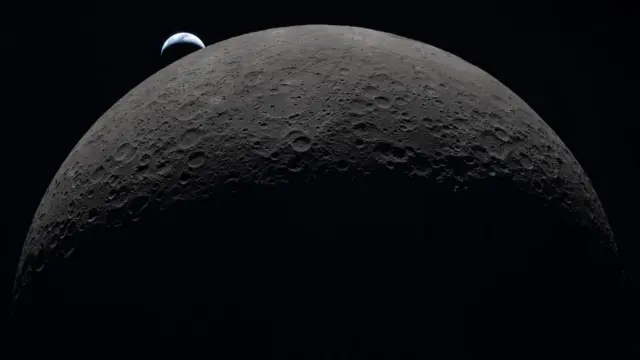
    The right side of Nasa’s Orion spacecraft is seen lit up by the Sun while a waxing crescent Moon is visible behind it alongside a small crescent EarthImage source, Nasa
    Image caption,

    The Orion spacecraft seen in front of the Moon and Earth

    The journey back to Earth for the Orion crew is a process involving numerous manoeuvres, ultimately culminating in the astronauts splashing down in the Pacific Ocean.

    Here's a look at the upcoming schedule:

    • 19:33 EDT (23:33 GMT): TheOrion crew module will separate from the service module in preparation for its return to Earth's atmosphere
    • 19:37 EDT (23:37 GMT): The spacecraft performs a crew module raise burn to set the correct entry angle
    • 19:53 EDT (23:53 GMT): Orion will reach 400,000 feet above the Earth's surface and make its first contact with the Earth's upper atmosphere, when a six-minute communications blackout will begin
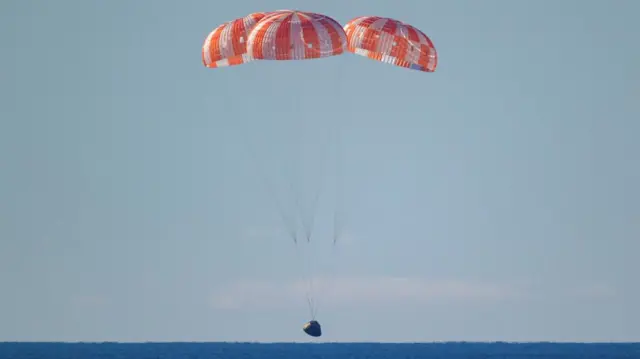
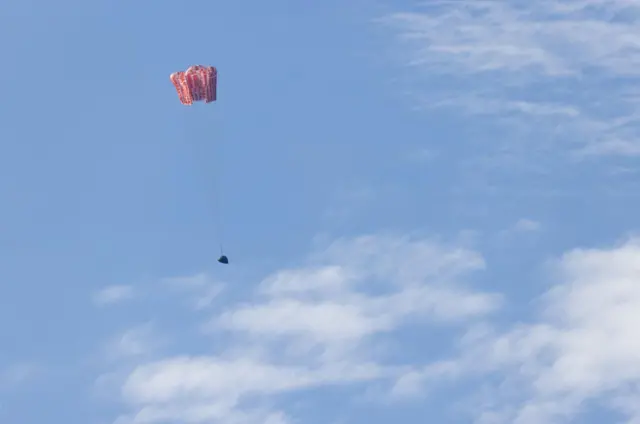
    • 20:03 EDT (Saturday, 00:03 GMT): Drogue parachutes are deployed, slowing down and stabilising the capsule
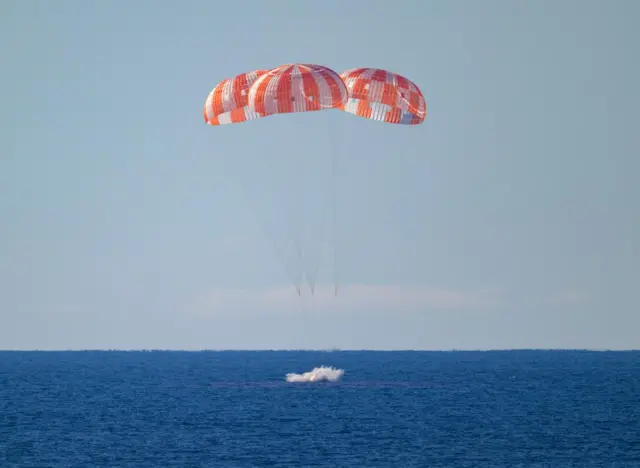
    • 20:04 EDT (Saturday, 00:04 GMT): The drogues will release and the three main parachutes are deployed
    • 20:07 EDT (Saturday, 00:07 GMT): The Orion crew splash down in the Pacific Ocean off the coast of San Diego, where they will be assisted out of the spacecraft by Nasa and US Department of War personnel
    • 22:30 EDT (Saturday, 02:30 GMT): A news conference will be held at Nasa's Johnson Space Center in Houston
  5. The crew have a distance record - but won’t get a speed recordpublished at 23:29 BST

    Rebecca Morelle
    Science editor

    The Artemis astronauts have travelled further than any humans have ever flown from Earth. They’ve flown a whopping 252,756 miles (406,771km), exceeding Apollo 13’s distance record by more 4,100 miles (6,600 km).

    But they won’t break the record for the fastest re-entry through the Earth’s atmosphere. That’s still held by the Apollo 10 crew, who screamed back to Earth at 24,791mph (39,897km/h).

    Nasa calculations put the Artemis crew’s re-entry at 24,661mph (39,688km/h) - just 130mph slower. So it’s not record breaking - but still incredibly fast, more than 30 times the speed of sound.

    To put this into perspective, astronauts returning home from the International Space Station come in at speeds of about 17,500mph (28,163kmh).

  6. 'The vibes are pretty awesome' at mission controlpublished at 23:15 BST

    Peter Gillibrand
    BBC Newsbeat

    A man walks through the middle of three silver doors at Nasa's Mission Control CenterImage source, Getty Images

    As Nasa's Lyndon B. Johnson Space Centre in Houston prepares for splashdown, we're hearing the vibes are “pretty awesome”.

    That's from Antonia Jaramillo, who works for Nasa.

    "We are eagerly awaiting them to make sure they return home safely," Jaramillo tells BBC Newsbeat.

    She compares the atmosphere to a big sports match.

    "It's always going to be a little bit nerve-wracking, but in the best way,” she says.

    Jaramillo thinks people will start to relax when the parachutes are deployed in splashdown.

    "The big celebrations, that big sigh of relief, the cheering, the whooping, the high fives, the hugs, everything is going to happen once Orion is down on Earth and we have that crew back on land,” she says.

    On the significance of the mission, Jaramillo explains: "This is not just for Nasa. Not just for our international partners. Not just for America. But for everyone. For the next generation too, of space explorers."

  7. In space no one can hear you... oh wait, we did - here's what the crew saidpublished at 22:50 BST

    Joe Coughlan
    Live reporter

    The Artemis II mission has had no shortage of memorable moments. Not only collecting images never seen before, but also the crew's messages back to Earth.

    'Sights no human has ever seen'

    The astronauts described the "spectacular" scale of the beauty in space several times, with commander Reid Wiseman telling US President Donald Trump: "We saw sights that no human has ever seen, not even Apollo, and that was amazing for us."

    A touching tribute

    Mission specialist Jeremy Hansen shared a poignant moment, when he and the crew named one of the Moon's craters after Wiseman's late wife Carroll. He said to mission control: "A number of years ago we started this journey... and we lost a loved one," adding at certain times in future the crater will be seen from Earth.

    Media caption,

    Emotional crew names Moon crater after commander's late wife

    A space plumber who sleeps like a bat?

    Christina Koch became Orion’s self-appointed "space plumber" following issues with the capsule's toilet. She said: "I like to say that [the plunger] is the most important piece of equipment in space."

    Koch also drew attention from the rest of the crew for "sleeping like a bat" during the rest periods, according to Wiseman.

    ‘We love you from the Moon’

    Shortly before the crew began their flyby around the far side of the Moon, and a 40-minute break from communications with Nasa, pilot Victor Glover sent out a touching message to those listening from Earth.

    "To all of you down there, we love you from the Moon."

  8. A snapshot of a record-breaking Moon missionpublished at 22:35 BST

    Jacob Phillips
    Live reporter

    Over ten ground-breaking days, the crew of Artemis II have broken a record, seen the far side of the Moon and fallen victim to a broken toilet.

    Before the spacecraft splashes down in the Pacific Ocean in the next few hours, here's a moonwalk back through the mission:

    First, liftoff.

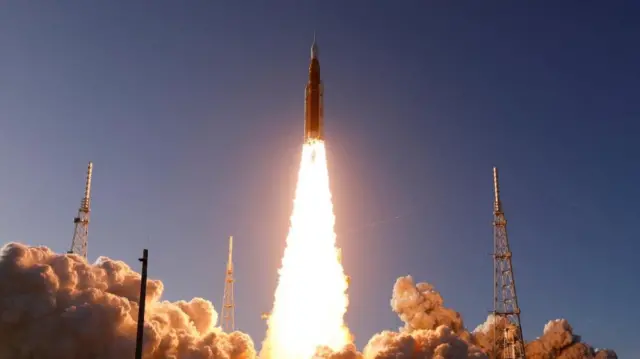
    Artemis II began its journey on 1 April with a dramatic blast off from Florida - watch that moment below:

    Day two saw the crew fire the spacecraft's main engine - sending the Orion capsule out of Earth's orbit and on track for the Moon.

    Once they were on the right flight path, the four astronauts prepared for a lunar flyby, bracing for 40 minutes of no contact with Earth as they circled behind the Moon.

    The history-making moment came on day five of the mission, when the crew were further away from Earth than any human had ever been before.

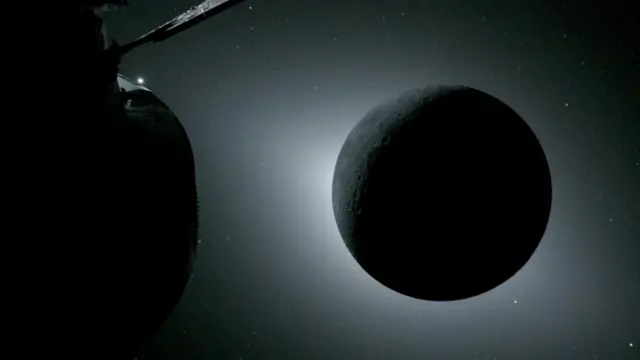
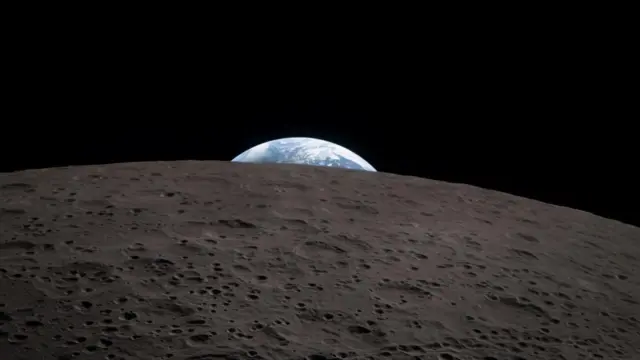
    During their historic moment, the crew photographed its craters, ridges and signs of ancient lava flows.

    They also witnessed a solar eclipse as the spacecraft, the Sun and the Moon aligned.

    A view of craters on the Moon.Image source, NASA
    Image caption,

    Craters, ridges and a view of the Moon unseen by human eyes - until now

  9. Artemis crew returning to Earth with 'all the good stuff'published at 22:22 BST

    Media caption,

    Watch: BBC asks Artemis II crew a question in space

    The Artemis II crew say they have "many more pictures" and "many more stories" to share with the world as they near their return to Earth.

    The four astronauts on board the Orion spacecraft have completed their mission around the Moon and are expected to splash down later.

    Speaking from space on their way home, the mission's pilot, Victor Glover, said the crew was eager to share what they have seen.

    When asked about their re-entry to Earth two days ago, he said: "We have to get back. There's so much data that you've already seen, but all the good stuff is coming back with us."

    He said he would be "thinking about and talking about all of these things for the rest of my life.

    "There's so many more pictures, so many more stories."

  10. One small step (or giant leap) left to go for Moon missionpublished at 22:14 BST

    Joe Coughlan
    Live reporter, on Earth

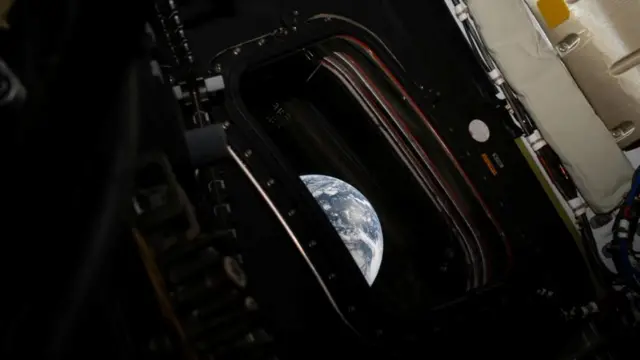
    The Earth is viewable beyond the Moon from the Orion spacecraft window during the Artemis II mission. A crescent on the top portion of the Earth is visible while the rest of the planet is in darkness, with the Moon in the foreground of the image.Image source, NASA

    Orion is approaching Earth at the end of its ten-day mission to the far side of the Moon.

    According to Nasa's real-time tracker,, external the spacecraft just over 20,000 miles (32,186 km) away and hurtling towards its final splashdown destination: the Pacific Ocean off the west coast of the United States.

    The crew on board have travelled further away from Earth than any human has before.

    A lunar flyby and a solar eclipse have been ticked off their mission checklist, and the four astronauts are heading home with new images of the planet in clutch.

    Close-ups of the Moon and a breathtaking snap of Earth are among the pictures taken by the crew, who have seen things no other human has ever seen.

    In just under three hours, the Orion spacecraft - nicknamed Integrity by the crew - will break through the atmosphere and quite literally splashdown into the Pacific Ocean.

    We'll be bringing you every moment in the build-up, and you'll be able to watch their descent back to Earth above.

    Stay with us, it’s going to be out of this world. Well, the first bit will be…