Summary

  • The SNP launch their manifesto for the Scottish Parliament election 2026

  • Leader John Swinney focuses on the cost of living, pledging a £2 bus fare cap and introducing a legal price ceiling on a basket of essential food items sold by supermarkets

  • He said the "fair foods" law would be time limited, ending when the public's "wellbeing" improves

  • The six larger political parties in Scotland will be hitting the campaign trail

  • Voters will go to the polls on 7 May to elect 129 MSPs

Media caption,

SNP pledges price cap on essential foods sold by supermarkets

  1. Food price cap is 'back-of-a-fag-packet plan' say Toriespublished at 14:16 BST

    The Scottish Conservatives are branding John Swinney's pledge to cap essential food prices as "another back-of-a-fag-packet plan that is only designed to create another SNP rammy with the UK government".

    The party's business and economy spokesman Murdo Fraser says people in Scotland are "rightly worried about rising bills right now and deserve better than these ill-thought-out plans from the SNP".

    “And at a time when our farmers and food producers are struggling to stay afloat, a price cap would be the last thing they need when selling their iconic products," Fraser says.

    “The best way the SNP could help people struggling with the cost of living right now is by backing Scottish Conservative plans to reduce people's taxes by reining in their out-of-control benefits bill.”

  2. Analysis

    Many of the SNP's justice pledges are already in placepublished at 13:48 BST

    David Cowan
    BBC Scotland home affairs correspondent

    Many of the SNP's manifesto commitments on justice are already in the pipeline; a continuation of what they've been doing while in power at Holyrood.

    Their promise to "fund two new prisons within the next parliamentary term," for example, presumably refers to the new jail in Inverness and the replacement for Barlinnie, both of which are already under construction.

    If elected, they say they will expand the use of "mental health triage cars" to reduce the workload on the police from calls involving people in distress.

    Police commanders will argue that it will require a major investment to make a real difference.

    There is a promise to back part of a campaign by a mother whose son died in an alleged stabbing last year.

    Lisa Petrie has been distributing bleeding control kits around Edinburgh since the death of her son, John McNab.

    Each contains medical equipment for dealing with catastrophic blood loss caused by stabbings, falls or accidents.

    The SNP are pledging to roll out the kits to community settings and public areas, including high schools, supermarkets, community centres and pubs.

    Lisa Petrie also wants tighter security around the sale of knives.

    In February, Justice Secretary Angela Constance instructed officials to examine what could be done.

    There's no manifesto commitment to do anything beyond that.

  3. Analysis

    SNP is finding it difficult to back up its own 'climate leader' tagpublished at 13:34 BST

    Kevin Keane
    BBC Scotland energy correspondent

    The SNP manifesto pledges to "take the necessary action to achieve net zero by 2045" and frames it as an opportunity to create new industries and jobs.

    But it also requires some difficult choices which might not be popular with voters and that's difficult to confront head-on during an election campaign.

    It asserts that Scotland is "ahead of the UK as a whole in delivering long-term emissions reductions" and yet official figures contradict that claim.

    The most recent year for which emissions reporting exists for both the UK and Scottish governments is 2023 - and that data says levels since 1990 fell by 51.3% in Scotland and by 53% for the UK as a whole.

    Add to that the optics of annual targets being scrapped along with intermediate goals for 2030 and 2040 and the SNP's once self-proclaimed title of "climate leaders" looks more difficult than ever to justify.

  4. Analysis

    GPs are sceptical that walk-in clinics will ease pressurespublished at 13:22 BST

    Claire McAllister
    BBC Scotland health producer

    The SNP manifesto prominently features walk-in GP clinics to end the morning rush for appointments.

    GPs do not believe these will help ease demand on existing services after a similar pilot was largely unsuccessful in England.

    Initially, 16 clinics had been promised; now the SNP is committing to at least another 14 sites.

    Four have opened since February, with the rest of the initial bunch to be running by next year.

    Staff can only help with certain conditions, so it is unclear how much of a difference they are making.

    Doctors say these should be evaluated and if they do not significantly ease pressures, then they should close.

    With ambitions to move more healthcare into the community, staffing continues to be a challenge.

    The manifesto points to a deal worth over £530m over the next three years which has already been struck with GPs to boost recruitment.

    Although questions remain if the longstanding target to increase the GP workforce by 800 by next year is achievable.

  5. Analysis

    Artists' minimum income scheme not enough to resolve pressures on the sectorpublished at 13:17 BST

    Pauline McLean
    BBC Scotland Arts Correspondent

    Like Labour, the SNP plans to pilot a minimum wage for artists.

    Like the Irish scheme on which it’s based, the Scottish Artists Minimum Income would offer up to two thousand practising artists and creative workers a wage for three years.

    While the pledge will be welcomed by a sector still recovering from the pandemic and the cost of living crisis, it will not resolve the huge financial challenges they face.

    Who would operate the scheme – and thus decide who and what qualifies? Would it be Creative Scotland, the country’s arts agency, which the SNP has pledged to reform?

    Demand for money from any funding stream has long outstripped what’s available, and it’s likely that any new scheme would be just as inundated.

    It’s the flip side of a country which is wildly proud of its cultural identity and keen to express it.

  6. BBC Verify

    Could electricity bills be reduced by one third?published at 13:03 BST

    BBC Scotland: Anthony Reuben

    The SNP manifesto claims that the party could reduce household electricity bills by one third.

    This relies on Scotland becoming independent, deciding its own energy policy and setting up its own electricity market, and is based on this SNP report, external.

    Clearly there are a lot of hypotheticals involved depending on when Scotland became independent and how the new systems were designed, which means the level of any savings are highly uncertain.

    The ownership of North Sea oil and gas was a key part of the 2014 Scottish independence referendum debate, and it’s possible that the ownership of offshore wind generation would be contested by the Westminster government.

    One of the key points is that the wholesale electricity price in the UK is often set by the price of gas, which the SNP claims would happen less often after independence because Scotland produces so much of its electricity from renewables.

    But the UK government is also aiming to be generating almost all of its electricity from low-carbon sources by 2030, which would begin to have a similar effect.

    The plans also include saving money by not building any new nuclear power stations, although the SNP said there would be additional spending on power storage.

    And there are also savings factored in from changing the way generators in remote areas are charged for energy transmission.

  7. Analysis

    Huge challenges for NHS after two decades of SNP governmentpublished at 12:54 BST

    Lisa Summers
    BBC Scotland health correspondent

    After almost two decades of SNP government, huge challenges remain for the NHS.

    In the face of financial pressures, experts say politicians must be clear about what the health service can afford.

    There are promises here to make it easier to see a GP.

    "Walk-in" clinics might please voters, but many doctors are critical, saying it will not relieve the pressure.

    One in 10 Scots are on an NHS waiting list, and a target to end long waits has not been met.

    Promises to build National Treatment Centres have been scaled back in the face of financial pressures.

    The SNP now says it will spend £10bn over the next decade on building health hubs and vital equipment, all to increase capacity.

    But that money also has to cover existing buildings in need of essential maintenance.

    Avoiding strike action by NHS workers will be seen as a win, and the manifesto sets out plans to recruit more staff.

    But pay agreements are costly, and the next government will have to consider how it can afford everything.

  8. Swinney's indyref2 pledge 'a wake-up call to pro-UK voters' says Findlaypublished at 12:45 BST

    russell findlayImage source, Getty Images

    John Swinney's political opponents have been having their say on the SNP's manifesto launch.

    The Scottish Conservatives describe Swinney's insistence that 2028 is a very realistic date for a second independence referendum as “deadly serious” and a “wake-up call to pro-UK voters that the union is on the line at this election”.

    Party leader Russell Findlay adds that nobody would believe Swinney’s pledge not to increase income tax bands and rates after the SNP broke the same pledge in the last parliament.

    He says: “John Swinney spelled out loud and clear that breaking up the UK will be his only priority if the SNP win a majority on May 7.

    “If he was serious about tackling the cost of living crisis then he wouldn’t have made Scots poorer by hitting them with the highest tax bills in the UK.”

  9. Analysis

    How wealthy will the wind farm wealth fund be?published at 12:34 BST

    Kevin Keane
    Scotland energy correspondent

    The manifesto promises a ScotWind Wealth Fund, which brings echoes of the £1.5 trillion Norway Wealth Fund, formulated in the 1990s and funded through profits from its vast oil and gas reserves.

    ScotWind was a seabed leasing auction - announced in 2022 - which is expected to deliver up to 20 offshore wind farms in the seas off Scotland, although developer Shell has already scrapped one of the schemes.

    It's long been a gripe of the Scottish National Party that no wealth fund was set up to capitalise on the North Sea's profits the way it was in Norway, with taxation instead being used for day-to-day spending across the UK.

    This feels like an attempt to right that perceived wrong with the next generation of energy.

    But wind won't bring anything like the tax revenues that oil did, and whereas the profits of Norway's state-owned energy company can be funnelled into the fund, here the energy operators are private companies and so the profits will go to shareholders.

    Although Crown Estate Scotland has estimated that the combined 30 GW of all the planned wind farms will generate around £120m annually, almost half of the £755m one-off windfall has either been spent or allocated, and so the question remains, how wealthy will this wealth fund actually be?

  10. Supermarket food price cap and Swinney's other manifesto pledgespublished at 12:28 BST

    Angus Cochrane
    BBC Scotland senior political reporter

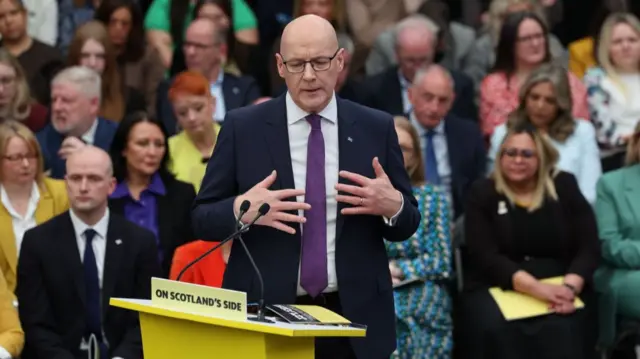
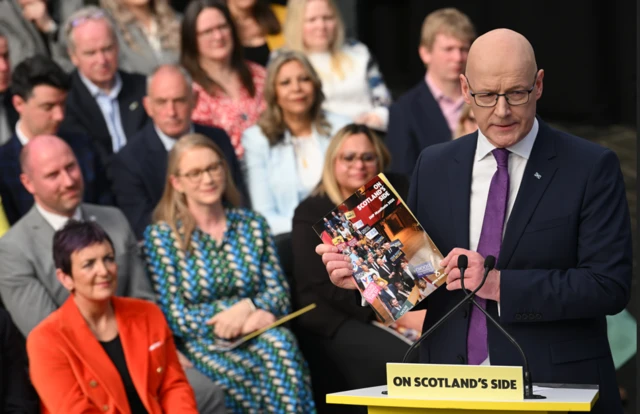
    John Swinney holds the SNP manifestoImage source, PA Media

    The price of "essential" supermarket groceries is to be legally capped to help consumers with the cost of living, First Minister John Swinney has pledged.

    The SNP leader, announcing his party's Holyrood election manifesto, external, said he would use devolved powers to compel supermarkets to limit the cost of bread, milk, cheese and other items.

    He also announced ambitions to simplify the income tax system, roll out a nationwide £2 bus fare cap and deliver extra funded childcare.

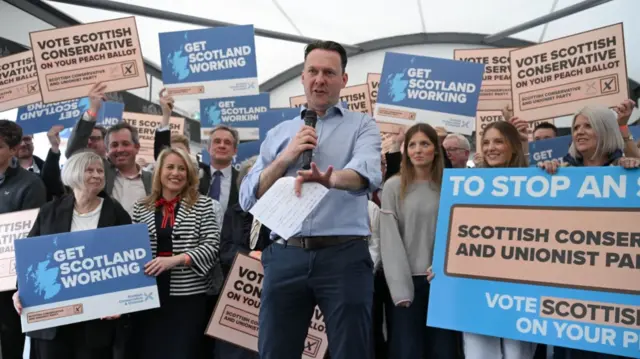
    At an event in Glasgow, Swinney urged voters to deliver a majority for his party to fuel a push for a second independence referendum.

    As well as independence, he identified the SNP's top priorities as improving access to GPs and cutting NHS waiting lists, eradicating child poverty, taking action on the climate crisis, and introducing a cost-of-living package "unrivalled" elsewhere in the UK.

    Swinney, who has been first minister for almost two years, said he was "just getting started".

    He described the 7 May election as a referendum on independence, bringing down energy bills and allowing Scotland to rejoin the EU.

    Read more from Angus Cochrane here.

  11. Food price cap branded a 'potty gimmick'published at 12:23 BST

    We're hearing from the Scottish Retail Consortium (SRC), who are hitting out at the SNP’s food price cap proposal.

    Deputy director of the SRC Ewan MacDonald-Russell says elevated food prices are the result of “soaring supply chain and commodity costs” and “relentless rises” in statutory costs.

    He says retailers have invested heavily to keep prices down by expanding affordable food ranges and locking the price of essentials.

    “Rather than recreating 1970s-style price controls and potty gimmicks, public policy should get serious and focus on cutting retailers’ costs so that resources can be directed to keeping prices as low as possible for customers,” MacDonald Russell says.

  12. Analysis

    SNP's referendum plans will likely face a UK government roadblockpublished at 12:18 BST

    Andrew Kerr
    BBC Scotland political correspondent

    The loudest cheers at any SNP event come when independence is mentioned, and this manifesto launch was no different.

    It’s the whole reason for the SNP’s existence, and John Swinney has set out his plan for 2026.

    Page 13 of the manifesto says that a constituency vote for the party delivers an SNP government; the second, regional list vote “delivers independence” by securing a majority that “will lay the path to a referendum.”

    If the SNP do secure a majority, as happened in 2011, they want the same procedure - an agreement for a fresh referendum with 2028 pencilled in already.

    They want to rely on that precedent.

    But, of course, the next big roadblock for the party is a UK government that consistently says “no”.

    Swinney says the people of Scotland have a right to decide and that the UK is a “voluntary union” - saying even Labour’s Anas Sarwar thinks that.

    The SNP believes that a fresh refusal after securing what they see as a mandate changes the nature of the union - and would be a fundamental affront to democracy.

  13. Analysis

    Getting more disabled young people into work will be a challengepublished at 12:07 BST

    Ian Hamilton
    BBC Scotland senior social affairs reporter

    There’s a recognition across the political spectrum that there are too many young disabled people not finding their way into sustainable employment.

    That’s something I have routinely heard from Disabled People’s Organisations (DPOs), charities, and disabled people themselves for years now.

    The SNP want to create what they’re calling a “bespoke scheme” to ensure that more disabled young people get apprenticeships in the public sector.

    Just over half the adults in Scotland with disabilities are in work – that’s a figure that raises concern for many parties.

    In all my years covering disability stories, I’ve heard the same mantra; as young people approach working age, they need to be given the opportunity to work as soon as possible.

    Otherwise, they end up stuck in a welfare trap.

    The lack of disabled people working has remained stubbornly high during the SNP’s time in government, and before.

    The challenge now is whether the youth strategy pays off long-term.

  14. Analysis

    Swinney is trying to set himself apart from other political leaderspublished at 12:01 BST

    Kirsten Campbell
    BBC Scotland political correspondent

    John Swinney's speech was not just about policies, it was also about character.

    He's trying to set himself apart from other political leaders, at home and abroad, saying he stands against despots and dictators.

    He sees himself as offering the "experienced, principled, reliable leadership " the country needs in troubling and uncertain times.

  15. Food price cap will give 'false hope'published at 11:56 BST

    Reaction is coming in about the SNP's food price cap plan.

    Earlier, John Swinney said the SNP would introduce a maximum price for some essential items in supermarkets to reduce weekly food shop costs.

    But the former president of Scottish Grocers Federation has called the proposal a “PR gimmick”.

    Abdul Majid, who owns a shop in Bellshill, added: “It gives people who are struggling false hope.”

  16. BBC Verify

    Can the Scottish government cap food prices?published at 11:47 BST

    BBC Scotland: Phil Sim

    John Swinney says an SNP government would set up a “maximum price for essential food items”, listing bread, milk, cheese, eggs, rice and chicken as examples.

    How would this work?

    Mr Swinney believes the government can do this by using its public health powers, in a similar fashion to their move to put a minimum price on alcohol sold in shops.

    It would work by requiring supermarkets to offer one example line of a set group of essential items at a capped price. Shops could still sell other varieties of the same item at higher prices.

    The latest figures published by the Office for National Statistics, external show the UK’s inflation rate (the annual percentage change in prices) for food and non-alcoholic drinks was 3.3% - this means food prices were 3.3% higher in February 2026 than they were in February 2025.

    The UK government has been drawing up worst-case scenario plans for potential food shortages if the Iran war continues.

    This Flourish post cannot be displayed in your browser. Please enable Javascript or try a different browser.

    It is worth nothing that the minimum unit pricing system cited by Mr Swinney took six years to come into force, due to legal challenges in the courts.

    He has acknowledged there is a “live issue” in terms of the potential impact on farmers and food producers as well as owners of small shops.

    And there is a constitutional hurdle in the UK Internal Markets Act, which seeks to maintain a level playing field for businesses north and south of the border.

    It means Scottish ministers would likely need an exemption from internal market rules in order to set this system up.

    There have been clashes over this before, with Scottish plans for a deposit return scheme to promote recycling bottles and cans having to be kicked into the long grass after a row over internal market rules with the previous Conservative UK government.

    The SNP has urged UK ministers not to “block” the plans.

  17. SNP manifesto launch: The headlinespublished at 11:41 BST

    If you're just joining us, here are the key lines that emerged from John Swinney's launch of the SNP's manifesto:

    Stick with us as we bring you reaction to the manifesto, external and analysis from our correspondents.

  18. Greens say bus fare cap should go furtherpublished at 11:38 BST

    “Imitation is the sincerest form of flattery," says the Scottish Greens' transport spokesperson Mark Ruskell in reaction to the SNP's £2 bus fare cap announcement.

    He says the move is to be welcomed but says it was previously rejected by the SNP when his party touted it.

    Ruskell adds the Greens want to go further by making bus travel free for everyone and putting buses into public ownership.

  19. Labour says SNP promises not 'worth the paper they are written on'published at 11:30 BST

    Here's some reaction to the SNP manifesto launch:

    "This tired and out of touch SNP government is offering more of the same empty rhetoric we've been hearing for decades," says Scottish Labour deputy leader Jackie Baillie.

    She accuses the SNP of 20 years of failure and insists the "SNP promises are not worth the paper they are written on'".

  20. Analysis

    SNP will keep council tax but bring in new bandspublished at 11:17 BST

    Jamie McIvor
    Scotland news correspondent

    Fundamental reform to council finance can be easier said than done.

    In 2007, the SNP said it would abolish what some in the party called the "hated" council tax.

    Since then, the party has taken steps to modify the system so people in the most expensive properties pay more. But the council tax is still with us.

    It plans to continue this trend. The manifesto confirms that there will be new bands from 2028 for homes valued at more than £1m and £2m if the SNP is re-elected.

    But what about fundamental reform?

    The manifesto says the future of local tax reform requires consensus, and it will seek a cross-party consensus on this.

    Around 10 years ago, a detailed report commissioned by the Scottish government carefully considered alternatives to the council tax.

    Ultimately, though, the lack of a consensus on the best alternative meant the tax was modified rather than replaced.

    Is a consensus on a replacement going to be any easier to achieve now?