| 24 September 2014 |

| |
| BBC Homepage | | |
| |||
| Contact Us | | |
Manchester placesYou are in: Manchester > Places > Manchester places > The castles of Manchester 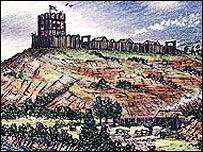 Stockport Castle (c) Stockport Council The castles of ManchesterFrom Radcliffe in the north to Ullerwood in the south, rather than being a castle wasteland, Greater Manchester is actually teeming with mottes, baileys and long-forgotten keeps. Here's where and what they are: Glossary- Manor house: buildings ranging from small country houses to grand stately homes, particularly when the houses were fortified Buckton CastleBuilt by William de Neville, possibly as a defensive structure – though the recently discovered large stone walls suggest it may have been much more important - Buckton Castle was first mentioned in 1360, by which time it was already ruinous. The site, positioned between Moor Edge Road and Castle Lane above Mossley, was used during the sixteenth century as a beacon during the Pilgrimage of Grace. It has been damaged by eighteenth century treasure hunters and threatened by the nearby Buckton Vale Quarry. Bury CastleOriginally a manorial base for the de Bury family in the twelfth century, it passed to the Pilkingtons by marriage in the mid-fourteenth century. In 1469, Thomas Pilkington obtained a licence from King Edward IV to fortify the manor house. 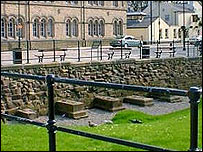 Remains of Bury Castle (c) Bury Council However, Thomas, as a Yorkist, had a change in fortune after Richard III’s defeat in the War of the Roses and in 1489, his castle passed into the hands of Thomas Standley, Earl of Derby. Thomas didn’t need the castle, so had it dismantled. Gradually, stone was taken from the castle walls and the moat was filled in, and by the eighteenth century, the castle site was lost – it was rediscovered in 1865, when new sewers were constructed in Castle Square. Dunham CastleFirst recorded in 1173 and belonging to Hamon de Massey, Dunham Castle was a motte and bailey wooden structure, which was still standing in 1323 and fell into disuse between then and 1362, after passing to Roger le Strange, Lord of Knocking. The motte is thought to have been turned into an ornamental lake in the grounds of Dunham Massey Hall. It has, in the past, been protected as a Scheduled Ancient Monument, but was descheduled when it was proposed that it may simply be a 'natural hummock of glacial sand'. 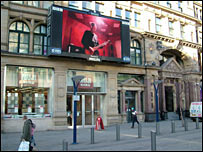 Exchange Square, site of Manchester Castle Manchester CastleOriginally a manor house first recorded in 1184, Manchester Castle was situated on a sandstone outcrop at the confluence of the Rivers Irk and Irwell (near where the Chetham's School of Music now stands, just north of the Cathedral), and held by the Greley family in the twelfth and thirteenth centuries Excavations in the area have revealed three rings of ditches surrounding the likely site of the castle, two of them running along the line of Long Millgate and Hanging Ditch (in Exchange Square), next to the Arena, and one running through the yard of Chetham's. Radcliffe TowerThe site of Radcliffe Tower started life as a simple manor house built by Nicholas de Radeclive in the eleventh century. This was renovated in 1403 as part of a larger structure of a hall and two towers, erected by James de Radcliffe under licence from King Henry IV. 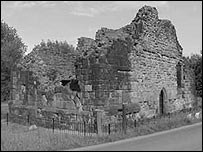 Radcliffe Tower (c) Bury Council By 1781, the structure was recorded as a two storied timber house with a ruinous tower – the house was dismantled at some point in the nineteenth century, leaving only Radcliffe Tower still standing, overlooking Close Park and the River Irwell. Rochdale CastleRochdale Castle was a motte and bailey, built in the late eleventh century. It stood on Castle Hill near the site of an older Saxon castle (near the present day Sparth Bottoms Road). It was surrounded by an earth rampart and ditch with a second ditch added later to the South and South-East. The castle was abandoned in early thirteenth century. Stockport CastleLike Rochdale Castle, Stockport Castle was also a Norman motte and bailey structure surrounded by trees - the name Stockport means 'a castle in a wood' - first mentioned in 1173 when Geoffrey de Costentyn held it defensively against King Henry II. The original wooden palisade was replaced by stone walls in the early thirteenth century. It was described as ruinous when Henry VIII’s librarian, John Leland, visited the town between 1535 and 1543, and finally levelled in 1775 by Sir George Warren to make way for a cotton mill. Two fragments of the stone wall still survive on Mealhouse Brow and Great Underbank. Ullerwood CastleOften confused with the nearby Watch Hill Castle, Ullerwood was another of the castles belonging to Hamon de Massey. It was first mentioned in 1173 as one of the castles de Massey held against the King Henry II. Positioned above the River Bollin, the site now sits underneath a modern house at the end of one of Manchester Airport’s runways, bordered by Wilmslow Road and Mill Lane. Watch Hill CastlePositioned between Dunham Castle and Ullerwood Castle, Watch Hill Castle was a motte and bailey structure built in the twelfth century by Hamon de Massey to aid his defence against Henry II. Having served its purpose, the timber castle quickly fell into disuse by the thirteenth century and was discarded by Roger le Strange when the Massey estate passed to him in the fourteenth century. last updated: 23/07/2008 at 12:23 SEE ALSOYou are in: Manchester > Places > Manchester places > The castles of Manchester |
| | About the BBC | Help | Terms of Use | Privacy & Cookies Policy |