| 24 September 2014 |

| |
| BBC Homepage | | |
| |||
| Contact Us | | |
History featuresYou are in: Manchester > History > History features > The lost castle of Stalybridge The lost castle of StalybridgeWhat it looked like, we can only guess. But archaeologists have revealed that, 900 years ago, ‘one of England’s most important castles’ once stood on a hill on the edge of Greater Manchester. 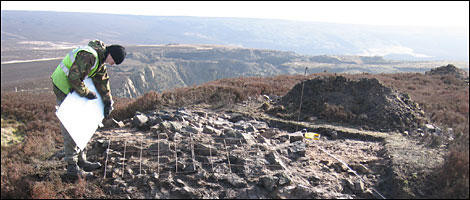 Finding: early stages of the excavation The name Buckton Castle had lived on in the Stalybridge area, but it was commonly thought by local historians to refer to an ancient hill fort of little importance. But the revelation that a huge 12th Century stone built castle once stood on a ridge above Buckton Moor has caused a sensation. 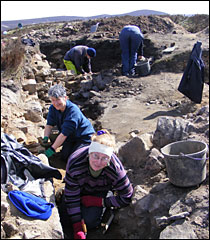 Excavating the gate tower of Buckton Castle Excavating the site, a team from the University of Manchester Field Archaeology Centre expected to find an earthwork of little importance. But what they found left the archaeologists stunned: a ‘massive’ stone outer wall, 2.8 metres wide, indicating that Buckton was a castle on the scale of Beeston Castle near Chester. “The discovery of a high ranking castle in England is a tremendously rare event – and was definitely not what we were expecting,” said Director Mike Nevell. RiddleBuckton Castle has been an object of curiosity for a long time. A 1359 survey by the Black Prince who had just acquired the lands, described it as ‘a ruined castle.’ 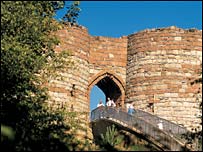 Beeston Castle, Cheshire And with a pub called 'Buckton Castle' and the nearby Castle Lane, there were clearly some local clues! But with much of the stonework missing, walls overgrown with heather and peat, and no ancient drawings in existence, there was little hard evidence - until now. Alan Rose of the Tameside Local History Forum and Stalybrige Historical Society said the finding solved a riddle which had intrigued locals for hundreds of years. "This is a significant discovery and very exciting indeed. Most people thought the name simply referred to the hill and we knew there was some defensive structure there. But no-one ever thought it was a stone castle in the conventional sense."
He added that a group researching the diaries of a Saddleworth man had suggested that a large amount of stone still remained in the early 19th Century. Further excavations also revealed that the castle was defended by a large rectangular gate tower – which helps to date it to the 12th century. Greater Manchester County Archaeologist Norman Redhead said the scale of the defences clearly indicated a building ‘at the top end of the social hierarchy.' “Greater Manchester is not well known for its castles, but Buckton Castle will put the area well and truly on the castle map as it is clearly the best preserved of the eight known castles in the county area.” QuestionsWho owned the castle and why it was built are questions that remain unanswered. One leading contender is the second Earl of Chester who may have built a castle on the edge of his lands to protect himself from his sworn enemy William of Peveril – who went on to poison him in 1153. 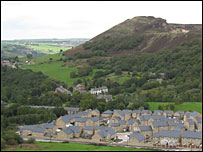 The site is on the hill above Carrbrook Village But the team wants to know why the castle faced north and west - rather than south where the Earl of Chester’s enemy, Peveril, lived. Nevell added: "When we return to Buckton next year we’ll hopefully find more answers to these still intriguing questions." last updated: 30/07/2008 at 08:42 You are in: Manchester > History > History features > The lost castle of Stalybridge   |
| | About the BBC | Help | Terms of Use | Privacy & Cookies Policy |