| 28 October 2014 |

| |
| BBC Homepage | | |
| |||
| Contact Us | | |
Made In EnglandYou are in: Manchester > Made In England > Michael Browne: interview 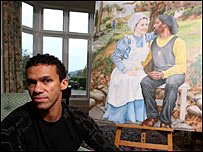 Michael Browne Michael Browne: interviewRomance, immigration and multiculturalism: it’s all described in Michael Browne's painting for the BBC’s Made in England project which looks at the relationship between the people and places of England expressed in art. Michael Browne: art CV1984: held first exhibition at just 19 years of age 1992-94: painted Sistine Chapel copy on ceiling of Cocotoo's restaurant 1997: Art of the Game: controversial painting depicting Eric Cantona as Jesus 2003/04: satirical painting of Osama Bin Laden 2005: produced painting of Ricky Hatton 2006/07: painting featuring Rio Ferdinand and Wayne Rooney with Winston Churchill Michael Browne is known for producing large scale Renaissance-style paintings often controversially featuring well known figures in challenging cross-cultural situations. For instance, his depiction of Eric Cantona as Christ in his painting The Art of the Game famously drew criticism from the Church. For Made in England, Michael travelled to Grasmere, home of Wordsworth and his daffodils, and produced a pre-Raphaelite style painting that offers a tongue-in-cheek view of the Romantic movement, multiculturalism and indeed, our view of what is English. We talked to Michael Browne about his art, and Made in England: Your paintings often contrast different ideas and cultures, don’t they?"Ever since I was at college, I’ve been doing images of environmental disconnections. Using Renaissance-style art, I end up producing images of people in different walks of life. So with the Cantona painting, that was the result of that kind of juxtaposition of different backgrounds. 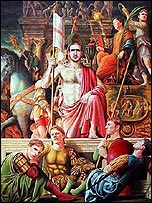 The Eric Cantona painting by Michael Browne "It gets people looking at things they wouldn’t normally be interested in. People who don’t normally go into art galleries are now looking at work in a religious context, because the idea of a footballer in a Renaissance context pulls them in." What do you hope you to achieve with your art?"Artists are there to ask questions, not to provide answers. If a painting is done well, it can put conflicts in a scenario that people are going to look at. There's a kind of reverence to a good painting, so you've got a licence to speak, haven't you? "I used to do paintings of Moss Side and they have a very romantic, escapist view, but with a backdrop of a very unsettled past in that area. "When I went to the Lake District, you've got Wordsworth’s lifestyle, where he had an ideology of being in the lakes and the hills, and he was this fantastic writer, but he was quite temperamental as a younger person. 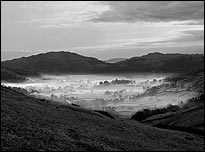 Dawn: Grasmere Village "Wordsworth was part of the Romantic movement; high morals, nature and religion were combined as an ideal – and it was painted and written about. But life is not as picturesque as it's made out. "For instance, there’s now rubbish washed up on the lakes and William Wordsworth had a love child. So there’s lots going on in people’s backgrounds. And not everything as it seems." What do the two characters in the painting symbolise in terms of English culture?"I just felt that you’ve got this black guy from Manchester – big city, in this samba band - it’s a good example of multiculturalism where all kinds of people from different backgrounds play together. "And then you’ve got the lady, Joanne, from Grasmere and her family have been running this [gingerbread shop] business for years. I wanted to do a mock-up of the Garden of Eden and in a way, she represents that way of life. It’s a romantic view of what we want.
"The irony is that the black guy in the painting is as English as they come! He looks Caribbean but he’s from Kent. His roots are Jamaican and he’s got dreads but he’s just so well spoken and he’s educated as well. Yet, superficially, he’s all samba. "But he fits the stereotype because of the people he brings in and the kind of influences he draws to him, which are all from out of England. I just find that intriguing." Why choose these two contrasting characters?"It all boils down to sex in the end. The message in society seems to be: do what you want, look after the individual, not the family. So this is the conflict with the Church and its morals. "All I see is: 'have it now and pay for it tomorrow'. We've got cultures tied up in religion and, in this day and age when individuality is the key and religion is secondary, you've got this melting pot of attitudes and hedonism. The painting is there to highlight these things. "For instance, there's a groundskeeper [in the background] and he doesn't like the idea of immigration. He's very fixed in his ways; he’s observing the couple under the tree and he’s looking with disdain as he’s looking after the garden, the English ground, the green grass. There’s all that going on. "It's about representing different points of view. But you've got to show the differences. In any creative form, you don't move things forward until you have polarity and opposition." And has this project changed your own view of Englishness?"I do think it’s really important to protect culture and I do like the idea of Englishness. If you try to get rid of aspects of Englishness now, I just think it would so sad. I think there should be that kind of ideology, even though it can be romantic because people are always going to be looking at it as a positive." Made in England was shown on Wednesday, 23rd April, at 10.40pm on BBC One in the North West. It is available for seven days after broadcast on the iPlayer.You can see Michael’s painting in the café area at Manchester Art Gallery from 22 April 2008.last updated: 24/04/2008 at 09:09 SEE ALSOYou are in: Manchester > Made In England > Michael Browne: interview |
| | About the BBC | Help | Terms of Use | Privacy & Cookies Policy |