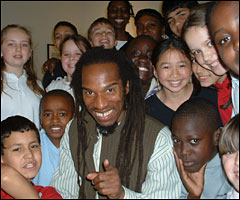
 | | I have a dream: Zephaniah and schoolkids |
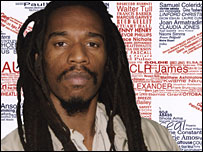
Benjamin’s Britain at Manchester Art Gallery is Zephaniah’s vision for the future: a nation where Muslims live without fear, people with facial disfigurements walk with heads held high and where everyone loves animals and punky reggae music! After talking to youngsters from Medlock Primary School about the exhibition (see picture left), he explained his dreams for a truly united UK: Zephaniah: my vision for Britain "I was asked to do the exhibition by the National Portrait Gallery and they said: look we’re giving you this space in Manchester – just do whatever you want with it. I wanted to express something to do with multiculturalism: There’s a backlash against it at the moment. And I’m not very keen on what would happen without it: we’d have monoculturalism. I really think multiculturalism is the way to go. "At the same time, I don’t’ want to create ghettos. So I’ve got my four themes: • Brit Islam
• Face Me (people with facial disfigurements)
• Animals
• Punky Reggae Party "But as you see the pictures laid out in the gallery, there are no ghettos: they are all mixed up together. This is my vision for Britain. We're not there yet but we’ve got to work towards it. I think because we’re not there yet, it doesn’t mean dismantling it and having Government dictate what Britishness is, and then people doing exams to see if they can pass a ‘Britishness test’. I think the idea of Britishness is always evolving - just like the British people." Theme 1: Brit Islam 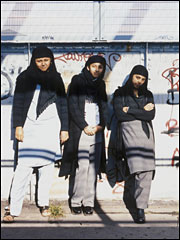 | | Untitled (photo: Manchester Art Gallery) |
"One of my favourite photographs is like three girls just leaning against a wall which is graffiti-ed. They’re no older than 20 I think and they look the complete opposite of the stereotype of the submissive Asian woman. They look like a hip-hop band – they’ve got so much attitude! "I am not a Muslim and if I sit down with Muslims, I find myself arguing with them a lot. But I will really defend their right to be. Islam is a growing religion and I think someone like Cat Stevens represents the white guy who’s really successful but gives it all up to go to Islam." What's your concern about British Muslims? "Because right now, I think Muslims are under attack. A friend of mine did a survey in two schools in Kent and when the children were asked to describe what a Muslim was, 70% used the word ‘terrorist’ in their reply. And that was really frightening. The media seem to demonise Muslims. Tony Blair seems to have ‘bad Muslims’ and his Muslims! "I think that’s a real shame because Islamic culture has such a long history. Just forget about the religion: look at the cultural side, the arts, the mathematics, the architecture.. to forget all that and concentrate on a few terrorists is just ridiculous. "I really find that the Muslim people I know around me are basically living in fear and saying one thing in public and another in private. It really worries me." Theme 2: Face Me  | | Untitled: from Changing Faces |
"A lot of the photos of people with facial disfigurements - you just look at them and these are people at work or kids playing. To me that says: they’re just like you and me. What’s the problem? But when you talk to these people they’ll tell you about discrimination, people not wanting to serve them at restaurants, sitting on a bus, people getting up and moving away from them. What’s the problem? "In society, we have all sorts of discrimination. As a black person, racial discrimination is obviously important to me, but there are other forms of discrimination that are not so sexy. I wrote a novel about what I call ‘facial discrimination’ and some of the stories are really horrific and that’s happening now." Theme 3: Animals "In this exhibition I don’t want to make too much of a statement - I just want to show some beautiful animals! There are animals that look like they’re thinking; there’s one photograph I’ve called Family Values - some sheep sitting there, like a family who have just eaten. They’re just funny really!" Is it aimed at children - they seem to like it? | "I really find that the Muslim people I know are basically living in fear and saying one thing in public and another in private. It really worries me." | | Benjamin Zephaniah |
"Not really, but then again I always think about accessibility in my writing of poetry or novels. I always want to demystify things and yes I wanted to make this accessible. "I want people to come in and read all sorts of things into it. Some people of my age will come in and say: ‘Ah I remember Aswad, that reggae band. I remember Lee Perry – who’s still doing the rounds. Earlier on, I saw a group of young Muslim girls and they were really attracted to the posters of Muslim girls. And I think it was saying something about showing them in positive light. I can see animal lovers coming in and thinking this is a statement about animal rights and things like this. "But accessibility has always been an important part of everything I do." You're a writer - why use photos? "It’s a very personal exhibition - that’s why it’s called Benjamin’s Britain. Some things I don’t think I can do very well is drawing – or painting – and photography. And I think you can say so much through those two media. So this is me shortcutting.. using other people’s photographs to express how I feel!" Black History Month: is it working? "I want to be able to do away with Black History Month. I can understand why we need it now. And we really do need it now. But I want us as a people to reach a point where we go: Hey! the history of black people is such an integral part of our education that we don’t need it anymore. We will get there, we will get there. We’re just not there yet. Black history is important to white people. White history is important to black people. Asian history is important to us all. And that’s the point I want to reach: where we know our World history and understand how inter-connected we are." |