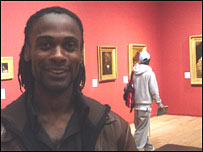
It’s what artists have always done: challenge our views through paintings, photographs and sculptures. Victorian artists were no different. When they saw black people, they wanted to capture them in paint or on film and present them to a predominantly white society. But in exhibiting images of black people in Victorian art, Manchester Art Gallery is also challenging this country's perceived Black History and the view that Victorian Britain was one colour: white. | "A lot of black people should come and see it. You think because you’re black, you know Black History until you see stuff like this. " | | Dike Omeje, poet |
It wasn’t. Long before the Empire Windrush brought a generation of black people to the UK from the West Indies, Britain already boasted black actors, footballers, acrobats, and nurses in its proud past. They’re all featured in an exhibition called Black Victorians. Coinciding with Black History Month, the exhibition has been getting some great write-ups in the national press. But what does it teach us about our Black History? We asked the poet Dike Omeje to take a look round: The Secret of England's Greatness (by Thomas Jones Barker, 1863) Description: The African ambassador presents a gift to Queen Victoria 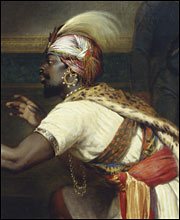 | | Secret of England's Greatness (detail) |
"It’s just the way it stands out – it’s almost 3-D. I know because I used to do some painting and know a very good painter friend of mine and it’s very hard to mix the colours to paint skin – and it’s even harder to paint black skin. But this, it’s very well done. And that’s what struck me about it. The title – I don’t know if’s there’s a bit of irony in that. But definitely the first thing that strikes me is how well crafted it is, how well painted." The Toyseller (by William Mulready 1857 -1862) Description: A white child recoils at the sight of a black pedlar in the street "What was most striking is the reaction of the child to the black toy seller. Because I was on a train about a week ago with white friend of mine and sat opposite was a white guy with his son who was about two, if that. Every time my friend looked at him and pulled faces, the kid would laugh. Every time I looked at him and did the same thing, the kid would cry! It’s just how from such an early age, a little white toddler has an aversion to the look [of a black person]." Mary Seacole (by Albert Charles Challen, 1869) Description: Portrait of the nurse who became known as the Angel of the Crimea for helping soldiers from all sides on the battlefield 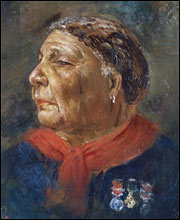 | | Mary Seacole, 1869 (detail) |
"I think it’s something that a lot of people don’t know. I didn’t know about Mary Seacole until very recently to be honest – you always hear about Florence Nightingale. But by all accounts this woman was probably more so. She has a very worn in face, she’s seen some hard times. It looks like she was obviously posing for the portrait but it looks as though it’s not her real expression. I don’t think that’s her genuine expression. But she’s got some medals on her chest though, so hard times were acknowledged." Visit to the Village School (by Thomas Faed 1852) Description: a young black manservant is unmoved as he is mocked by young boys "What I notice is that he’s unwavering – he’s almost like one of the soldiers outside Buckingham Palace. He’s not letting it get to him, he’s not really looking or making eye contact with anyone. Maybe he wasn’t allowed to. I think because the difference, visually, is greatest between black and white – different hair, different features – I think maybe that’s why there is the greatest tension between black and white." Arthur Wharton (Famous Footballers Magazine, 1895) Description: photograph of Wharton, the first black professional footballer who played for Sheffield United and Stockport County 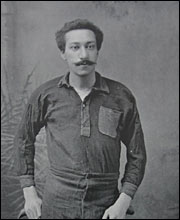 | | Arthur Wharton |
"I’m not a huge football fan but again it’s interesting to see how much of an input black people had in sport from such an early time. Uniforms are pretty interesting too, the kit – long shorts, and long sleeved shirts. And a moustache. But sport always seems to play an instrumental part in breaking down barriers. If someone excels in that sport – or entertainment in general - especially if it’s something that’s well liked then somehow people just tend to see your talent while you’re on the stage or football pitch. After that I think it returns back to their stereotypes." Hunted Slaves (by Richard Ansdell, 1861) Description: ferocious dogs corner slaves who have escaped from a plantation in the Deep South of America "At first, you look because the dogs are so close to him. It’s almost like he’s disciplining him like they’re his own dogs who have turned against him until you see the chains around his wrists. It’s very powerful and yet frightening as well. He’s like the last thing between her and the dogs." Mademoiselle LaLa (photo taken at Gaiety Theatre, Manchester 1876) 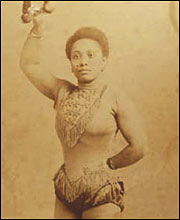 | | Mademoiselle LaLa |
Description: the only photograph of the famous Victorian acrobat known across Europe. "She’s very very short. I’m very short myself and she looks even shorter than me. And very powerful. It’s interesting to see athletes from that far back. A circus performer – she could lift a field gun with her teeth, allegedly – I wouldn’t doubt it to be honest." Conclusion: "Will it make a difference? It will make a difference if the right people come and see it. If people who are already quite open minded come and see it then you’re preaching to the converted. Hopefully, the BNP might pop down and see that when they’re talking about sending black or Asian people back home, that this country is a home that they were instrumental in helping to build. But some people are comfortable in hating so they don’t want to know anything that might change that. A lot of black people should come and see it because, myself – you think because you’re black, you know Black History until you see stuff like this. And it’s like - you don’t know half of it – and I don’t know the half of it. Apparently the first life started in Africa, so we’ve all got black roots if you like. So yeah it’s definitely it’s an exhibition that I hope people take time out to go and see." |