_____________________________________________________________________________________________________
Download a free 6 Minute English worksheet and transcript!
Try our free interactive quiz!
______________________________________________________________________________________________________


Introduction
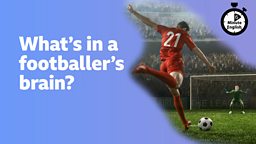
Football players are faster than ever before. But in a game where every tiny decision counts, elite clubs are turning to neuroscience to understand how players can think, decide and perform even faster. Neil and Georgie discuss this and teach you some new vocabulary.
This week's question
Which part of the brain is best known for its role in processing fear and detecting threats? Is it:
a) the brain stem
b) the amygdala
c) the cerebellum
Listen to the programme to hear the answer.
Vocabulary
(something) going on
something unknown and interesting happening
expertise
specialised knowledge or skill gained through study or experience
conscious
involving active thought or attention
driven by
influenced by or pushed forward by
all over the place
describes a situation or mental state that is disorganised, chaotic or confused
margin
a measure of difference, small details of which can affect an outcome
TRANSCRIPT
Note: This is not a word-for-word transcript.
Georgie
Hello, this is 6 Minute English from BBC Learning English. I'm Georgie.
Neil
And I'm Neil.
Georgie
Neil, I'm not a huge fan of football, but I know you are. So, why do you love it so much?
Neil
Oh, where can I start? I think it's the combination of the passion and also the skill and athleticism of the players. They call it 'the beautiful game' for a reason.
Georgie
Now, football players are faster than ever before, but the game is also about making very quick decisions.
Neil
Yes. To be the best of the best, some football clubs have started looking beyond the body, to the brain. Here's Tom Cooke, Academy Psychologist for Nottingham Forest Football Club, talking to the BBC World Service.
Tom Cooke
We're watching these athletes make decisions in split instincts, under the highest pressures and the highest intensities. It made a lot of sense to go, well, neurologically or cognitively, there's somethinggoing on.
Neil
There's something going on in the brain when the athletes are making quick decisions. If there's something going on, something unknown and interesting is happening. So, what's happening inside the brains of football players? And could brain training help win more games? That's what we'll be hearing about in this programme. And don't forget to find a free transcript at bbclearningenglish.com.


Georgie
But first, Neil. I have a quiz question for you. As we've heard, football players have to make decisions in high-pressure situations, and their performance may be influenced by their emotional state and fear response. But which part of the brain is best known for its role in processing fear and detecting threats? Is it:
a) the brain stem
b) the amygdala
c) the cerebellum
Neil
Well, I don't know, but I'm going to guess b) the amygdala because I like the sound of the word.
Georgie
OK, well I'll reveal the answer later in the programme. In 2014, a group of Japanesescientists studied the brain of Brazilian football star Neymar. They found that his brain was a lot less active than the brains of his peers when he rotated his right ankle. Here's Holly Bridge, Professor of Neuroscience at the University of Oxford talking about this research to the BBC World Service.
Holly Bridge
That reduction in activity in Neymar's cortex reflects that he has absolute expertise in moving his feet. And it's essentially done with very, very little conscious effort.
Neil
Holly said Neymar has absolute expertise in moving his feet. Expertise means a high level of skill or knowledge gained with experience. Neymar's expertise is shown without much conscious effort. Conscious describes something done with awareness, not by accident. So, if Neymar kicks the ball without much conscious effort, he plays without thinking too much.
Georgie
Decades after this research, football clubs are becoming more interested in brain data technology, even exploring whether a player's brain can be trained.
Neil
Here's Tom Cooke, Academy Psychologist for Nottingham Forest Football Club.
Tom Cooke
What we're doing is trying to design sessions but with cognition or neuroscience at the centre of it. So it could be something like they're not great at storing lots of information, so we're trying to overwhelm them, in a safe environment like training, that's where the development and improvement can happen to hopefully affect when they go out into games or cup competitions.
Neil
Training can help players deal with the pressures of the game. Here's Holly Bridge again, talking about how emotions can affect a player's game.
Holly Bridge
A lot of performance is also driven by your emotional state. And that is something you can learn to control.
Neil
How well a player performs is driven by their emotional state. Here, driven by means influenced by or pushed forward by. Holly says that too many emotions can lead to a lack of precision and focus.
Georgie
In a football match, high-pressure scenarios like penalties, corners and free kicks offer rare moments of stillness. Here's Niklas Häusler, founder and CEO of Neuro 11, talking to the BBC World Service. He measures player's brainwaves before these important kicks and teaches them how to stay relaxed.
Niklas Häusler
If you don't focus right in those moments, and let's say mentally you're all over the place, then it becomes more difficult to, to have an accurate corner and to try to win the game. And when we talk about margins, those are the little margins that can make all the difference.
Neil
If you're mentally all over the place, it's more difficult to kick the ball accurately. When we describe something as 'allover the place' we mean that it's chaotic, disorganised or confused. Niklas said that small margins can make all the difference to a game.
Georgie
Yes. A margin is a measure of difference. Here, we're talking about small details that can affect a player's performance or outcome of a match.
Neil
Now, speaking of how emotions can affect performance, I think it's time for the answer to your quiz question Georgie.
Georgie
Yes. I asked you which part of the brain is best known for its role in processing fear.
Neil
And I guessed b) the amygdala.
Georgie
Which was the correct answer! Well done. The amygdala is associated with our processing of fear and anxiety. OK, time for a vocabulary recap. If there is something going on, something interesting or important is happening.
Neil
Expertise is specialised knowledge or skill gained through study or experience.
Georgie
Conscious means involving active thought or attention.
Neil
If something is driven by something, it is influenced by it and pushed forward by it.
Georgie
All over the place describes a situation or mental state which is disorganised, chaotic or confused.
Neil
And finally, a margin is a measure of difference, small details of which can affect an outcome.
Georgie
Once again, our six minutes are up, but remember you can find a free transcript, worksheet and quiz, on our website at bbclearningenglish.com. Goodbye for now.
Neil
Goodbye!

Next
Learn more in this video from BBC World Service: 'Inside a footballer's brain'
Find an A-Z list of our programmes.
Learn more about emotions and feelings in English.
Practise your reading skills with The Reading Room.
6 Minute English dhihoo kanaa

What should you eat for a better night’s sleep?
Episode 261022 / 22 Oct 2026
How much sleep do you get each night?


Can apps teach you a language?
Episode 260910 / 10 Sep 2026
What's better for learning languages – an app or a class?

Climate change and extreme weather
Episode 260903 / 03 Sep 2026
Every year we see damage, death and destruction caused by hurricanes, cyclones and typhoons - tropical storms. Is climate change making this impact worse?


Sharing the road with driverless cars
Episode 260820 / 20 Aug 2026
Would you trust a robot to drive you around a city?

Who does the housework?
Episode 260813 / 13 Aug 2026
When you were growing up, did your mum or dad do more household chores?

How do climate scientists make predictions?
Episode 260806 / 06 Aug 2026
What is the difference between a prediction and a projection?

The Enhanced Games
Episode 260730 / 30 Jul 2026
Would you watch a sport if you knew the athletes had taken drugs?

What's in a footballer's brain?
Episode 260716 / 09 Jul 2026
How do footballers cope with high-pressure scenarios like penalties and corners?



Stress-free family meals
Episode 260625 / 25 Jun 2026
What foods did you dislike when you were growing up?

Limiting screen time for children
Episode 260618 / 18 Jun 2026
Children are spending too much time with electronic devices.

How advertisers make us spend money
Episode 260611 / 11 Jun 2026
When was the last time you bought something you didn't need?




How reading shapes your brain
Episode 260514 / 14 May 2026
Can learning to read alter the way your brain works?


Should we eat ultra-processed food?
Episode 260430 / 30 Apr 2026
Ultra-processed food can be tasty, but what is it doing to our health?





Weight loss drugs
Episode 260326 / 26 Mar 2026
How do weight loss drugs like Ozempic and Mounjaro help people lose weight?

How do we adapt to the cold?
Episode 260319 / 19 Mar 2026
Would you prefer to be too hot or too cold?


Why are some animals black and white?
Episode 260305 / 05 Mar 2026
The answer is not as black and white as you might think!





Why are billionaires building bunkers?
Episode 260129 / 29 Jan 2026
Is the end of the world closer than we thought?

Scared of speaking English?
Episode 260122 / 22 Jan 2026
Beth and Pippa talk about why we often find speaking a new language scary.

What English phrases really mean
Episode 260115 / 15 Jan 2026
Why don't British people say what they mean, or mean what they say?