Apprenticeship application process
The BBC apprenticeship application process explained, step by step
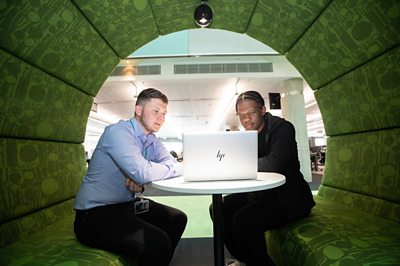
So, you’re hoping to apply for an apprenticeship at the BBC, but you’re finding the application process a little bit daunting. Let us talk you through each of our application stages, and hopefully by the end of this video things will be a lot clearer and you’ll be ready to hit submit.
Let’s start from the beginning.
So, the first thing you need to do is fill out an application form. Now, this form has two purposes. Firstly, we need to collect some info about you to make sure you’re eligible for the scheme that you’re applying for. Secondly, the form will ask you why you’re interested in the apprenticeship.
Now, it’s really important to do some research at this stage, just to make sure you’re kind of applying for the scheme that you’re most interested in for this point in your career journey. Have a look at the level of apprenticeship you’re applying for and whether that’s right for you. Also, it’s important to look at the roles people typically go into after completing the apprenticeship you’re applying for. Is this something that interests you or excites you?
For our apprenticeships, we don’t require you to upload a CV or cover letter as part of your application.
Once your application form has been seen, you will be invited to do a short interactive assessment. This will vary depending on the apprenticeship that you’ve applied for. We’re not worried about past experience; we want to hear about your strengths and your skills. You will have a chance to practise beforehand, so don’t worry about that.
Candidates who reach stage three of the application process will be invited to submit a new set of information via a digital platform. At this stage of the process, we want to know more about you — so what you like doing, what you’re good at, and what motivates and drives you. Our questions will require you to submit written responses and video responses. Don’t worry though, you’ll have the opportunity to get familiar with the platform and recording your responses, and you can actually re-record your responses as many times as you need to. Don’t worry, we’re not scoring your performance — it’s not an audition — but you might want to think about the location that you’re filming in. Remember, we’re listening to what you’re saying, so don’t worry if you’re nervous about being on camera.
At step four, you will need to complete an interview or assessment centre. These are usually held virtually, but could be in person for some of our schemes. You will also need to complete a pre-assessment task, and this will be linked to the skills you need for the apprenticeship that you’ve applied for. This is for you and us to determine whether it is the right scheme for what you hope to achieve.
There will be the opportunity to meet BBC staff and ask any questions you may have as well. One you might be thinking about at the moment is what you should wear for your assessment centre or interview, and the answer is whatever you feel confident and comfortable in. You don’t need to wear a suit unless it’s what you would normally wear, but please don’t rock up in your PJs either.
And the final step — step five — if successful, we’ll send you an offer to join us. Between then and your start date, our schemes team will be in touch with everything you need to know before your first day, and you’ll also have the opportunity to connect with fellow people in your scheme and have any questions you need to answer.
Our ambition is that the BBC is for everyone and should include everyone. We are proud to be a Level 2 Disability Confident employer and committed to removing disability-related barriers. We take inclusivity seriously and want to ensure that all candidates who have a disability or have long-term health conditions receive the support or adjustments they need.
If you require reasonable adjustments for the application process or have access needs that you’d like to let us know about, you can do so via our online contact form, which is available on our early careers website. We’ll be happy to have a conversation in confidence to discuss how we can best support you throughout the application process.
Overview
Throughout the recruitment process, we want to learn more about your skills, interests, and potential, as well as how you demonstrate the BBC's values and behaviours.
The recruitment process is tailored to each apprenticeship scheme, so the stages may vary depending on the role you've applied for. We'll provide more information when you apply and guide you through each stage of the process.
Below is an overview of what you can typically expect during the application process.
Step 1 – Online application
The first stage of the process is completing an application form. This helps us confirm your eligibility for the scheme and learn more about your motivation for applying.
Before starting your application, we recommend taking some time to research the available schemes and identify the role that best matches your interests, skills, and the stage you're at in your career journey.
For BBC apprenticeship roles, you do not need to submit a CV or cover letter as part of your application. Instead, we'll consider the information you provide within the application form itself.
Step 2 – Online exercises
If you meet the eligibility requirements for the scheme you've applied for, you'll be invited to complete an online interactive assessment. Depending on the role, this may include strength-based questions, situational judgement exercises, or job-specific assessments such as coding tasks.
We want you to feel prepared and able to perform at your best, so you'll be given the opportunity to practise before completing the assessment. This will help you familiarise yourself with the format and understand what to expect. They will take around 60 - 90 minutes to complete. Your assessment results are used to determine progression through to the next stage.
Step 3 – Video interview
At this stage, we want to learn more about you, your strengths, and your motivation for applying for an apprenticeship at the BBC.
For most schemes, you'll be asked to complete a video interview, where you'll record responses to a series of questions. Some questions may require a written response instead. We'll provide an opportunity to practise and familiarise yourself with the platform before you begin, and you'll be able to re-record your responses if needed.
Please note that some apprenticeship schemes may use alternative assessment methods and may not require a video interview.
All responses will be reviewed by members of the team and assessed against the criteria for the role.
Step 4 – Assessment centres
The final stage of the recruitment process is usually a virtual assessment centre. This is designed to give you the opportunity to showcase your skills, strengths, and potential, as well as your motivation for joining the BBC, the role, and the apprenticeship scheme.
The assessment centre typically includes a range of activities, such as a group exercise and an interview. You'll also have the chance to meet BBC colleagues and ask any questions you may have about the role, team, or organisation.
Depending on the scheme, you may be asked to complete a pre-assessment task ahead of the assessment centre, or you may be invited to attend a standalone virtual interview as part of the final stage of the process.
Step 5 – Offer
If you're successful, we'll make you an offer to join the BBC. From the moment you receive your offer through to your start date, our team will keep in touch and provide all the information you need to prepare for your first day.
You'll also have opportunities to connect with other apprentices joining the BBC, helping you build your network, get to know your future cohort, and ask any questions before you begin your apprenticeship.
Support for your application
Our ambition is for the BBC to be inclusive and provide value for all. We are committed to removing disability-related barriers throughout the recruitment process.
We take accessibility and inclusion seriously and want to ensure that candidates with disabilities, long-term health conditions, or access requirements receive the support they need to participate fully and perform at their best.
We are committed to making our recruitment process as accessible and inclusive as possible.
If you require any adjustments to help you complete your application or participate in assessments or interviews, please contact us using our support form and select 'Reasonable Adjustment' as the topic. Let us know what support you may need, and we'll be happy to discuss the options available.
There are a number of ways we can support you, including adapting our application and selection processes to ensure you can perform at your best throughout the recruitment journey.
Use of AI in the recruitment process
At the BBC, we know that tools like AI can help you prepare, organise your thoughts and feel more confident when applying for one of our Early Careers opportunities. But what we're really interested in is you.
We want to hear about your experiences, your skills, your potential and what motivates you. The strongest applications are the ones that reflect your own thinking, achievements and perspective. So, whilst you're welcome to use AI for support, we encourage you to make sure your application reflects your own voice and tells your story.
When AI can support your application:
AI tools can be helpful when used ethically and transparently. For example:
- Proofreading and grammar checks - helping ensure your application is clear and easy to understand
- Preparing for interviews or online assessment activities - using AI to practice common questions or build confidence
- Clarifying scheme and role information in the job description - asking AI to explain unfamiliar terms or requirements
- Researching careers, job titles and the industry - helping you learn more about the role, team or sector
- Organising your thoughts - helping you structure ideas before writing your own responses
These uses help you present your best self, not someone else's version of you.
When AI should not be used:
- We ask you to avoid using AI in ways that mask your true voice or misrepresent your capabilities:
- Generating responses to application questions that do not reflect your own experiences, skills or motivations
- Submitting AI-written answers during any stage of the application process
- Using AI to complete online assessments that are designed to evaluate your own skills, judgement or potential
- Using AI to impersonate your voice, image or responses in video, audio or live interviews
- Relying on AI to fabricate achievements, skills, qualifications or experiences
If we suspect that AI has been used to generate application or assessment content, it may affect how your application is assessed.
What we value most:
We're looking for people who bring curiosity, integrity and originality to their work. That starts with how you apply. Use AI to support your preparation, not to create your application for you. Let your real voice shine through, because that's who we want to get to know.
Apprenticeships explained
Everything you need to know about BBC apprenticeships.BBC apprenticeship directory
A complete guide to our apprenticeship roles (view PDF).Frequently asked questions
If you’ve still got questions about what you’ve read or how we hire, this could help.
