


A fine line
- 26 Feb 07, 12:52 PM
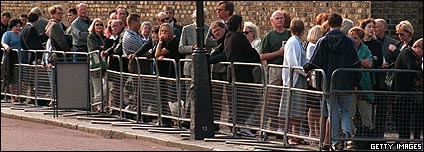
Should the NHS let waiting times grow in order to save money this year?
Certain NHS trusts have apparently decided to save cash by postponing treatments, even though this increases waiting times. (Although they only do it if they remain within the waiting time targets. You can read a bit about this in a piece by Liam Halligan in yesterday's Sunday Telegraph.)
Now this sounds like a very different question to the one discussed in the last entry which obliquely looked at whether we should have road pricing.
But in fact, the very same idea that queues are awful can be used to justify road pricing and can also be used to criticise the NHS, if the allegation that queues are re-developing is true. 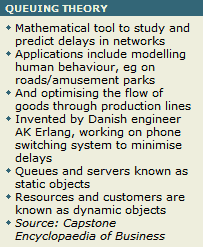
The link between road pricing and NHS waiting times is that queues are often very inefficient. And it is often incredibly cost-effective to invest in ways of preventing queues growing. Let me explain why.
There are three very simple rules about queues.
• 1. They grow longer when the number of people joining at the back of the queue exceeds the rate at which people are being dealt with at the front.
• 2. They grow shorter when the rate at which people are dealt with at the front exceeds the rate at which people join at the back.
• 3. They stay constant when the flow of new arrivals is equal to the flow of people being seen.
The rules explain a pattern you see at the ticket office at my local station. During the first hour of the morning rush, lots of people arrive at the station, and the queue grows longer and longer. The ticket seller can only handle a certain number.
Then, during the second hour, things fall into balance. The queue no longer grows. One person joins at the back at the rate that one person is dealt with at the front.
Finally, in the third hour, hardly anyone arrives to join the queue, so the queue begins to shorten. 
Now, simple as this account is, it has an important implication. During the second hour when the ticket seller is dealing with customers as fast as they are arriving and the queue is in balance, the queue is already long and stays long.
Suppose that in the first hour, the queue grows up to 20 people. (It can be a lot worse than that in my station). That means for the whole of the second hour, there are 20 people waiting. (It’s not the same people waiting for the whole hour – but 20 person-hours of waiting are wasted by people standing in the queue.)
It means that if – in the first hour – you could just employ one extra ticket seller to cope with just 20 tickets, you would ensure that no queue develops, and 20 person-hours of waiting in the second hour would be saved.
This is a simplified example, but it illustrates the potential disjuncture between costs and benefits in dealing with queues. The key is that when a system is coping in a balanced way – i.e. when the inflows and outflows of people match – it is far better that they balance with a short queue than a long one.
So, resources should be invested in those periods when the queue is growing, in order to save the waiting time not just of the people waiting in that period, but all the people who wait in the queue thereafter.
If you allow yourself a short period of imbalance in which a queue develops – for example to solve a one year deficit crisis in the NHS – you might be stuck with permanently longer waiting times as a result. All for a one-year benefit in financial results.
It's not just the NHS which might be affected by this. In many real situations, you have a growing queue in the first part of the morning, then a balanced queue for most of the rest of the day, and finally a shrinking queue at the very close of the day.
Clearly, the inflows and the outflows of the queue balance over the whole day, but the total waiting time that has been expended in getting that balance could amount to weeks and weeks of person-time.
If the average queue length for the whole day is 23 people long, the total time wasted amounts to the equivalent of 23 person-days, or one person working for a month. And that queue might easily have been avoided by one extra hour of labour first thing in the morning.
In summary, it’s very hard to get a solid intuition of the costs and benefits of reducing queue sizes. The relationship between queue length, and queue inflows and outflows appears absurdly simple, but is in fact quite complicated, with some very unpredictable effects.
Queuing theory is in fact, quite a science. It comes up in the discipline of Operations Research, which studies processes, production and organisations using maths, statistics, economics and management science. It’s a fascinating subject.
I should of course stress that some queues are efficient, in that it would cost more to eradicate them than live with them. But you don’t need a PhD to know that other queues represent an awfully bad use of customer time.
And finally one comment: in the very competitive supermarket sector, check-out queues are pretty short. A lot of effort has been expended in getting them down. That’s because in competitive businesses, your customer time matters a great deal.
The BBC is not responsible for the content of external internet sites
I'm Evan Davis, the former BBC economics editor.
I've now moved on to a new job, presenting Radio 4's Today programme. Evanomics will continue to exist in some form, as yet undecided.
Evan's categories
- (Latest entries, and comments)
- Notes on Real Life
| Are we stupid? (63) Central banks get together (32) Flat market (55) |
Small Change
 | Taboo of nationalisation (11) Chancing it (10) Shrinking economy (3) |
Vital Statistics
 | Setting prices (17) Unsustainable deficit (68) The first quarter... (20) |
Stars and strife
 | Dollar thrill (13) Prompts v causes (9) Dow vs ABX (11) |
Evan's Reading List
 | Irrationality (72) |
Archive
« January 2008
| Sun | Mon | Tue | Wed | Thu | Fri | Sat |
|---|---|---|---|---|---|---|
| 1 | 2 | 3 | 4 | 5 | ||
| 6 | 7 | 8 | 9 | 10 | 11 | 12 |
| 13 | 14 | 15 | 16 | 17 | 18 | 19 |
| 20 | 21 | 22 | 23 | 24 | 25 | 26 |
| 27 | 28 | 29 | 30 | 31 |
Evan's TV/Radio reports
- Banks' share trading probed
Broadcast: 19 Mar 2008 - Evan Davis on the economy
Broadcast: 18 Mar 2008 - Banks unite on credit crisis
Broadcast: 11 Mar 2008 - Housing slump hits flat prices
Broadcast: 29 Feb 2008 - Bank predicts soaring inflation
Broadcast: 13 Feb 2008
- The above links are to some of Evan's recent TV & Radio reports.
You will need Windows Media or Real Player to watch/listen (help).
Feeds

- News Editors
- Sport Editors
- Journalism Labs
- BBC Internet Blog
- Radio 4 Blog
- Peston's Picks
- Nick Robinson's Newslog
- Stephanomics
- Mark Easton's UK
- Mark Mardell's America
- Nick Bryant's Australia
- Andrew Harding on Africa
- Gavin Hewitt's Europe
- Soutik Biswas' India
- dot.Rory
- Science: Jonathan Amos
- Richard Black on environment
- Today: Tom Feilden
- Fergus Walsh's medical files
- Newsnight: Paul Mason
- Newsnight: Mark Urban
- Torin Douglas
- Will Gompertz's arts
- Phil Coomes on photojournalism
- Magazine Monitor
- Mark D'Arcy in Westminster
- NI: Mark Devenport
- Scotland: Brian Taylor
- Scotland: Douglas Fraser
- Wales: Betsan Powys
- Martin Rosenbaum on FOI
- 5 Live Breakfast
- Newsnight
- PM programme (iPM)
- World Tonight: Robin Lustig
