


Queuing conundrum
- 23 Feb 07, 09:15 AM
Here’s an old economist conundrum about queues.
Suppose there is a water fountain in a park. It’s a hot day and lots of people want to drink from the fountain. Being awfully British and civilised, they form an orderly queue at the fountain.
Now, if the number of thirsty people strolling past the fountain is large enough, the rate at which people join the queue will exceed the rate at which people satisfy their thirst and leave the queue. So the queue will get longer and longer.
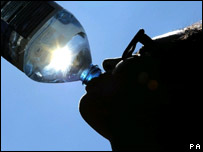 But at some point, thirsty people will reason to themselves that the displeasure of waiting in the queue is not worth the pleasure of the drink at the end. They’ll avoid the wait, and the queue will grow no longer.
So far so good. That’s how life works in many ways.
But this simple account has a devastating implication.
If there are people who are not joining the queue because it’s not worth it, then the people who do join the queue are probably barely getting any positive benefit out of their drinking fountain experience at all. They enjoy the drink, but for them, it is only just worth the wait. It’s a close run thing between bothering to drink or not.
In fact, you might as well not have a drinking fountain on the hot day, as no-one can enjoy it without paying a time penalty that more or less wipes out the benefit.
I hope I’ve explained this properly. It’s a simplified account, and it relies on all the people in the park having a similar taste for drinking and not queuing.
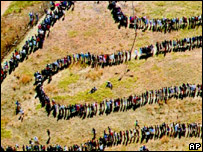 But it shows that when queuing does the rationing, it does a really bad job.
In the park, if you could get a warden to ban people from queuing, and who instead insisted that only random people could drink, (people whose surname begins with A to K for example), the fountain would give more benefit, (although that benefit would be distributed a little unfairly).
There is another alternative that’s a little more equitable. If it’s practical, you can charge people to use the fountain.
Now, those who do pay, have the benefit of drinking without queuing, but they have the cost of paying. So on balance they are better off using the fountain, but probably only just better off. As far as they’re concerned, we haven’t improved things much over the queuing situation: we’ve just changed the pain of queuing by the pain in the purse.
The difference is though, that the money they’ve handed over can be of benefit to someone else, or the population at large. There is an upside to the drinkers’ displeasure, unlike in the case where the queue does the rationing.
Or to put it another way: when you queue – I get no benefit from your pain. When you pay, I probably do.
Now that is a pretty good argument against the use of rationing by queues.
It may not be a good argument for road pricing, but it does explain why economists tend to think of the price mechanism as a better method of rationing things than congestion.
The BBC is not responsible for the content of external internet sites
I'm Evan Davis, the former BBC economics editor.
I've now moved on to a new job, presenting Radio 4's Today programme. Evanomics will continue to exist in some form, as yet undecided.
Evan's categories
- (Latest entries, and comments)
- Notes on Real Life
| Are we stupid? (63) Central banks get together (32) Flat market (55) |
Small Change
 | Taboo of nationalisation (11) Chancing it (10) Shrinking economy (3) |
Vital Statistics
 | Setting prices (17) Unsustainable deficit (68) The first quarter... (20) |
Stars and strife
 | Dollar thrill (13) Prompts v causes (9) Dow vs ABX (11) |
Evan's Reading List
 | Irrationality (72) |
Archive
« January 2008
| Sun | Mon | Tue | Wed | Thu | Fri | Sat |
|---|---|---|---|---|---|---|
| 1 | 2 | 3 | 4 | 5 | ||
| 6 | 7 | 8 | 9 | 10 | 11 | 12 |
| 13 | 14 | 15 | 16 | 17 | 18 | 19 |
| 20 | 21 | 22 | 23 | 24 | 25 | 26 |
| 27 | 28 | 29 | 30 | 31 |
Evan's TV/Radio reports
- Banks' share trading probed
Broadcast: 19 Mar 2008 - Evan Davis on the economy
Broadcast: 18 Mar 2008 - Banks unite on credit crisis
Broadcast: 11 Mar 2008 - Housing slump hits flat prices
Broadcast: 29 Feb 2008 - Bank predicts soaring inflation
Broadcast: 13 Feb 2008
- The above links are to some of Evan's recent TV & Radio reports.
You will need Windows Media or Real Player to watch/listen (help).
Feeds

- News Editors
- Sport Editors
- Journalism Labs
- BBC Internet Blog
- Radio 4 Blog
- Peston's Picks
- Nick Robinson's Newslog
- Stephanomics
- Mark Easton's UK
- Mark Mardell's America
- Nick Bryant's Australia
- Andrew Harding on Africa
- Gavin Hewitt's Europe
- Soutik Biswas' India
- dot.Rory
- Science: Jonathan Amos
- Richard Black on environment
- Today: Tom Feilden
- Fergus Walsh's medical files
- Newsnight: Paul Mason
- Newsnight: Mark Urban
- Torin Douglas
- Will Gompertz's arts
- Phil Coomes on photojournalism
- Magazine Monitor
- Mark D'Arcy in Westminster
- NI: Mark Devenport
- Scotland: Brian Taylor
- Scotland: Douglas Fraser
- Wales: Betsan Powys
- Martin Rosenbaum on FOI
- 5 Live Breakfast
- Newsnight
- PM programme (iPM)
- World Tonight: Robin Lustig
