


Looking after the aged
- 28 Feb 07, 09:23 AM
The Alzheimer’s Society is clearly on to something. But it's a far more general problem than Alzheimer’s.
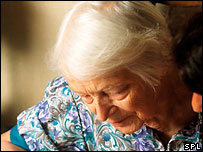 In fact, it is arguably the big, unresolved issue of our time.
We have a number of periods in our lives when we are not productive - and require the support of someone else to look after us.
Alzheimer’s is one extreme case of such a condition, but there are far more obvious ones, from the period we are children, or college students, to those where we are too old or sick to work.
Indeed, if - quite plausibly - you are born at age zero, start work after university at 21, retire at 67, and live to 92, you will only have spent half your life at work.
As it happens, of the current total UK population, only 48% are out earning. Most of the rest are either young, old, sick, pretending to be sick, or caring for any the above.
Now, however you cut it, somehow we have to channel resources from the half of the population who are working, to the other half who are not. Or, to put it slightly differently, we have to channel resources from the half of your life when you work, to the half when you don't.
Now the traditional way of doing it is via the family. Mum or dad works and pays for one or two other dependants. Of course, you have to have a family - it's a bit hit and miss for everyone else.
But the main problem is that while it's fulfilling to bring up dependent children, it seems far less satisfying to look after aged parents. My evidence for that is that couples will go to a lot of trouble to adopt children, but there is no equivalent market for adopting grandparents.
And when you examine the other ways of looking after the aged, outside the family, the sad news is that none of them are as painless as handing over the needy to the NHS or the council, because someone has to pay for the NHS or the council.
In the end, we always come back to the same old painful choices: taxes, (which we grumble about); charity (which we love, but which doesn't raise enough cash), or insurance (which we generally call an outrageous privatisation of the welfare state).
We can tamper with these options, yet the basic grumble is the same - in each case, the people out of work end up getting some support, but the people in work end up losing part of their money.
The only other well-developed idea for paying for aged care is to use the housing wealth of those who that have it, to pay for their care. (After all, it doesn't seem unreasonable to say that if I can't be bothered to look after granny, I shouldn't expect to inherit her house.)
But that option hasn't been proved popular either.
So aged care remains an unresolved issue. We haven't voted for any of the obvious choices, but we seem to be voting with our feet against each of them. That's why pensions have been a headache, and why long term care is under funded, and why Alzheimer’s is a growing problem.
Short of employing young children to look after aged parents, any new ideas would be welcome.
The BBC is not responsible for the content of external internet sites
I'm Evan Davis, the former BBC economics editor.
I've now moved on to a new job, presenting Radio 4's Today programme. Evanomics will continue to exist in some form, as yet undecided.
Evan's categories
- (Latest entries, and comments)
- Notes on Real Life
| Are we stupid? (63) Central banks get together (32) Flat market (55) |
Small Change
 | Taboo of nationalisation (11) Chancing it (10) Shrinking economy (3) |
Vital Statistics
 | Setting prices (17) Unsustainable deficit (68) The first quarter... (20) |
Stars and strife
 | Dollar thrill (13) Prompts v causes (9) Dow vs ABX (11) |
Evan's Reading List
 | Irrationality (72) |
Archive
« January 2008
| Sun | Mon | Tue | Wed | Thu | Fri | Sat |
|---|---|---|---|---|---|---|
| 1 | 2 | 3 | 4 | 5 | ||
| 6 | 7 | 8 | 9 | 10 | 11 | 12 |
| 13 | 14 | 15 | 16 | 17 | 18 | 19 |
| 20 | 21 | 22 | 23 | 24 | 25 | 26 |
| 27 | 28 | 29 | 30 | 31 |
Evan's TV/Radio reports
- Banks' share trading probed
Broadcast: 19 Mar 2008 - Evan Davis on the economy
Broadcast: 18 Mar 2008 - Banks unite on credit crisis
Broadcast: 11 Mar 2008 - Housing slump hits flat prices
Broadcast: 29 Feb 2008 - Bank predicts soaring inflation
Broadcast: 13 Feb 2008
- The above links are to some of Evan's recent TV & Radio reports.
You will need Windows Media or Real Player to watch/listen (help).
Feeds

- News Editors
- Sport Editors
- Journalism Labs
- BBC Internet Blog
- Radio 4 Blog
- Peston's Picks
- Nick Robinson's Newslog
- Stephanomics
- Mark Easton's UK
- Mark Mardell's America
- Nick Bryant's Australia
- Andrew Harding on Africa
- Gavin Hewitt's Europe
- Soutik Biswas' India
- dot.Rory
- Science: Jonathan Amos
- Richard Black on environment
- Today: Tom Feilden
- Fergus Walsh's medical files
- Newsnight: Paul Mason
- Newsnight: Mark Urban
- Torin Douglas
- Will Gompertz's arts
- Phil Coomes on photojournalism
- Magazine Monitor
- Mark D'Arcy in Westminster
- NI: Mark Devenport
- Scotland: Brian Taylor
- Scotland: Douglas Fraser
- Wales: Betsan Powys
- Martin Rosenbaum on FOI
- 5 Live Breakfast
- Newsnight
- PM programme (iPM)
- World Tonight: Robin Lustig
