Briefly, it looked as though questions about Gordon Brown's leadership had been put on hold. Not any more.
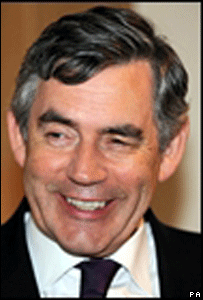 The former Home Secretary Charles Clarke has written an article for this week's New Statesman which will re-open them. Labour, he writes, is "destined to disaster" and "utter destruction at the next general election" unless it changes course.
His article denies that there is any "Blairite plot" against Gordon Brown before adding, menacingly, that "There is, however, a deep and widely shared concern which does not derive from ideology - that Labour is destined to disaster if we go on as we are, combined with a determination that we will not permit that to happen." What could he mean by that? He doesn't say.
Here's my guess. Mr Clarke knows that there is a sizeable section of the Labour Party who have concluded that Gordon Brown cannot recover and that their party is heading for defeat at the next election. He will also know that many of that group have also concluded that removing their leader could be even more damaging than letting him stay in post. His message to them appears to be "some of us won't keep quiet whilst the ship heads for the rocks".
It is, of course, not news that Mr Clarke is not Mr Brown's biggest fan. However, he has once again said in public and his usual eye wateringly blunt way what many are saying in private.
Are ministers being blackmailed?
Yes, according to the Lib Dem leader Nick Clegg. He says it's the energy companies who are doing it.
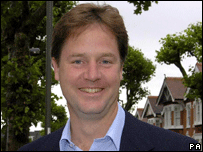 He claims that the message coming from the companies to ministers, who are asking them to fund more help for people struggling to pay their fuel bills is - in effect - if you force us to cough up for that we won't invest in the new nuclear power stations and renewable energy sources that you need to meet your climate change targets.
An announcement on a new energy package which was, at one stage, slated for this week is now not due till next. Negotiations are, I'm told, still ongoing.
Ministers are not ready to adopt the idea of a windfall tax which is so popular amongst Labour MP's and activists for fear of further undermining business confidence in the government. Publicly, they refuse to rule it out hoping that the threat of it will focus the minds of the industry.
The idea of auctioning off the remaining carbon trading permits is complex and would require European Commission agreement.
So, for now, ministers need the industry to cough up voluntarilty and, what's more, they are reliant on the companies to deliver their goals for them. It will be the energy companies themselves that offer a better "social tariff" (cheaper energy for the poor) to more customers. It will be them too, along with government, who will have to promote energy efficiency measures to cut household bills. My Whitehall sources claim that the delay is precisely because ministers are ensuring they're not blackmailed and that the companies do not simply pass on the cost of helping the poor other customers.
After a lukewarm reaction to his housing plans Gordon Brown will want to be sure that his energy plans are not greeted in the same way.