Use of Form in Twelfth Night
Twelfth Night is a Shakespearean comedy that blends romance, disguise and playful confusion to explore the unpredictable nature of love. Instead of relying on everyday humour, Shakespeare uses mistaken identity, When the audience knows something that the characters don’t. and exaggerated situations to show how desire can be irrational and transformative. The play shifts between three contrasting worlds: Orsino’s court, Olivia’s household and the chaotic realm of Sir Toby and the servants. Each setting highlights different aspects of love, identity and ambition.
Although the play is light-hearted, Shakespeare includes moments of tension and cruelty. Viola is shipwrecked and believes her brother is dead, while Malvolio’s humiliation in the dark room borders on tragic. These darker moments never lead to disaster; instead, they emphasise how unstable emotions can be and how quickly love can change. Viola’s disguise as Cesario creates confusion and conflict, but ultimately leads the characters toward recognition and reconciliation.
The play also follows the tradition of a genre of drama characterized by a, turning upside down of social hierarchy, gender roles, and conventions. It is closely tied to holiday celebrations., which celebrates misrule, disguise and the temporary overturning of social order. Illyria becomes a space where normal rules are suspended, allowing characters to explore desires that would be restricted in a stricter society. By the end, the multiple marriages signal a return to harmony and stability.
The subplot involving Malvolio, tricked by a forged letter, mirrors the main plot’s romantic misunderstandings and parodies more serious dramatic conventions. Through its intertwined plots and final restoration of order, Twelfth Night shows how comedy can explore serious ideas while celebrating joy, transformation and renewal.
Use of structure in Twelfth Night
Structure refers to how Shakespeare organises events and presents them to the audience. In Twelfth Night, the structure moves from confusion and disguise toward recognition and harmony. Shakespeare shifts the action between different households in Illyria – Orsino’s court, Olivia’s home, and the chaotic world of Sir Toby and the servants. Although the play follows a mostly Chronological means following the time order in which events happened. Stories told chronologically start with the earliest event and end with the last. order, the use of disguise and mistaken identity creates uncertainty, as characters (and the audience!) struggle to see the truth clearly.
The play begins as Viola is shipwrecked, separated from her brother, and forced to disguise herself as Cesario. This moment triggers the rest of the plot. Viola’s disguise leads to a chain of misunderstandings, especially when she becomes caught in a love triangle between Orsino and Olivia. This early confusion introduces the theme of mistaken identity and prepares the audience for the confusion ahead.
As the play develops, Shakespeare presents several storylines running in parallel. The first is the romantic confusion involving Viola, Orsino and Olivia. The second is the comic subplot involving Sir Toby, Sir Andrew, Maria and Feste. The third focuses on Malvolio, whose self‑importance makes him fall for the forged letter, which ultimately humiliates him. These plots overlap, showing how easily people can misread signs of love or favour.
The central section is dominated by increasing confusion, intensified by Sebastian’s arrival. The final acts restore order: identities are revealed, couples are united, and harmony returns. The play ends with clarity, celebration and marriage, typical of Shakespearean comedy.
Language features in Twelfth Night
Imagery
Imagery is language that creates pictures in the audience’s mind. It appeals to the senses (sight, sound, touch, taste, smell). Shakespeare uses several types of imagery in Twelfth Night, some of which are considered below along with their effects.
Love is a major theme in Twelfth Night, so Shakespeare uses music imagery to show how powerful and overwhelming it can be. Orsino opens the play with “If music be the food of love, play on,” comparing love to something people crave. Songs like Feste’s “O mistress mine” also reflect the uncertainty and longing love creates. The effect of this imagery is to make love seem emotional and sometimes confusing, and – like music changing mood – it shows how unpredictable love is in the play.
Shakespeare uses imagery of disguise and appearance to show how confusing and unreliable Illyria can be. Viola’s choice to dress as Cesario creates immediate uncertainty, captured in her line “I am not what I am.” Olivia is also misled when she falls for Cesario’s appearance rather than Viola’s true identity. The effect of this imagery is to highlight how easily characters are deceived by looks, making love and identity tangled and unstable.
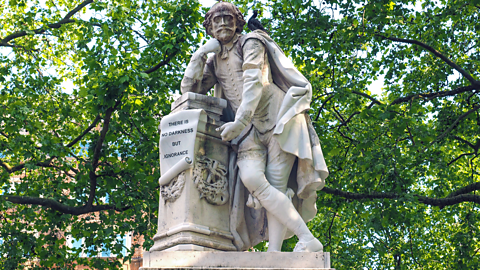
Shakespeare uses dark and light imagery in Twelfth Night to show the secrecy and confusion that run through the play. Much of the action happens in hidden or private spaces where characters deceive one another, creating a sense of emotional “darkness.” This is especially clear when Malvolio is tricked: he is literally shut away in a dark room, while Feste pretends to be Sir Topas and tells him he is in “no darkness but ignorance.” The effect of the darkness in this scene is to symbolise confusion, cruelty and the loss of certainty. In contrast, moments of truth or realisation are linked to light, such as Olivia’s belief that love enters “through the eyes,” connecting sight with clarity. The effect of this contrast is to show how characters move between misunderstanding and understanding.
Other linguistic devices
A metaphor is a word or a phrase used for dramatic effect, to describe something as if it were something else.
“If music be the food of love, play on.” The effect of this is to show how emotional Orsino is and how love, like food, can be something crave and perhaps overindulge in.
Simile
“She sat like Patience on a monument, / Smiling at grief.” The effect of this A simile is a word or phrase used to make a comparison for dramatic effect, using 'like' or 'as'. is to explain Viola’s feeling of being trapped and unable to express her true feelings.
Hyperbole
“So full of shapes is fancy / That it alone is high fantastical.” The effect of this Over-the-top exaggeration for effect. statement is to show how dramatic and self-indulgent Orsino is in his reaction to unrequited love.
Comic language and word play
Shakespeare uses comic language and wordplay throughout Twelfth Night to create humour, show character relationships and highlight the confusion that drives the plot. Much of the comedy comes from characters twisting meanings, misunderstanding each other, or deliberately playing with words to tease and entertain.
An example is the banter between Sir Toby and Sir Andrew. Sir Toby often mocks Sir Andrew without him realising, such as when he calls him a “foolish knight” while pretending it is a compliment. Their conversations are full of A play on words, relying on similar sounding words or two meanings of one word., misunderstandings, and exaggerated language, which makes their scenes lively and chaotic.
The effect of this type of language is to cause confusion, contrast with the serious aspects of the play but ultimately, to create humour.
Prose and verse
Shakespeare wrote his plays in both Ordinary language both spoken or written; different from poetry (which does not reflect everyday speech patterns). and verse, using each form for a particular reason. Most of Shakespeare’s plays are written in verse and prose is used strategically.
Use of verse
One ‘iamb’ is a two-beat combination: an unstressed syllable followed by a stressed (emphasised) syllable, making a ‘da-DUM’ pattern, like a heartbeat. Pentameter means five of these two-beat units per line, making ten syllables altogether is unrhymed Lines in a poem that don't rhyme, usually in iambic pentameter - five two-syllable feet per line.. There are ten syllables (or beats) in each line following a pattern of unstressed and stressed syllables (da‑DUM) repeated five times. The effect of iambic pentameter is it reflects natural speech but it also give a sense of authority and elevation to the words; hence it is used appropriately by the nobility in the play.
In Twelfth Night, iambic pentameter is often used when characters speak seriously about love or identity. For example, Orsino opens the play with the rhythmic line “If music be the food of love, play on” (Act 1, Scene 1).
The effect is that the language feels musical and romantic, matching Orsino’s emotional mood. It also contrasts with the prose used by comic characters like Sir Toby, helping the audience distinguish between serious emotion and comic disorder.
Rhyming couplets
Rhyming couplets are two lines which rhyme. They are typically used by Shakespeare to indicate the end of a speech or scene giving it a sense of completion.
Away before me to sweet beds of flowers;
Love-thoughts lie rich when canopied with bowers.
The effect of this In poetry, a pair of lines that rhyme and have the same length and metric pattern. is that the rhyme of flowers / bowers creates a soft, musical ending to the scene, matching Orsino’s dreamy, romantic mood. It also gives his speech a sense of closure and poetic elegance, emphasising how idealised and exaggerated his view of love is. This couplet is a great example of how Shakespeare uses rhyme to highlight emotional moments and signal the end of a scene.
Use of prose
Shakespeare used prose to indicate a lower-class character, to demonstrate emotional instability and for letters. Characters like Sir Toby, Sir Andrew, Maria, and Feste often speak in prose. This makes their scenes feel lively, chaotic, and humorous. For example, Sir Toby’s drunken banter in Act 1, Scene 3 is in prose, helping to highlight his disorderly behaviour.
What a plague means my niece to take the death
of her brother thus? I am sure care’s an enemy to life.
This prose is loose, rambling, and informal, and the effect of it is to immediately signals Sir Toby’s drunken, carefree attitude.
Another effect of Shakespeare’s use of prose in the lower-class characters is to signal a clear contrast with the nobility.
Dramatic techniques
Remember that plays are written to be performed; therefore you should use the term ‘audience’ and not ‘reader’.
Setting
Illyria, the setting of Twelfth Night, is a mysterious, coastal place where normal rules don’t seem to apply. When Viola arrives after the shipwreck, she asks “What country, friends, is this?” (Act 1, Scene 2), showing how strange and unfamiliar the world feels. This effect of this setting allows characters to change identity, fall in love suddenly, and make mistakes without serious consequences. Olivia’s household also becomes a chaotic space, highlighted when Malvolio demands, “My masters, are you mad?” (Act 2, Scene 3). Overall, Illyria creates an atmosphere of confusion, comedy, and transformation that drives the play’s events.
Dramatic irony
Dramatic irony is a technique where the audience knows something important that the characters on stage do not. This creates tension, humour or a sense of inevitability because the audience can see the truth while the characters remain unaware.
The audience knows that Viola is really a woman disguised as Cesario, but the other characters do not. This means we understand the true meaning behind her words even when the surrounding characters are confused.
A clear example is when Viola says, “I am not what I am” (Act 3, Scene 1). Olivia thinks Cesario is simply being mysterious, but the audience knows Viola is hinting at her real identity. The effect is that the audience feel sympathy for Viola’s difficult situation and enjoy the humour created by the misunderstandings her disguise causes.
Soliloquy
A A speech performed by a character, often depicting that person thinking or talking aloud to his or herself. is a speech delivered by a character alone on stage. It reveals their true thoughts, motives and feelings directly to the audience. As no other character can hear these words, this creates dramatic irony – the audience are privy to information which the other characters are not.
Shakespeare uses soliloquies to create sympathy, tension and humour.
An example is from Viola in Act 1, Scene 4, when she admits:
“Whoe’er I woo, myself would be his wife.”
Here, she reveals her secret love for Orsino while still disguised as Cesario. The effect is that the audience feels closer to Viola and understands the emotional difficulty of her situation, which increases both the comedy and the pathos of the play.
Test your knowledge of the language in Twelfth Night
Further study
The study of Shakespeare, controlled assessment guidance. activity
Unit 3 of the CCEA GCSE English Literature qualification is a controlled assessment unit based on the study of a play by William Shakespeare.
In Our Time - Twelfth Night, or What You Will. audio
Melvyn Bragg and guests discuss one of the great comedies of world literature.
Opening Lines - Twelfth Night audio
John Yorke explores one of Shakespeare's best loved comedies, Twelfth Night
Twelfth Night performed
Drama on 4. audio
A 400th anniversary production of Shakespeare's wonderful comedy of mistaken identities and unrequited love, starring Toby Jones as Malvolio and Giles Terera as Orsino.
KS3 English Literature. revision-guide
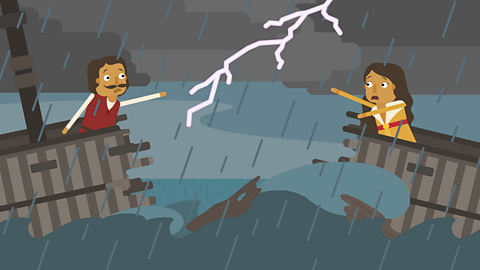
An animated version of William Shakespeare’s Twelfth Night in a retelling of the classic play set to modern music.
CBeebies Twelfth Night at Shakespeare's Globe. video
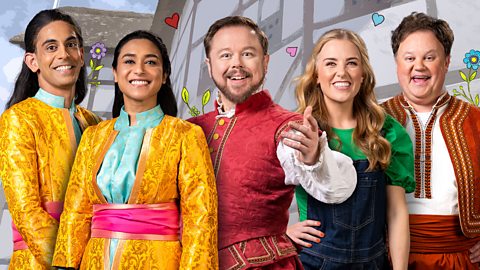
A host of CBeebies stars and actors take to the world’s most famous stage to perform William Shakespeare’s Twelfth Night.
More on Twelfth Night
Find out more by working through a topic
- count1 of 5
- count2 of 5
- count3 of 5
- count4 of 5