Overview of setting in Yellow Moon
Yellow Moon is set in two very different parts of Scotland:
- Scenes 1 to 7 are set in urban setting of Inverkeithing in Fife.
- Scenes 8 to 20 are set in and around the fictional Blackwaterside House, near Kinlochewe in the rural Highlands.
The changing setting reflects the emotional and psychological journey of the characters and reflects some of the themes of the play.
Location
The play is set in, or near, real locations in Scotland. Inverkeithing and Kinlochewe are real towns. This choice connects to the theme of fantasy vs reality that is seen throughout the play. The violent and frightening events, the stuff of ballads, are happening in real towns.
Urban Inverkeithing
At the beginning of the play, the action takes place in the town of Inverkeithing in Fife.
This urban environment features locations that would be familiar to young people living in small towns across Scotland: a block of flats and all-night superstore.
The urban settings are domestic and familiar but trouble is present from the very beginning. Lee’s home life is unstable, while Leila feels trapped by expectations and her own negative self-image.
The town therefore represents these restrictions, and they both have a desire to escape.
The scene of Lee and Billy's confrontation, the cemetery, is both realistic and symbolic. It is a quiet, secret place for underage drinking, but it also clearly signals death and mortality.
Rural Highlands
Lee and Leila travel north to the Highlands after Billy's violent death, ("This is the part of the story where Leila and Lee go on the run to the Highlands and nearly die."). Lee has a single postcard, apparently sent from his dad to his mum, from which he has romanticised this whole journey, person and place: ("It's a postcard of the Highlands. Mountains. Forest. Loch. In the middle of the picture - a house.")
The landscape is presented as completely unfamiliar, with forests, caves and moorland. This new environment allows Leila and Lee to step away from their urban lives and reflect on who they are.
The rural setting presents the pair with primal challenges - surviving the cold and snow, facing the danger of fire. They learn new skills and prove more resilient and resourceful that they might have expected. Although the conditions are hard, Leila, Lee and Frank find a routine and way of living together that is far removed from their previous lives::
They had almost forgotten everything about that other world." (Scene 12)
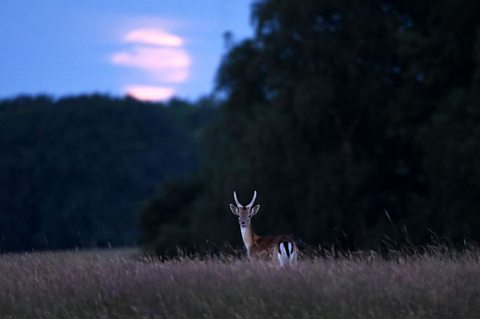
The natural, rural setting is closely linked to key symbols in the play, such as stags and deer and the moon. Stags are a symbol of Lee's identity throughout the play, as well as his relationship with his father. The presence of nature also strips away the distractions of their own home lives, forcing Lee and Leila to confront reality.
However, the Highlands do not bring the escape or fatherly reunion that that Lee imagines. The Blackwaterside Estate, which he associates with wealth and success, brings hardship and disappointment. This contrast highlights the gap between fantasy and reality. The stories Lee has told himself about this place and about his father, all from the postcard, are not true. ("My dad's not dead, is he? Scene 16)
By the end of the play, the rural setting has become a place of truth and consequence. The cave, where Leila and Lee find Frank’s dead body, symbolises confrontation and acceptance.
The journey through different locations mirrors Leila and Lee’s emotional development, moving from harsh reality, through escape and illusion towards understanding and responsibility. It also brings them together, as by the end of the play they are united, rather than fleeing two different situations.
Timeline
The play takes place over a relatively short period of time. Scenes 1 to 7 take place in one night, during which Lee and Leila meet, Billy is killed and the two young people escape.
The brief timescale contributes to the sense of sudden, impulsive teenage behaviour.
There is a noticeable passage of time during Lee and Leila's stay in the Highlands. It is mentioned at the start of Scene 12 that they live and work there for three months. This compressed but intense timescale allows the play to explore:
The consequences of violence and impulsive decisions - they have to flee fast, and even though they find some sanctuary on the estate, the three months they live there are not described in detail. This allows the pace of the story to continue and doesn't take the audience out of the journey.
The development of Lee and Leila’s relationship, which increases intensely and ends with them in complete support of each other.
Their gradual emotional growth and self-awareness.
The movement through time, combined with the changing locations, helps to show how quickly lives can change and how experiences shape identity.
Information and support
If you, or someone you know, have been affected by the issues in this article, the following page contains a list of organisations and information for young people that may be helpful: Information and Support: Bitesize
More on Yellow Moon by David Greig
Find out more by working through a topic
- count6 of 7

- count7 of 7

- count1 of 7

- count2 of 7