Overview of style and technique in Yellow Moon
Yellow Moon is influenced by A traditional form of narrative poem or song. A ballad tells a story about dramatic events including war, love, betrayal, long journeys and even magical events. A ballad normally features repetition, regular rhyme scheme and rhythm. Ballads were traditionally written to be sung or read aloud., which often focus on a dramatic event or legend. The subtitle, ‘The Ballad of Leila and Lee’, highlights that the play is not purely realistic.
Originally designed to be performed in schools with minimal staging, the play relies on the audience’s imagination. The focus is on storytelling and the inner lives of the characters. David Greig’s approach involves:
- Structure
- Narrative voice
- Language
- Symbolism
- Staging and stagecraft
Structure
The play is made up of twenty short scenes. The scenes move quickly between locations and moments, creating a fast-paced and engaging narrative. The structure is influenced by the A traditional form of narrative poem or song. A ballad tells a story about dramatic events including war, love, betrayal, long journeys and even magical events. A ballad normally features repetition, regular rhyme scheme and rhythm. Ballads were traditionally written to be sung or read aloud. form:
The story is told in episodes, similar to separate verses in a ballad.
Events are sometimes retold or shown from different perspectives.
The focus is on storytelling rather than strict realism.
The early scenes in Inverkeithing are fast and chaotic. Later scenes in the Highlands, although compressed at points, are typically slower and more reflective. This shift in pace mirrors the emotional journey of the two main characters, Leila and Lee.
Narrative voice
Yellow Moon uses different The perspective the story is told from: the voice the reader ‘hears’ in the writing., traditional dialogue and the inner thoughts of the characters to tell the story. This creates a distinctive storytelling style.
Throughout the play, the voice of an All-knowing; a narrator who knows everything. narrator introduces characters and describes events: (eg. “This is the part of the story where Leila and Lee go on the run to the Highlands and nearly die.” (Scene 8)) This is similar to the omniscient voice that frames the events in a ballad.
This technique helps to move the story forward quickly, and gives important background information. In Scene 12, it is the omniscient narrator who notes that Leila and Lee "work on the estate for three months", allowing this time to be compressed rather than describing it in detail to the audience.
The narrative voice also describes the characters’ emotions: (eg. “In her heart at this moment there is a feeling she’s only ever had twice before … A feeling like someone opening a door.” (Scene 4)). This allows the audience to understand emotions that are not spoken aloud.
The narrative voice switches between first, second and third person, allowing the audience to see events from different perspectives. It is not always clear whose narrative voice is speaking. This encourages us to question what is true, to think about whose voice is being heard and to consider how our understanding of the characters might change if we heard different perspectives.
One of the most important techniques is the use of As if we are hearing characters’ thoughts.. This is particularly significant for Leila, who rarely speaks in conversation. Through her thoughts, the audience gains insight into her low self-worth and her developing feelings for Lee. The character tells Lee "I don't speak because most people aren't worth speaking to" in Scene eight, but it's revealed that she doesn't actually reply to him:
"Of course she didn't really say that. She didn't really say any of that." (scene 8)
The same technique is used in Scene 17, with Frank's internal monologue outlining his past, and his conflicted feelings about Lee, while he is unable to express any of this out loud to his son.
Language
Yellow Moon uses a mixture of everyday speech and more descriptive, sometimes lyrical language. The characters speak in a natural, realistic way, while the narration and inner monologues are often more expressive. This helps to show the difference between the characters’ outward lives and their inner thoughts and emotions, and highlights the contrast between reality and imagination.
Everyday language makes the characters feel believable, particularly Lee, Frank and Billy. Their use of informal speech and swearing reflects their background and adds authenticity to their voices. It also highlights themes such as masculinity and aggression, especially in Billy’s harsh, abusive language.
- "Look at yourself. You're a disgrace. Take that stupid hat off. Come here. Come here. I don't care about you or about your worthless life but your mother does and I love your mother." (Billy, scene 1)
- "You think you're hard, Macalinden, but you're all front. You wouldn't last two minutes with me. Two minutes with me and I'd have you wetting your pants. Get up." (Billy, scene 5)
- "Dan. That's my dad's name. Blackwaterside. That's where we're going. Blackwaterside. Nr. Kinclochewe. Nr. means near." (Lee, Scene 8)
The narration and inner monologues allow for more detailed and expressive language. Leila’s sections are often the most poetic. As she rarely speaks in dialogue, her thoughts are expressed through more descriptive and image-based language. This allows the audience to understand her emotions more deeply. For example, “two bodies / two breaths / two flames in a world of flames” uses repetition and imagery to convey both intimacy and intensity. This poetic style highlights the contrast between her controlled exterior and her emotional depth. It also hints at the possible future Leila sees for herself. Her gift for language suggests that she possibly could become a writer, telling her version of the story.
Ballad influence
Yellow Moon is influenced by traditional ballads, particularly the 'Stagger Lee' folk song. This influence can be seen in the way the play is written and how the story is told. Short, direct lines help to build pace and tension, echoing the rhyme and rhythm of music and oral storytelling:
“Night’s black, too cold to sleep /Leila thinks she’s in too deep/As you sow so shall you reap.” (Scene 8)
Where a word, phrase or idea is repeated for emphasis., a common feature of ballads, is also found throughout the play. Repeated phrases such as “I’m here” and “I’m not scared” show what the characters are thinking or what they are trying to convince themselves is true. Ballads are narratives which tell a story, often from the perspective of an anonymous narrator. Much of the story in Yellow Moon is presented from the perspective of an unidentified narrative voice.
The ballad style links to the idea that the characters see their lives as a kind of story or legend. However, unlike traditional ballads, Yellow Moon shows that real life is more complicated and that actions have real consequences.
Symbolism
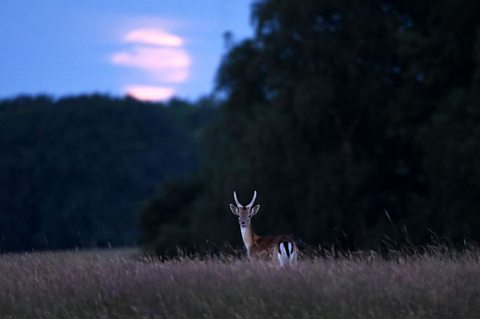
Stags and deer
Images of stags and deer are seen throughout the play. They act as a powerful symbol linked to:
Identity and masculinity (for Lee)
The connection between Lee and his father
Conflict between Lee and Billy.
Leila’s journey
The contrast between stories and reality
The nickname 'Stag Lee' comes from the hat that Lee has worn throughout his life. It is central to his sense of identity and symbolises his sense of pride and masculinity. The fight between Billy and Lee is foreshadowed in the detail that Billy meets Jenni Macalinden at the Volunteer Arms when he "came in with a stag party". Their clash, over Lee's hat with the stag emblem, leads to Billy's violent death and Lee and Leila fleeing.
When Lee fantasises about becoming a "pimp" he connects this to the symbolism of stags and deer:
A pimp has to have ho's but I would have does, as in doe a deer. Because I'm Stag Lee." (Scene 5).
The stag also represents Lee’s connection to his father. When Frank meets Leila and Lee, he is stalking for deer. The graphic descriptions of the deer killing in Scene 9, and then Frank handing Leila the heart of the deer ("I held the beast's heart still warm") provides a gritty, gruesome image of nature and death that is very different from the stag symbol.
This scene also foreshadows the end of the play. After Frank's death, Leila and Lee open up his body, just as he did with the deer, removing and burying his heart.
Lee eventually sees Frank’s stag tattoo, and realises he is his father, seeing it as evidence of their bond. This shared symbol has helped Lee to build a story about who he is and where he comes from. However, Frank disagrees with Lee’s way of thinking:
…I'm thinking why did the sky have to go and be red and beautiful as if this was a story, it’s not a story…” (Scene 17)
This shows the contrast between fantasy and the harsh reality. While Lee sees symbols like the stag as meaningful, Frank – whose job involves killing the deer – sees things more realistically.
Deer imagery is also linked to Leila and her transformation. Before she runs away with Lee, she sees a roe deer on the beach:
Deer and girl, eyes locked for a second, two worlds trembling…” (Scene 6)
The deer represents instinct and escape. It marks a turning point as Leila moves from her controlled life into the unknown.
In the Highlands section of the play, deer are shown in a much harsher way. The dead deer in the cave and the deer heads in the Blackwaterside house contrast with the magical image on the beach. This highlights the difference between romantic ideas of escape and real life. Lee, who ends up on the run, is also hunted down much like a deer. This is particularly evident in Scene 18 when he is running down the mountainside pursued by Holly and Leila in a Land-Rover.
Yellow moon
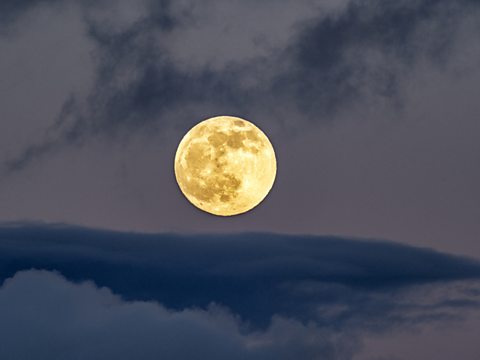
The yellow moon is an important symbol that carries different meanings throughout the play. A July full moon is often more yellow or orange in appearance. It is sometimes called a Stag (or Buck) Moon as it occurs around the time a stag loses his antlers.
For Leila, the yellow moon reflects how she sees Lee and their lives in the Highlands:
Yellow moon made Lee’s face seem cast in gold … Yellow moon makes a glint of gold in Lee’s eyes.” (Scene 10)
The repetition of “gold” highlights how magical and precious Lee seems to her, and how she experiences their life together almost like a story or legend.
For Lee, the yellow moon also represents fantasy and the way he romanticises his life. In the final scene, he imagines the moments leading up to Frank’s death:
He must have climbed up here in the dark. It was a full moon, wasn’t it? Full yellow moon. … He must have been sitting here and he was thinking about me.” (Scene 20)
This echoes an earlier speech where Lee imagines his father living in Blackwaterside House and thinking of Lee. The yellow moon symbolises Lee’s use of imagination to escape reality, romanticising events as a way of coping.
The yellow moon also connects to the traditional 'Stagger Lee' ballad. The Lloyd Price version begins: “The night was clear and the moon was yellow / And the leaves came tumbling down”.
This links the yellow moon with the violence and tragedy of the ballad. It reminds the audience that actions have real and serious consequences.
Scars
In the play, scars represent both physical harm and emotional damage.
Scars suggest that many people carry trauma, even if it is not immediately visible to others.
Both Leila and Holly have physical scars from self-harming. This highlights an important idea in the play that suffering is not limited to one type of person. Outward appearances, whether it is Leila as a “good girl” or Holly as a celebrity, can hide inner pain.
When Leila takes off her clothes in front of Lee, her scars are described as “old cuts like tribal markings”. This suggests that the scars are linked to culture and have become part of her identity.
Lee’s reaction to Leila’s scars is significant: “And he touches you. You are a prize.” For the first time Leila feels valued and accepted by someone.
Video - what is symbolism?
The symbolism running through Yellow Moon allows the characters' relationships to echo the wider themes of the play.
Brush up on your understanding of symbolism with this short National 5 English revision video.
What is symbolism? How and why would you use it?
Symbolism
The use of symbols to represent deeper meanings or themes.
Symbols are usually objects which are easy to understand.
What they represent is more complex.
We use symbols every day. Some are universal.
We all know that a red rose symbolises love or romance.
A clock is a symbol of time.
Diamonds can represent wealth or value.
A white flag symbolises surrender or a truce.
Symbolism helps writers illustrate and develop the themes of their story.
If you wanted to explore the theme of death, you might use symbols like:
The colour black
Angel’s wings
or even a skull
These symbols provoke emotions in the reader linked to death, adding depth beyond action or conversation.
In her poem 'Revelation', Liz Lochhead uses symbolism to explore the idea of evil through a young girl’s experience on a farm.
“I remember once being shown the black bull… In the yard outside, oblivious hens picked their way about…”
The black bull, half seen in the darkness, symbolises evil. This evil is a danger to order and calm, which is symbolised by eggs as well as innocent female hens.
“I had always half-known he existed – this antidote and Anti-Christ, his anarchy threatening the eggs”
Once these are established as the symbols of the poem, Lochhead uses them to guide us through the heavy concept of evil versus good.
The next time you explore difficult themes in your writing, why not give symbolism a go?
You might just crack it!
Staging and stagecraft
David Greig designed the play to be performed with basic costumes, very few props and no elaborate set or lighting. This means the play can be performed in a classroom, hall or theatre. It also keeps the focus on the characters and their story.
The play is often performed with the audience surrounding the actors. This allows for direct eye contact and creates intimacy, making the audience feel involved in the story.
Settings such as the beach, the Highlands and the caves are created through language and audience imagination. This allows the play to move quickly between locations and maintain a strong narrative flow.
Stage directions
Stage directions in Yellow Moon are used carefully to emphasise key moments, reveal character and create tension.
In the fight between Billy and Lee, actions such as “Billy pushes Lee … Lee stays down … Billy grabs Lee’s hat” build tension step by step. The repetition of actions slows the moment down and makes the violence feel more intense and unavoidable.
Stage directions are also used to highlight character and emotion, particularly in relation to Leila. Her silence is often shown through repeated directions such as “Silence” or small actions like “Leila shakes her head”. These show how she communicates physically rather than verbally and suggest her hesitation or resistance.
The most detailed stage directions appear in the final scene. They build tension and guide the emotional climax of the play. Short directions such as “Beat” control the pace of the dialogue, while actions like Lee putting the gun in his mouth and dropping the gun highlight key turning points in his mind.
The final sequence is physical and symbolic. Lee cutting open Frank’s body and burying his heart creates a powerful visual moment that represents grief and an attempt to come to terms with the past. The increasing sound of the helicopter builds tension as reality closes in, and 'Stagger Lee' plays.
Information and support
If you, or someone you know, have been affected by the issues in this article, the following page contains a list of organisations and information for young people that may be helpful: Information and Support: Bitesize
More on Yellow Moon by David Greig
Find out more by working through a topic
- count7 of 7

- count1 of 7
- count2 of 7
- count3 of 7