What are the main three states of matter?
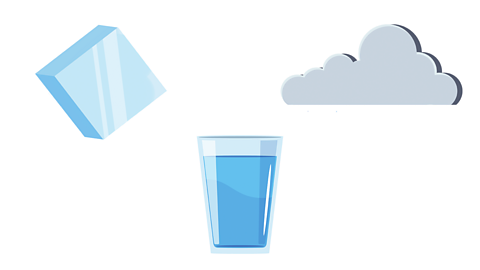
Most materials on Earth exist as one of three states of matter: solid, liquid or gas. The state of a material describes how its particles are arranged and how they behave.
- Solids keep a fixed shape.
- Liquids can flow and take the shape of their container.
- Gases spread out to fill the space around them.
Materials can change state when they are heated or cooled.
Watch: The Thantastic Three
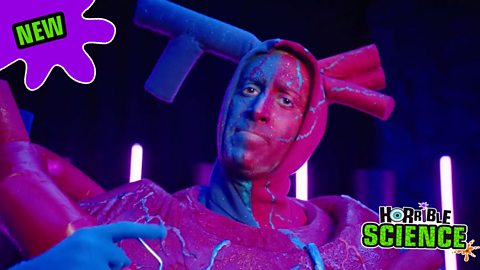
What’s the matter? Never seen an awesome team of shapeshifting superheroes before? Meet The Thantastic Three - they’re always in a state.
NARRATOR: They were three brave astronauts who went to space. And came back changed. Into superheroes. Each now able to transform into one of the three different states of matter.
State one: Mr. Solid. His solid hands have a fixed size and a fixed shape.
State two: Liquid woman who could turn to liquid and be poured like gravy. Flowing and changing shape depending on her surroundings.
State three: The gas.
GAS: Yes…
NARRATOR: Who has no fixed shape. So can move easily.
BACKGROUND: Open a window.
NARRATOR: Spreading out everywhere. Together they are the Thantastic Three. Superheroes that matter. And they'll face the world's most disappointing supervillain.
VILLAIN: You'll never stop me!
NARRATOR: Talk to the hand.
BACKGROUND: Solidly done.
VILLAIN: Okay, you stopped me.
NARRATOR: Someone's making a splash.
VILLAIN: Oh. Covered in liquid woman.
GAS: Let's get gassy.
VILLAIN: Oh, no. Not the fart.
GAS: Gas on. Wait. What did you just call me?
I can't believe people are calling me The Fart. I mean, this is the worst.
LIQUID: No, that's not the worst. They also call you the Invisible Plop.
SOLID: Pooper Man.
LIQUID: The Whifferine.
SOLID: The Brown Pants-er.
LIQUID: Kraven the Grunter.
SOLID: The Flush.
BOTH: Professor Eggs.
LIQUID: Sorry.
GAS: Okay, guys, I get it. But I'm still proud to be part of the Thantastic Three. This triumphant trio of ours. One of only three states of- what?
NARRATOR: Introducing the fourth member of the team - Plasma.
PLASMA: I have powers very like the gas. I flow easily, expand and change shape. I'm also what makes lightning and the burning essence of the Sun.
GAS: Oh, great. So I'm not even the best gaseous member of the team anymore? I'm out of here. Gas on.
PLASMA: Whoa!
LIQUID: Every time. I'm out of here too.
PLASMA: Please open a window.
NARRATOR: The Thantastic Three-ish. Finally a movie that matters.
How do solids, liquids and gases behave?
Each state of matter has its own properties.
| State | Properties |
|---|---|
| Solid | Solids are dense and strong. Their particles are tightly packed, so they keep their shape and do not flow. |
| Liquid | Liquids can flow and take the shape of their container. Their particles are close together but can move, so they can be poured while keeping a fixed volume. |
| Gas | Gases spread out to fill all available space. Their particles are far apart, so they can be compressed and do not have a fixed shape or volume. |
Materials can change between these states. For example, a solid can melt into a liquid, a liquid can evaporate into a gas, a gas can condense into a liquid, and a liquid can freeze into a solid.
Sometimes, a solid can change straight into a gas (this is called sublimation), or a gas can change straight into a solid (this is called deposition), without becoming a liquid first.
Is plasma a state of matter too?
Plasma is sometimes called a fourth state of matter. It forms when a gas is given so much energy that it becomes electrically charged.
Plasma is found in lightning and in stars such as the Sun, where it gives off light and energy.
Horrible Science fact
Lightning is made of plasma, a super-energised form of gas that can glow and crackle through the air. It forms when huge amounts of energy pass through the air during a storm.
Quiz
How to use Horrible Science in the classroom
If you're looking to bring energy, humour and curriculum-aligned content into your science lessons, Horrible Science might just be your new secret weapon.

More on Horrible Science
Find out more by working through a topic
- count5 of 50
- count6 of 50
- count8 of 50