What is a reversible change?
When a material, such as salt, can return to its original state, we call it a reversible change. For example, salt dissolved in water can be reversed by evaporating the water, which leaves behind the salt.
An irreversible change is when a material cannot return to its original state. For example, a fried egg cannot be turned back into an uncooked egg.
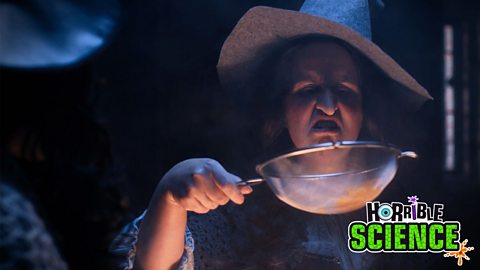
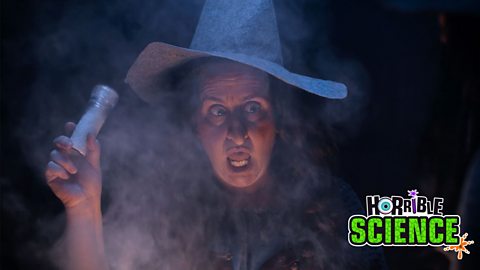
Watch: Witch mix
Explore how reversible changes can return a material to its original state.
CASEY: By the light of the Moon. The hair on my chin. This evil mixture is about to begin.
LINDA: First into the pot. From a dangerous creature… the wax from the ear of an angry maths teacher.
SARAH: Then I will add, as I cackle with glee, a thumb and a tongue and a knobbly knee.
CASEY: And next I will add a bucket of puke that I tickled out of a greedy old Duke.
SARAH: And with that my sisters our mixture's complete. Let's have a taste as our bedtime treat.
LINDA: But first, a little seasoning.
SARAH: Oh, Linda.
CASEY: Classic. Linda.
SARAH: We've told you once. We've told you a million times. We're off salt at the moment.
LINDA: Just so plain, without a little something to season it.
SARAH: You haven't even tasted it yet! Rude. And you know that too much salt can ruin the flavour of a delicate, knobbly knee.
LINDA: Oh, fine. I'll try and get it out.
CASEY: You can't get it out, Linda. The salt will have dissolved in the puke.
LINDA: Surely I can just sieve it out.
CASEY: You can't sieve it out. You're just getting chunks of thumb and tongue.
LINDA: Do you ever think it's weird that you're happy to eat a Duke's puke, but not a little bit of salt?
CASEY: Not really.
SARAH: No.
LINDA: Well, look, it's not working. The salt must be too small to catch in a sieve.
CASEY: It's dissolved, Linda. It's literally become a part of the mixture.
LINDA: Look, pass me that kitchen roll. Maybe I can filter it.
SARAH: Well, that won't work. Filtering is just like sieving, but with smaller holes to catch smaller solids.
LINDA: It's not working. You could just make another one.
CASEY: And where do you think we'll find a maths teacher's waxy ears at this time?
SARAH: And we'll need more knees. You offering yours up, Linda?
LINDA: Oh, jeez. Casey's.
CASEY: What are you saying?
LINDA: Saying you have really knobbly knees love.
CASEY: No. No, I do not.
LINDA: Everyone in the village says it.
CASEY: No, I do not. They are…
ALL: Not… There goes.
SARAH: Girls! All the liquids gone.
LINDA: Oh. It's magic.
SARAH: It's not magic, Linda. It's evaporating.
CASEY: All the liquids turned to gas and just left the solids, including your salt crystals.
LINDA: The evaporation separated out all the salt, all right. It's all over these ears. Tell you what. We could just have a nice cup of tea instead.
CASEY AND SARAH: Oh, yeah.
LINDA: Do you want salt in yours?
CASEY: No one puts salt in tea.
LINDA: Well, I do sometimes.
How can we change materials?
Materials can be either solids, liquids or gases. These are called states of matter. A material’s state can change under certain conditions. For example, ice is a solid. If we melt ice, it becomes water, which is a liquid. If we boil water, it becomes water vapour or steam, which is a gas.
Changing between states of matter is a reversible change because we can undo these changes. For example, water vapour or steam is a gas. If we condense water vapour or steam, it turns back into water (a liquid). If we freeze water, it turns back into ice (a solid).
Dissolving is another example of a reversible change. Dissolving occurs when a solid such as salt is mixed with a liquid such as water or magic potion to form a solution. We can reverse dissolving through evaporation.
Another example of a reversible change is mixing. Mixing occurs when a solid, such as sand, is mixed with a liquid, such as water to form a suspension. The sand is not dissolved in the water, and it floats around. We can reverse mixing by sieving, if the solid is large enough, or filtering, if the solid is smaller).
Horrible Science fact
Baking a cake is an irreversible change. You can't get your eggs, flour or butter back - no matter how hard you try.
Quiz
How to use Horrible Science in the classroom
If you're looking to bring energy, humour and curriculum-aligned content into your science lessons, Horrible Science might just be your new secret weapon.
More on Horrible Science
Find out more by working through a topic
- count6 of 50
- count8 of 50