How did wolves become dogs?
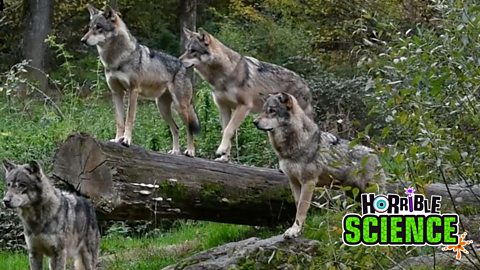
Dogs have not always lived alongside humans. Long ago, the animals we now call dogs were wild wolves.
Between 20,000 and 40,000 years ago, some grey wolves began living near humans to find food. Humans benefited from their protection and help with hunting.
The calmer wolves were kept and cared for. Over many generations, wolves gradually became the first dogs.
The transformation of wolves to different breeds (groups that share the same features) of dogs took thousands of years.
Watch: Paleolithic Grrrufts
The dogs we know and love today have come a long way since they roamed around as wolves and they definitely weren’t as well-trained.
OGG: Greetings. Me. Ogg.
CLARE: And I'm Clare Shedding. I've traveled back 29,000 years to Paleolithic times to host this dog show.
CONTESTANT: Don't eat me! Don't eat me! Help!
CLARE: As they call it here,
OGG: Grrrufts.
CLARE: Of course, at this point in time, there are no dogs, just wolves which means everything in this competition is a little bit…
OGG: Bitey, Bitey. Growl. Growl.
CLARE: That's right. Now, these wolves are just starting to live alongside people. But let's see just how friendly man's best friend currently is.
OGG: Spoiler alert! Not very.
CLARE: First up, we have hunter gatherer Ugg who's trying to win by getting his stunning wolf Bella to fetch.
UGG: Fetch!
CLARE: And you know Ugg found Bella scavenging for meat near his home and encouraged her to stick around.
OGG: Wolf nice for hunter gatherer.
CLARE: Well. That's true.
Are they trained yet?
UGG: Bella, wait!
VOICEOVER: No, she's just running off.
OGG: Bella no listen to Ugg.
VOICEOVER: And there she goes.
UGG: Oh, Bella!
Disappointment for Ugg. Bella run away!
OGG: Ugg sad.
CLARE: Next up, agility with Gog and her wolf, Cooper.
Now, it says here that Gog is a hunter gatherer and in her spare time, enjoys both hunting and gathering.
OGG: Oh, Cooper follow. Nice.
CLARE: Yes. The beginnings of training there.
OGG: Oh, no. No. Cooper chase her.
CLARE: These ancient wolves are known for their big teeth. Oh, dear.
Powerful jaws.
Disappointment for Gog there.
OGG: Here come final contestant. Thudd with his wolf Biscuit.
THUDD: Nice biscuit.
CLARE: You know, Thudd had Biscuit from when he was a puppy. Because, of course, that is another way that human wolf relations developed. People found cute baby wolves and brought them up themselves.
UGG: Oh, yeah. Of course. One minute they cute baby wolves. Next minute they big hungry wolf that want to eat its owner.
CLARE: Oh my word.
Disappointment for Thudd.
CLARE: Don't worry about that, viewers. In just a few thousand years, humans will breed and train these wolves to create all the dogs we know and love.
OGG: Oh, Wolf come back! Pack come to us now!
CLARE: Do join us again in a few thousand years.
OGG: Nice wolf.
CLARE: Someone call my agent!
What is domestication and selective breeding?
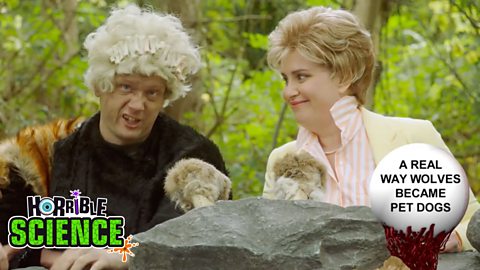
Domestication happens when humans gradually change plants or animals by choosing which ones to care for and breed (help reproduce).
In the case of dogs, the steps involved in domestication were that:
- Calmer wolves were kept close to humans.
- Those wolves had puppies.
- The calmest puppies were kept and raised.
- Then the process was repeated again and again.
This is called selective breeding. It means humans selected animals with useful traits, such as friendliness, loyalty or size.
Over many generations, this led to dogs that looked and behaved very differently from their wild ancestors and it is the reason why we have so many different dog breeds today.
How have dogs changed over time?
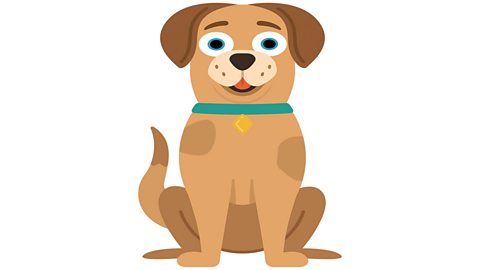
Ancient wolves were fast, strong and wary of humans. Modern dogs come in many shapes and sizes and are often trained to live closely with people.
Some changes include:
shorter snouts and smaller teeth in some breeds
differences in fur colour and length
behaviour that makes dogs easier to train
These changes happened slowly over many generations, showing how dogs have changed in their appearance and behaviour over time.
Horrible Science fact
There are now more than 400 dog breeds, from teeny tiny lap dogs you could fit in a handbag to huge working dogs that you’d definitely struggle to lift.
Selective breeding has made dogs one of the most varied animal species.
Quiz
How to use Horrible Science in the classroom
If you're looking to bring energy, humour and curriculum-aligned content into your science lessons, Horrible Science might just be your new secret weapon.

More on Horrible Science
Find out more by working through a topic
- count22 of 50
- count23 of 50

- count24 of 50
- count25 of 50