What are the main parts of a plant?
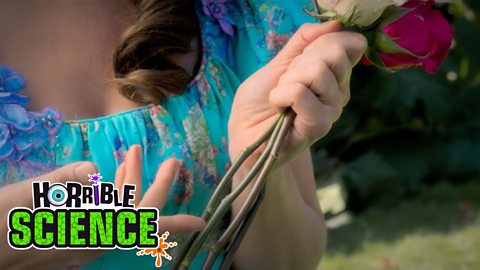
A plant has four main parts. They are the roots, stem, leaves and flowers.
Roots: Hold the plant in the ground and take in water and nutrients from the soil.
Stem: Supports the plant and carries water and nutrients to different parts.
Leaves: Make food for the plant using sunlight.
Flowers: Makes seeds so that new plants can grow.
These parts are important for helping plants stay alive and grow.
Watch: Romance of flowers
Mr Piggerton wants to show his love for Miss Cleverley with flowers, but Miss Cleverley wants to make sure he knows all about flowers before she accepts them.
MISS CLEVERLEY: Oh Mr Piggerton…
Why were you hiding in the bushes?
Have you been plagued by the geese once again?
MR PIGGERTON: Ah, yes. Noo, on this occasion, Miss Cleverley, I have not been hiding from Captain Honk as clever a goose as he is. I was on a quest for a token of our love. I can now present these.
MISS CLEVERLEY: Mr. Piggerton.
MR PIGGERTON: Miss Cleverley, I will always be a rock.
MISS CLEVERLEY: Where's the rest of it?
MR PIGGERTON: Excuse me.
MISS CLEVERLEY: The rest of the plant. These are just the flowers.
MR PIGGERTON: Well yes, they're prettiest part of the plant. Just as you are …
MISS CLEVERLEY: So you only love the pretty bits of me. You would cast the rest aside without so much as a thought.
MR PIGGERTON: That's not what I said is it? Hey, get out of it! Not for you.
MISS CLEVERLEY: On the contrary, Mr. Piggerton, that is precisely who they are for. Flowers only look and smell pretty, so that bees and other insects will visit them and carry their pollen to other plants.
Why are you so sure I would like them? Are you saying I'm a bee?
MR PIGGERTON: I'm not saying you're a bee. The flowers are just a metaphor for love. I don't know. Ow!
MISS CLEVERLEY: And you have ripped away the roots. Roots provide support. Without this, the plant will wither and die.
Are you saying that is what will happen to our love?
MR PIGGERTON: Digby, put the lid back on! I didn't know you liked roots so much.
MISS CLEVERLEY: I really like roots. Did you know the roots of some plants can go 70 metres deep?
MR PIGGERTON: Yes.
MR PIGGERTON: Well, that would not match a fraction of the depth of my affection for you.
MISS CLEVERLEY: And you have cut off the leaves.
MR PIGGERTON: I trimmed them.
MISS CLEVERLEY: You trimmed them? Oh, he's trimmed them.
Without leaves the plant cannot turn light from the sun into energy to grow. Are you saying our love won't grow?
MR PIGGERTON: Ow! You're only stinging me. Have you got stung?
MISS CLEVERLEY: And why have you cut off the thorns? Thorns defend the plant. Are you saying our love could be eaten by a cow?
MR PIGGERTON: What? No.
MR PIGGERTON: I am sorry, my love. Next time I will bring you a plant roots and all.
MISS CLEVERLEY: And the thorns and the leaves.
DIGBY: Oh, no!
MR PIGGERTON: All of the plant. Just as all of my love is yours.
MISS CLEVERLEY: What's happening?
MR PIGGERTON: Shall be for you.
MR PIGGERTON: From now until the end of time.
Ow! Oh. Stop hitting me with the net.
This is a disaster.
DIGBY: I said you should have got chocolates.
MR PIGGERTON: Captain Honk. He's found me.
Run! You'll never take me alive, Honk!
Why do flowers look and smell pretty?
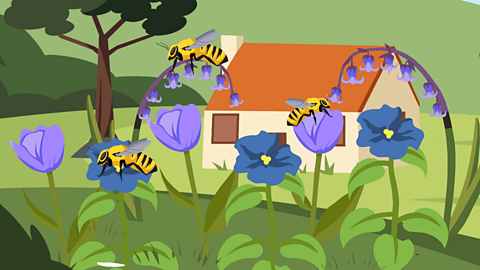
Flowers look and smell pretty to help the plant make new plants. Their bright colours and sweet smells attract insects such as bees and butterflies.
These insects visit flowers to drink nectar, a sweet sugary liquid which is made by the flowers. While they do this, they accidentally carry pollen from one flower to another. This is called pollination. It helps the plant make seeds, and seeds can grow into new plants.
If flowers were dull and had no smell, insects might not visit them. Flowers use colour and scent like a message saying, “Come here!” This helps the plant survive and grow more flowers in the future.
Horrible Science fact
Some plants such as daisies have roots of less than 20 cm, but some plants have incredibly long roots.
Mesquite trees can grow in very dry places as their roots can grow over 50 metres long to reach water deep underground - that’s longer than a football pitch. This helps the tree survive where there is very little rain. Think of their roots like a very long drinking straw - sluuuuurp!
Find out more about the parts of a plant.
Quiz
How to use Horrible Science in the classroom
If you're looking to bring energy, humour and curriculum-aligned content into your science lessons, Horrible Science might just be your new secret weapon.

More on Horrible Science
Find out more by working through a topic
- count15 of 50
- count16 of 50
- count17 of 50
- count18 of 50