What are classification keys?
Scientists like to sort living things into groups so they can understand them better.
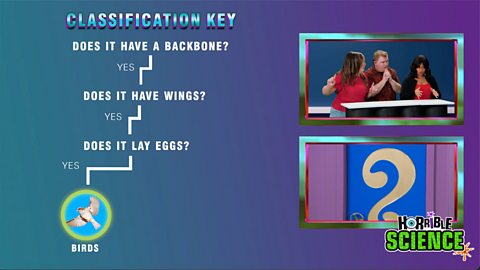
To do this, they use a classification key. This is like a quiz with yes or no questions about what the living thing looks like or how it behaves.
Each answer leads to another question, and step-by-step, they get closer to finding out exactly what the living thing is.
A scientist from Sweden called Carl Linnaeus created the classification system that today’s system is based on.
He gave every living thing a two-part Latin name.
For example:
humans are called Homo sapiens
a house cat is called Felis catus
Watch: What Animal's in the Box?
Learn about classification keys through a rather terrifying TV game show.
ANTON D'EQUE: Hello and welcome back to…
AUDIENCE: What animal's in the box?
ANTON D'EQUE: A fun game show where a member of the public is locked into a box with a mystery animal, and their teammates have to work out what that animal is by using a series of simple questions called a classification key. Here's a recap on how they've done so far.
In round one, the team sent Bill into the box.
SOUND: BILL SCREAMS
SANDRA: Does it have a backbone Bill?
BILL: Yes. Ah! Stop flapping at me!
SANDRA: So we know it's a vertebrate. That means it's either a fish, reptile, bird, amphibian or mammal.
JOHN: Has it got wings Bill?
BILL: Yes, massive wings. Ah!
SANDRA: I'm thinking bird. Does it lay eggs?
SOUND: SCREAMS
BILL: Yes, sorry I wasn't trying to steal it. I'm really sorry. Get away from me!
ZOE: It sounds big. Shall we say ostrich?
BILL: Please say ostrich! Ahhh!
ZOE: Errr, ostrich.
ANTON D'EQUE: Correct! And in round two, the team sent Bill into the box … again.
JOHN: You got this mate, go on!
SOUND: SCREAMS
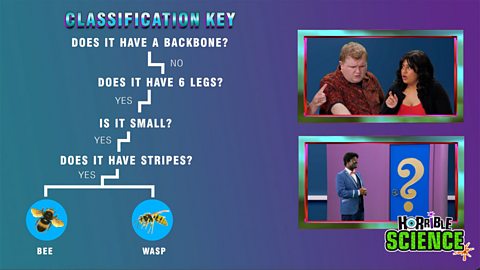
SANDRA: Okay, no backbone. So it's an invertebrate.
BILL: Aargh, they're everywhere!
SANDRA: Six legs means insect. Small, wings, stripes. Oooh. It's either a bee or a wasp.
BILL: Aargghh, argghh it's up my nose!
SANDRA: I think it's a bee. Bee!
ANTON D'EQUE: Correct! And in round three, Bill stepped up - again!
BILL: No, it's not my turn, it's not my turn.
SANDRA: In you go.
ZOE: If it's cold blooded, it might be a fish or a reptile. Is it cold-blooded Bill?
BILL: How am I supposed to know that? Oh, no no, no. Oh please no!
ANTON D'EQUE: Oh, and it was, of course, a crocodile.
Which means they're through to our final. Sandra, who are you going to send into the box for the final time?
SANDRA: Well, we've talked about it, and it is going to be Bill.
JOHN: It's the final round Bill!
ANTON D'EQUE: After a little persuading, Bill is back in the box.
BILL: Please keep your voices down. He's asleep.
ANTON D'EQUE: LETS CLASSIFY!
BILL: You've woken it! It's a bear, it's a grizzly bear!
ANTON D'EQUE: Ah ah ah, yes or no answers, Bill.
SANDRA: Bill, does it have a backbone?
BILL: Yes, it's a bear.
SANDRA: Okay, so it's a vertebrate.
JOHN: Right. Does it have feathers?
BILL: No, it's a bear.
JOHN: No feathers? So it's not a bird.
ZOE: Is their skin scaly?
BILL: It's a bear.
ZOE: Does it give birth to live young?
JOHN: Great question.
BILL: Aaaah, aaah, it's a bear!
SANDRA: I'm thinking it's a mammal.
JOHN: Right, right.
ANTON D'EQUE: Time is ticking. I'm going to need an answer.
BILL: IT'S AN ACTUAL BEAR!
JOHN: Tricky. I just don't know.
ZOE: Is it a bear?
ANTON D'EQUE: It is a bear.
SOUND: CHEERS, LIVELY THEME TUNE
BILL: Uh no! No he doesn't like the theme tune. Stop playing the theme tune.
ANTON D'EQUE: See you next time.
BILL: The bear's loose!
SOUND: SCREAMING
How do we classify animals?
Classifying a new animal is like being a detective. To do it scientists follow a process.
- They look at its features and behaviour.
- Then, they compare it with other animals.
- They use this information to answer the questions in a classification key.
- They give the animal a special name, so scientists everywhere know exactly what it is.
As part of this process, animals are divided into two groups: vertebrates (which have backbones) and invertebrates (which do not have backbones).
Then each of these groups is divided further. Vertebrates are divided into five smaller groups: amphibians, birds, fish, mammals and reptiles.
Invertebrates are divided into seven smaller groups: molluscs, arachnids, echinoderms, insects, crustaceans, annelids and cnidaria.
This sorting and grouping of animals continues until scientists can give it a scientific, two-part name such as Homo sapiens.
Horrible Science fact
Invertebrates make up around 97 per cent of all the animal species on Earth. A type of fish called the Greenland shark has the longest recorded lifespan of any vertebrates - one is thought to be around 400 years old - you’d need a big birthday cake to fit that many candles on!
Find out more about classification.
Quiz
How to use Horrible Science in the classroom
If you're looking to bring energy, humour and curriculum-aligned content into your science lessons, Horrible Science might just be your new secret weapon.
More on Horrible Science
Find out more by working through a topic
- count13 of 50
- count14 of 50
- count15 of 50
- count16 of 50