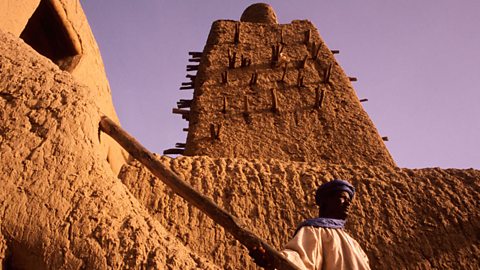
Exploring the kingdoms of West Africa
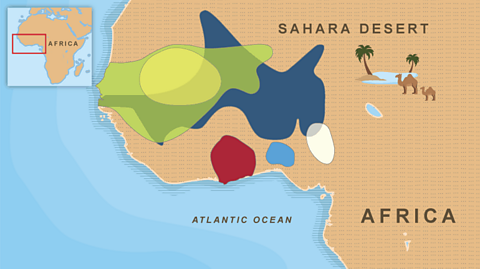
There have been many kingdoms in West Africa across history.
They used their natural resources such as gold to create wealth and produce works of art from clay and metals.
Over time, some were replaced by new kingdoms and others were conquered by European nations.
Important words
| Keyword | Definition |
|---|---|
| Conquered | Where someone or a group use an army to take control of a kingdom. |
| Nation | A country of people. |
| Settled | People who have largely stayed in one place. |
| Ornament | An object used to make somewhere look nicer or as part of religious worship. |
| Architect | A person who designs buildings. |
| Interpreter | A person who translates speech from one language into another. |
Which other kingdoms were in West Africa?
Find out about some of the kingdoms of West Africa in the table below.
| Name of kingdom | Fact |
|---|---|
| Nok | Its people were farmers, potters and metalworkers who settled near the River Niger. |
| Ife | It began as a settlement in the rainforests. |
| Ancient Ghana, Mali and Songhai | This kingdom became rich by selling gold. |
| Benin | Was at its most powerful in 1400s and 1600s. |
| Asante | This kingdom became well-known for its gold craft work. |
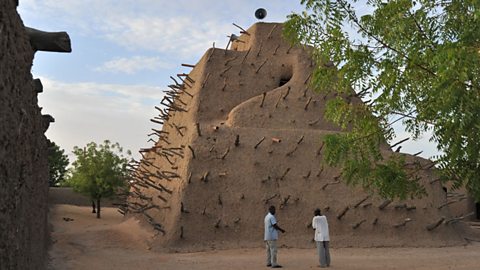
Historians know about the history of the kingdoms of West Africa as there are still many artefacts and historical sites that they can look at today. They can be used to find out about how people lived, what they believed in and how their societies were organised.
What things did people in the kingdoms make?
Skilled potters and metalworkers worked with brass or gold.
Potters in the kingdom of Nok made sculptures from a type of clay called terracotta.
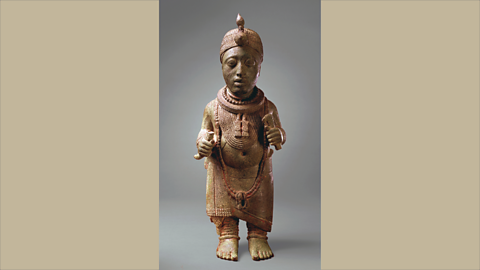
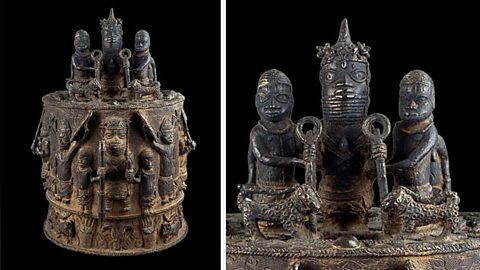
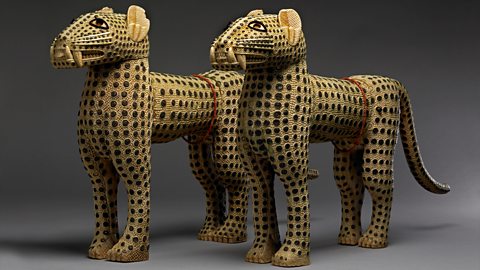
Brass-workers in the kingdom of Ife made brass figures of gods, humans and animals. Their art influenced the culture of Benin.
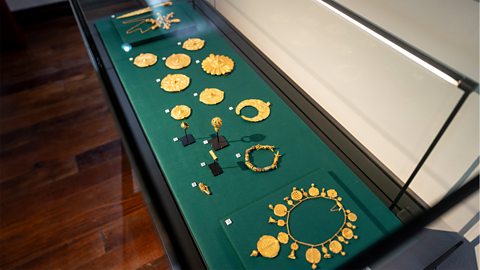
In the Asante kingdom, goldsmiths made ornaments to show their king was rich.
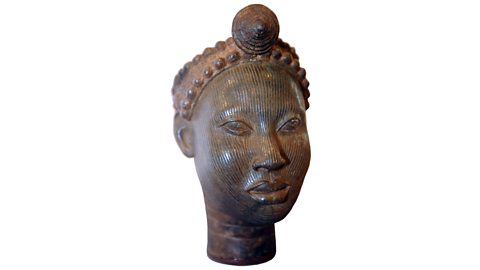
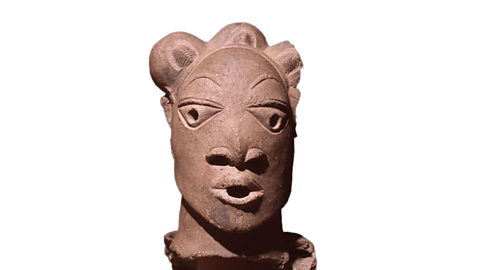
Examples of West African art
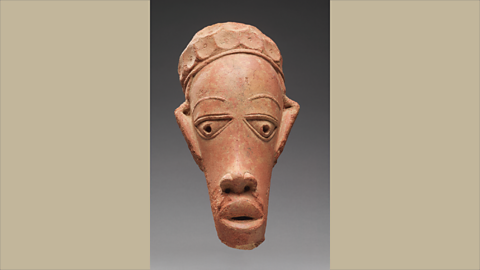
Image caption, A head made of terracotta clay from the Nok region. This was made between 600BC and AD250.
1 of 3
Who was Mansa Musa?
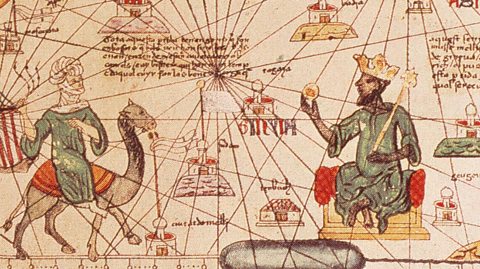
- Mansa Musa was a rich Muslim king of Mali.
- He travelled to the holy city of Mecca with thousands of men carrying gold to give to people along the way.
- He brought teachers and architects back to Mali from his travels.
- Mansa Musa also built many mosques and schools in Timbuktu and Gao.
Listen: Ibn Battuta’s visit to Mali
In 1352, an Arab traveller called Ibn Battuta visited Mali. He arrived at the city of Niani where Mansa Suleyman, grandson of Mansa Musa, had his palace. Suleyman was not a great ruler like Musa, but he lived in style! Find out what Ibn Battuta saw.
I had a wretched journey across the Sahara desert. Only the thought of the famous kingdom of Mali kept me going. I had heard great stories about the land of gold and I knew I had to see it with my own eyes.
Just then as I arrived in the kingdom of Mali, I very nearly died! I ate some rotten yams that made me so sick I had to take to my bed. It was two whole months before I had the strength to visit the royal palace.
As I reached the palace gates I saw around 300 slaves, some armed with bows and some with lances - all of them devoted to the service of their king, Mansa Suleyman. Then I was led to the vast council hall where the king received his visitors.
No one was allowed to approach the king directly. Instead I sat with chiefs and warriors and visitors of all kinds. We waited in a broad avenue lined with trees, for our turn to send a message.
When I finally took my turn, I had to speak through an Interpreter. He was a splendid figure in silken robes wearing a turban with elaborate fringes. Then the Interpreter spoke to a man who stood near the king and that man finally gave my message tothe king.
On another day, I attended a festival in honour of the king. I saw a parade of chiefs all riding on horseback, with their followers carrying weapons and playing drums and bugles. There were other musicians with instruments made from reeds and gourds, which they beat with sticks to make a wonderful sound.
The Interpreter sat on a special chair and sang loudly in praise of his king. He was joined by a choir of women and pages, and then came the acrobats and jugglers with swords.
When I finally got to see Mansa Suleyman, he gave me a strange gift - a small dish of bread, meat and yogurt. Later I complained to him, telling him of all the generous rulers I had met on my travels. After that, he offered me a house where I could stay and when I left his country he gave me gifts of gold.
I shall never forget my visit to Mali however long I live.
What happened to the African kingdoms?
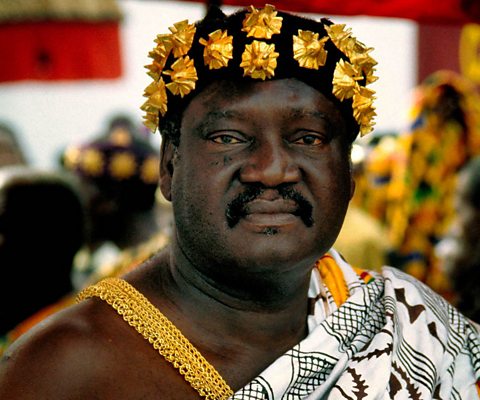
- By the 1890s, many countries in Europe were competing for land in Africa.
- They also wanted goods, like gold, oil and rubber.
- From 1897, Benin and other west African kingdoms were ruled by European countries.
- From the 1950s many African countries won their independence.
- Today, the ancient kingdom of Benin is part of Nigeria and Asante is in Ghana.
- Many people in West Africa still remember their ancient traditions.
Think like a historian

Have a look at the thinking points below and think about your answer to each question. You could even write them down on a piece of paper or discuss them with somebody else if you want to.
- How do we know religion was important to Mansa Musa?
- Trade was very important to the Benin kingdom. Is this true for other West African kingdoms?
Did you think about how Mansa Musa had travelled to the holy city of Mecca with a huge number of men accompanying him? He built many mosques in the cities of Timbuktu and Gao. These show he valued his religion.
You may think yes, West African kingdoms traded different goods and resources that were valuable. Ghana, Mali, Songhai existed from 700-1600 and became rich by trading gold. The Asante kingdom was founded around 1700 and also became rich through trading gold.
Activities
Activity 1: Map of West Africa
Explore the map below to find out more about the kingdoms of West Africa.
Activity 2: Quiz – Kingdoms of West Africa
Let's find out what you know about Benin and other West African kingdoms in this quiz.
Grown-ups corner
Are you a parent, carer or teacher?
Take a look at some of the links below on KS2 History which are packed full of knowledge, videos, quizzes and activities.
Introduction to the kingdom of Benin
KS2 History
What does the art of Benin tell us?
KS2 History
Horrible Histories: Raid and Trade game! game
Play Horrible Histories: Raid and Trade KS2 History
More on Kingdom of Benin
Find out more by working through a topic
- count1 of 8
- count2 of 8
- count3 of 8
- count4 of 8