What can we learn from the art of Benin?
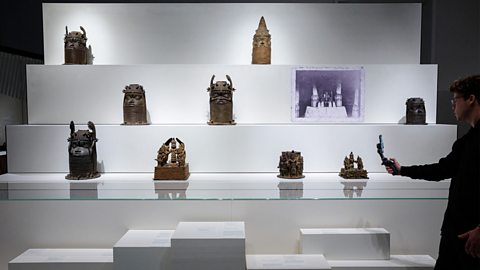
The craftworkers of the Benin kingdom produced beautiful artworks from metals and other materials including the famous Benin bronzes.
They help us understand what the people saw as important for their lives and religious belief.
Important words
| Keyword | Definition |
|---|---|
| Brass | A metal made from copper and zinc. |
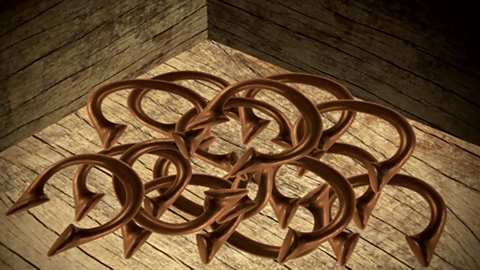
| Copper manillas | A piece of metal jewellery made from copper. It is a similar shape to a horseshoe. |
| District | An area of a city. They are known for a particular feature. |
| Fibres | A thread made from a plant. This is used to make textiles. |
| Merchant | A person who sells and trades things. |
| Plaque | A tablet made from metal that is fixed to a wall. It is used to remember a person or event. |
Watch: What role did guilds play in the Kingdom of Benin?
Learn about the role guilds played in the development of the Kingdom of Benin.
In the West African Kingdom of Benin, work groups called guilds made impressive objects. By the late 13th century, each guild had its own role. Some made ivory or brass objects, while others wove cloth.
They often worked for the Obas – the kings of Benin. The Obas controlled the guilds and used their work in ceremonies and in the royal palace. These included ivory, jewellery and bronze artworks that showed Obas, key battles, and important events.
When Europeans first visited, they were surprised because they didn't expect the people who lived in Benin to make such skilled and detailed artwork.
Members of the guilds taught their children how to weave, carve or cast metal. This meant their skills were passed down through families.
The guilds of Benin were more than craft workers. They strengthened the Obas’ power and made the kingdom well known for its art.
What was art in Benin like?
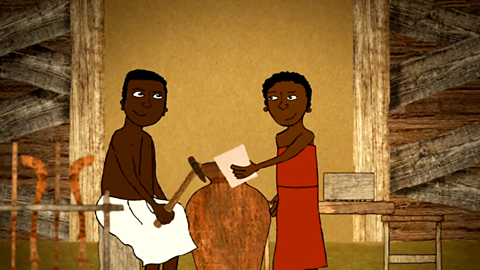
The people of Benin made many different kinds of art. Village craft workers made simple pots, weapons and tools.
They carved masks for ceremonies and they moulded sculptures of gods out of mud.
In Benin City, craft workers were organised into groups known as guilds. There were guilds for wood carvers, ivory carvers, leather workers, weavers and blacksmiths. The brass casters’ guild was only allowed to work for the Oba (king).
The art of Benin features people, animals and gods. It helps historians and archaeologists understand what life and religion were like in the kingdom.
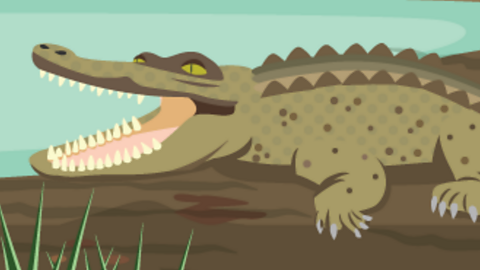
Some animals, such as crocodiles and leopards, appear many times in the art of Benin. They are used as symbols to show the power of their king, the Oba.
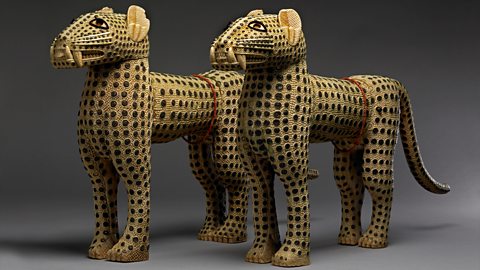
What materials did craft workers use?
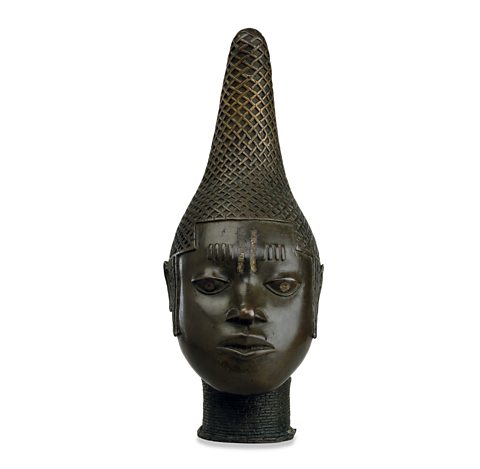
Each guild produced different types of goods. Some used ordinary materials and others crafted with the most precious available.
Craftworkers used:
- Clay
- Wood
- Leather
Weavers used fibres from plants to make colourful cloth.
The most precious materials were:
- Brass
- Coral
- Ivory
People believed they had special powers. Find out more about them below.
| Material | Power or symbol | How was it used |
|---|---|---|
| Brass | Had power to drive away evil | Could only be used in the royal court. The palace walls were covered with plaques made from brass and it was used to make figures and heads for the royal altars. |
| Coral | Seen as a gift from Olokun, god of the sea | Chiefs were allowed to wear coral necklaces, bracelets and anklets, but only the Oba could dress completely in coral. |
| Ivory | Symbol of purity and strength | Carved ivory tusks stood by the Oba’s throne and ivory bracelets and pendants were worn by the Oba and important chiefs. |
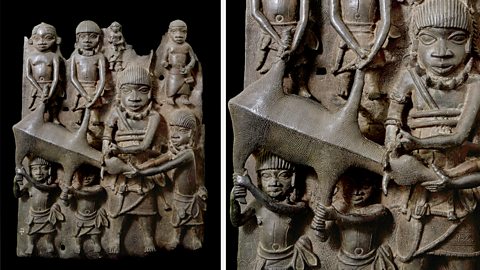
Metal workers in Benin made beautiful plaques, masks and statues for the Oba.These are often called 'Benin Bronzes', however most are actually made of brass rather than bronze.
Watch: Benin bronzes
What made the Benin craftworkers so important?
They used special techniques like wax casting.
The sculpture, plaques and objects they produced are incredibly detailed.
The skills used in the guilds were passed down from father to son.
Trading these goods brought wealth to the kingdom.
Find out how bronze statues were made
Narrator: Hello, future people of the UK. I’d like to show you around the Benin civilisation.
But to do that, you’ve got to go back 500 years. Before Queen Victoria, before the Spanish Armada, right back to the time of Henry VIII. Now, head south over France and into Africa.
We are in that little corner where Nigeria will be one day. You’ve made it! Welcome to the Benin civilisation. My name is Ibi. I’m on my way to the Oba’s Palace.
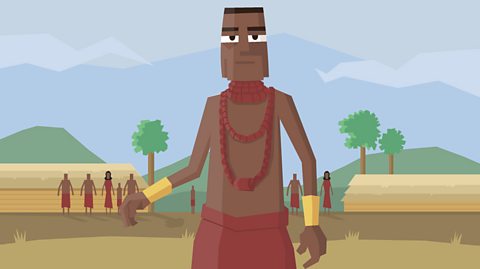
The Oba is our leader, but we hardly ever see him because he stays in there the whole time. Except for once a year.
Next week, he’ll come out of those gates for a big parade. The whole town is getting ready for the event. That’s why I’m here.
The Oba wants a special ornament made so he can show off his power. Cripes! This will keep my dad busy!
My dad is a bronze caster. He makes all kinds of stuff. But the Oba wants him to make a very fancy mask in time for the parade. This is going to be tight.
Dad uses these copper hoops, called manilla, as the main ingredient in bronze. But, oh, no!
It looks like we’ve run out of the other ingredient, tin!
Maybe our neighbours will have some tine we can trade for this copper. Follow me!
We’re a big trading nation so our city is organised into trading districts, making all kinds of different things. Hopefully one of them will have some tin.
Let’s try the… metal district? Nope.
Carpentry district? Nope.
Pottery district? Nothing.
This is bad. It’s not a good idea to disappoint the all-powerful Oba.
Some say he’s got magical powers. Hmmmm…
Ok, my last hope is the weaving district. Though I doubt they’ll have any tin.
Let me guess, no tin? Brilliant!
What are the chances? Let’s do a deal.
Hmmm… I’ve not seen a cup like this before. The weavers say it was traded for some cloth with merchants from very far away.
You see, we trade with the whole of Africa and some of our goods come from as far away as India.
But, apparently, some particularly strange traders showed up recently. They had weird, pale skin, beards and strange-looking clothes.
No-one had seen them before. But rumour was, they were from a place called Portugal.
They wanted to set up a direct trade route from their homeland all the way to here.
Ok, so you are probably wondering, How you turn all this into a work of art?
Well, step 1 -make your design out of wax.
Step 2 – cover with sand, leaving a hole.
Step 3 – make bronze by melting down the copper manilla and mixing with tin.
Step 4 – pour into the hold, which boils off the wax.
Step 5 – wait for it to cool.
Then, after a few days’ polishing it’s perfect for the Oba.
All done. What do you think? Right, I’d better get this to the Oba before he puts a spell on me or something.
Here you go. Please give this to the Oba.
He should be out any minute now. Here he comes! And yes, those are pet cheetahs.
And there’s the mask. Brilliant! I’m so relieved we made it in time.
Well, that’s about all. The Portuguese will carry on coming and more Europeans will arrive to start trading, too.
But in the end, it will all go wrong for us when the British invade.
That will spell the end of our empire. And all this, it will be history.
How were Europeans shown in Kingdom of Benin art?

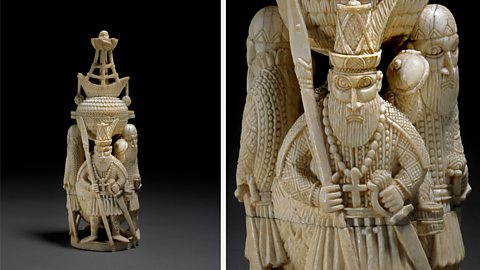
The craft workers of Benin often showed Europeans in their art.
Most of these figures have long, narrow faces and straight, shoulder-length hair.
Sometimes they have a beard and sometimes they wear armour and hold a gun.
Even though the Europeans must have seemed very strange, they were welcomed by the people of Benin.
The Obas had a good relationship with merchants from Europe until the 1800s but then the Europeans changed their attitude. Instead of simply trading with African kingdoms, they wanted to take their land.
In the late 1800s, European countries competed with each other for African land. They seized control of the African kingdoms and built their own empires.
What should be done with Benin’s art?
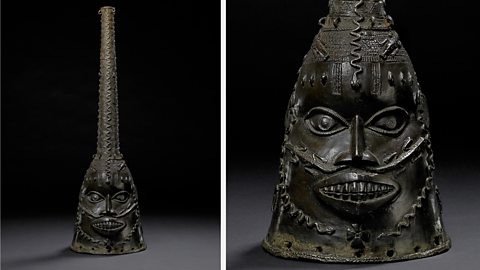
There has been a growing call from people of Nigeria for artefacts held in museums around the world to be returned to the country of origin.
The Benin bronzes were taken when the city was looted (forcefully taken), invaded by the British and made part of the British Empire in 1897.
In 2021, Germany agreed to return the artefacts it holds that were taken from Benin. In the same year, the University of Aberdeen returned a bronze back to its country of origin.
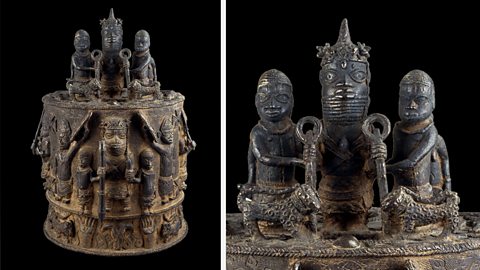
At the moment, many museums still hold hundreds of pieces of Benin art.
These artefacts are important to the people of modern-day Africa and many people are campaigning for the art to be returned to its home country.
Think like a historian

Have a look at the thinking points below and think about your answer to each question. You could even write them down on a piece of paper or discuss them with somebody else if you want to.
- How can historians claim the Benin craft workers were skilled metalworkers?
- How do we know some materials were important to the kingdom?
Did you think about how the sculptures, plaques and objects the craft workers produced are incredibly detailed? They used special techniques like wax casting. The skills used in the guilds were passed down from father to son.
You may have thought about how the brass caster guild could only work for the Oba. They were thought to have a power or were a special symbol.
Activities
Activity 1: Animals in art
Click below to find out about common animals in Benin art.
Activity 2: Quiz – Benin art
Grown-ups corner
Are you a parent, carer or teacher?
Take a look at some of the links below on KS2 History which are packed full of knowledge, videos, quizzes and activities.
What was Anglo-Saxon art and culture like?
KS2 History
What did Iron Age people make?
KS2 History
Horrible Histories: Raid and Trade game! game
Play Horrible Histories: Raid and Trade KS2 History
More on Kingdom of Benin
Find out more by working through a topic
- count4 of 8
- count5 of 8
- count6 of 8
- count7 of 8
