What was it like to live in Baghdad in AD900?
Life in Baghdad in AD900 was a busy and exciting time.
The city was advanced for its time and had a population of 1 million.
People from all over the Islamic Empire came to study and live in Baghdad, bringing with them ideas, goods and wealth.
Traders used the Tigris River to carry goods and farmers grew crops in the fertile (rich) land.
Baghdad had markets, schools, libraries and hospitals. It was famous as a centre of learning, culture and trade.
Important words
Important words on buildings and homes in the early Islamic Civilisation.
| Keyword | Definition |
|---|---|
| Calligraphy | Writing letters in a beautiful and fancy way. |
| Climate | The weather in a place: hot, cold, rainy, dry. |
| Courtyard | Open space in the middle of a house with a garden or fountain. |
| Minarets | Tall towers on a mosque used to call people to prayer. |
| Mudbrick | A brick made from mud and straw, that is dried in the sun. |
| Nomadic | People who move from one place to another. |
| Trade | Buying, selling and exchanging goods. |
What were houses like in early Islamic Civilisation?
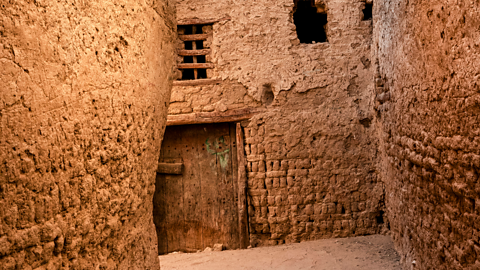
In the early Islamic civilisation, houses were made from mudbrick (brick made from mud and straw, that is dried in the sun), clay or stone.
The walls were thick and the ceilings high to help keep the inside cool in the hot climate.
Almost every house was built around a courtyard, which had a garden or fountain.
Families used it for cooking, playing and meeting guests.
There were also charcoal ovens that were used to bake bread.
Many houses were built with few or no windows facing the street.
Instead, windows usually faced the courtyard instead. This helped keep families safe.
Wooden screens over windows helped to keep houses cool by letting air inside while keeping the sun’s heat out.
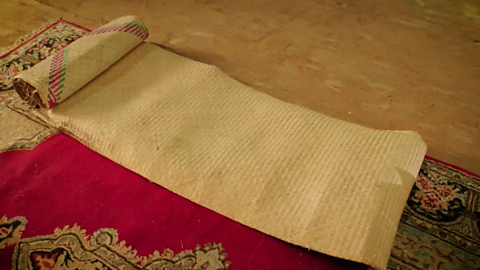
The houses were decorated with textiles on the walls, screens and pottery. People were used to sitting on carpets or low platforms which could be rolled out when needed.
What was Baghdad like in AD900?
Caliph Al-Mansur ordered the building of Baghdad between AD762 and AD767.
In AD900, Baghdad was one of the biggest and richest cities in the world.
There were around 1 million people living in Baghdad by AD900.
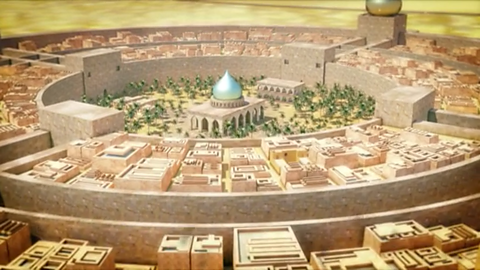
When Baghdad was built, it was made in the shape of a circle. That’s why it was called the Round City. It had round walls all around it and four big gates – one in each direction (North, South, East and West). In the centre of the Round City was the Caliph’s palace (the ruler’s home) a big mosque (place to pray) and the House of Wisdom. . The House of Wisdom was a huge learning centre where people studied.
Nomadic people (people who move from one place to another) were groups who did not live in one place but moved around often. They lived in tents that were easy to carry, which suited their lifestyle of herding animals such as sheep, goats and camels. As more cities were built, many people began to settle down and live in one place instead of moving from place to place. Nomadic groups still played an important role by trading animals, wool and other goods with people in big cities like Baghdad.
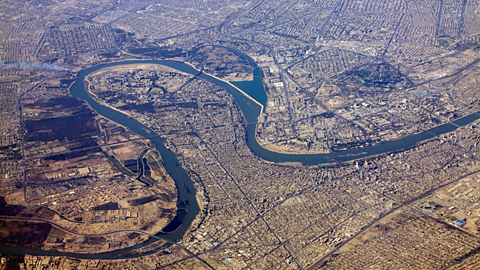
Baghdad was built on the banks of the Tigris River, which made it easy to travel and trade with other parts of the empire. Many important trade routes passed through the city. Boats carried goods like food, cloth and books.
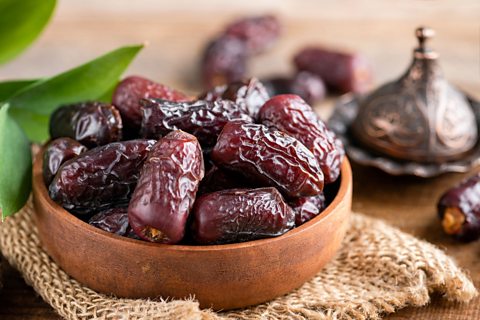
The river provided fresh water for drinking, cooking, and farming. The land around the river was very fertile (good for farming). Farmers grew crops like wheat, dates, and barley, which helped feed the big population.
People came from many different parts of the empire to live in Baghdad, bringing with them ideas, wealth and goods. The city was world famous as a centre of learning with libraries, schools and hospitals.
What did buildings look like in the early Islamic Civilisation?
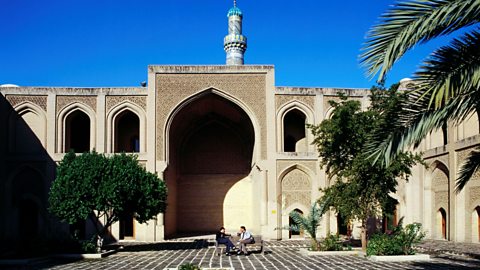
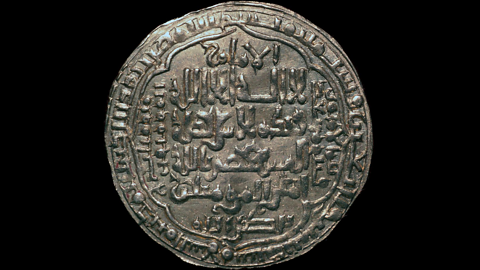
Instead of pictures of people or animals, many buildings had patterns and Arabic calligraphy (beautiful writing from the Quran or poetry) on the walls.
Mosques (a place to pray) had huge domes with tall minarets (towers). The minarets were used to call people to prayer. Inside mosques were decorated with patterns and calligraphy (beautiful writing) instead of pictures.
Rich buildings, mosques and palaces were decorated with colourful tiles, often blue, green, yellow, or white and arranged in patterns.
Doors and windows were often designed as arches and were carved with intricate designs to make them look elegant.
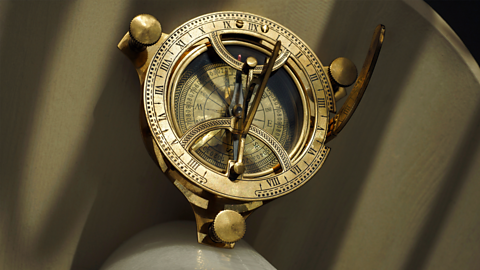
Click the arrows on the slideshow below for examples of early Islamic buildings:
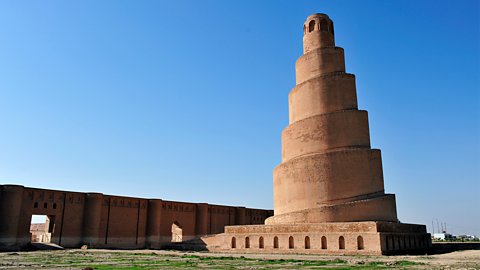
Image caption, The Malwiya Minaret was built in the 9th century in the city of Samarra. It was part of the Great Mosque of Samarra which was the largest mosque in the world at the time.
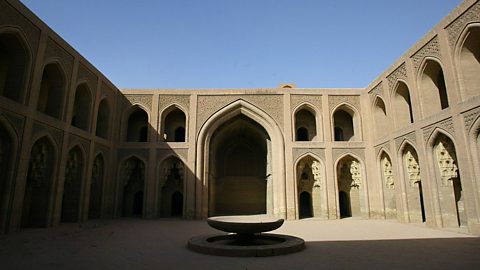
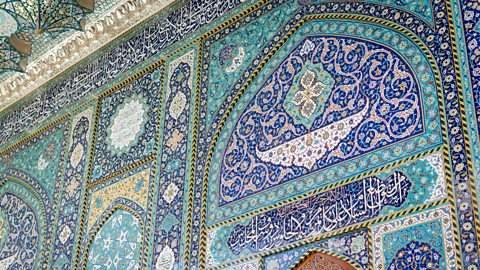
1 of 3
Think like a historian

Have a look at the thinking points below and think about your answer to each question. You could even write them down on a piece of paper or discuss them with somebody else if you want to.
Why were houses in the Islamic civilisation built from different materials like mudbrick, clay or stone?
Why was it important that Baghdad was built on the Tigris River?
How was Baghdad different from other cities because it had four gates?
Did you think about the climate in the places where early Islamic civilizations lived? It was very hot. Houses were made from mudbrick, clay or stone because these materials are strong but also help keep the inside cool. The thick walls stop the heat from getting in, so even on hot days, the inside of the house stays cool.
Perhaps you thought about why civilisations would build cities near rivers? The river gave people fresh water for drinking, cooking, and farming. It made it easy to travel and trade, boats could carry food, cloth, books and other goods to and from the city. The land around the river was fertile, which means it was very good for growing crops like wheat, dates, and barley to feed the city’s big population.
Did you think about why Baghdad had four big gates, one in each direction: north, south, east, and west. This helped people enter and leave the city easily, allowed traders and travellers from different regions to come in and helped the city manage traffic and goods. It also meant that if one gate was blocked, people could still use another to get in or out safely.
Activity: Quiz – Early Islamic houses
Grown-ups corner
Are you a parent, carer or teacher?
Take a look at some of the links below on KS2 History which are packed full of knowledge, videos, quizzes and activities.
KS2 History: Non-European Societies
BBC Bitesize for Teachers
Baghdad in AD900
BBC Bitesize for Teachers
How the pyramids were built
BBC Bitesize for Teachers
Horrible Histories: Raid and Trade game! game
Play Horrible Histories: Raid and Trade KS2 History
More on Islamic civilisation
Find out more by working through a topic
- count3 of 5
- count1 of 5