What was the early Islamic civilisation?
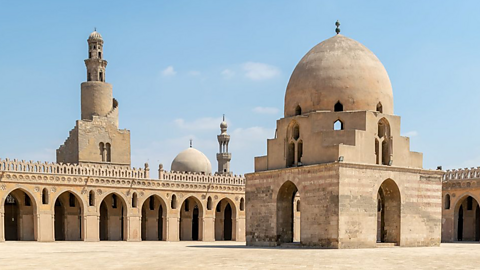
The early Islamic civilisation began in Arabia (now known as Saudi Arabia, Oman, UAE and Yemen) shortly after the death of Prophet Muhammad.
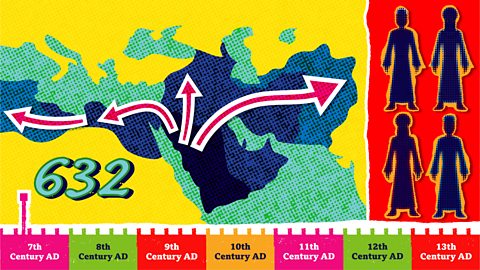
Under the leadership of caliphs, it grew into an empire and expanded across the Middle East, North Africa and parts of Asia.
Important words
Important words on where the Islamic Civilisation existed.
| Keyword | Definition |
|---|---|
| Caliph | A leader in Islam. |
| Empire | A group of countries and lands ruled by one person or government. |
| Golden Age | A time when Muslim countries made progress in science, maths, medicine and art. |
| Hostility | Unfriendly or unkind behaviour. |
| Revelation | Receiving an important message from God. |
Timeline: Early Islamic civilisation
Image caption, Click the arrows to learn more about the Islamic civilisation!
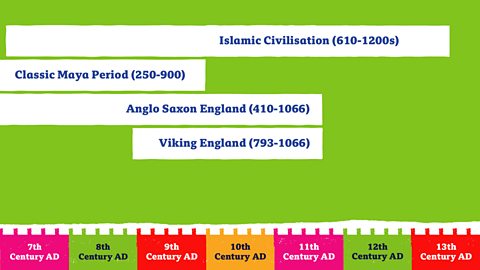
1 of 8
Watch: How did the early Islamic civilisation grow?
Explore how the early Islamic civilisation grew in this video.
The Islamic civilisation began with one man and a small group of people in what is now Saudi Arabia.
Over time, different leaders helped it grow into a powerful empire with many cities.
The first leader was the Prophet Muhammad, who started the religion of Islam. After he died, Muslim leaders called caliphs carried on his work. A caliph was like a king, and when he died, his son or another family member would usually take over.
This meant the same powerful family would rule for many years, until a different powerful family would take charge.
Each family's time in power, and the places they ruled, was called a caliphate. The first caliphate was called the Rashidun. They took over new lands where different groups lived. Over time, many people in these areas chose to become Muslims too.
Then, the Umayyad took power. Their caliphate linked regions together and made Arabic the official language. They built great buildings like the Dome of the Rock in Jerusalem.
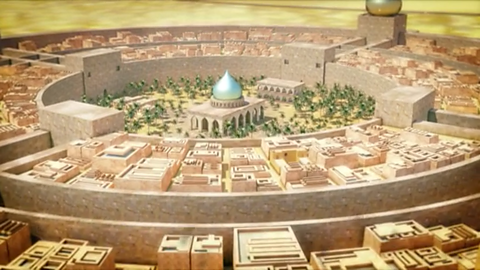
Later, the Umayyads were defeated and the Abbasid caliphate began. Its capital, Baghdad, became a centre of learning and trade for people from many places.
Since the Prophet Muhammad, strong leaders, new lands, and learning helped the Islamic civilisation grow for over 700 years.
When was the early Islamic civilisation?
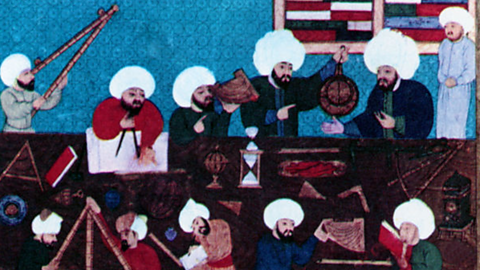
The early Islamic civilisation began around AD600 and expanded quickly.
Historians disagree about when it ended, but many believe it ended in the 13th century when cities like Baghdad were invaded and destroyed.
Where was the early Islamic civilisation?
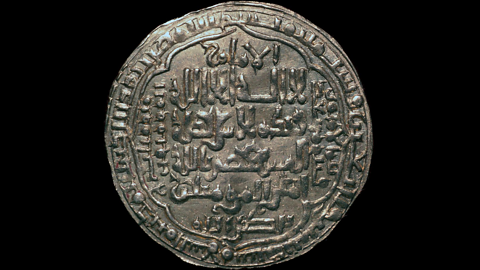
The civilisation wasn’t one country, it included many areas where people practised Islam. Religion was very important in everyday life.
It spread from the Middle East, west to North Africa and Spain and east to India. The leaders of the Islamic Empire helped spread Islam by travelling to these countries and sharing their beliefs, teaching people about the religion, building mosques and encouraging learning.
In some areas, leaders gained control of new lands through military conquests as the empire grew.
Important early Islamic cities were Baghdad (in modern-day Iraq), Córdoba (in Spain) and Cairo (in Egypt).
How did the early Islamic civilisation begin?
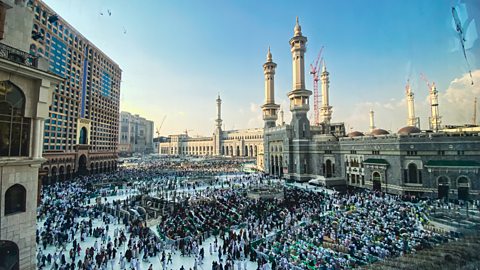
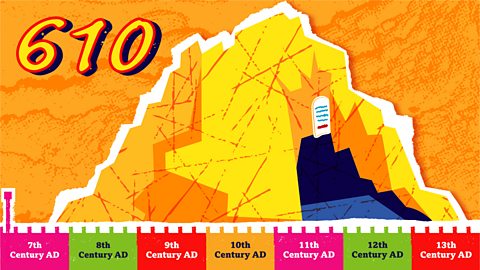
Muhammad was born in Mecca, in AD610 it is believed that he received his first revelation.
He was called a Prophet – a person who receives and shares messages from God. He taught that there is only one God.
Those who believed these messages became known as Muslims. This marked the beginning of a new religion – Islam.
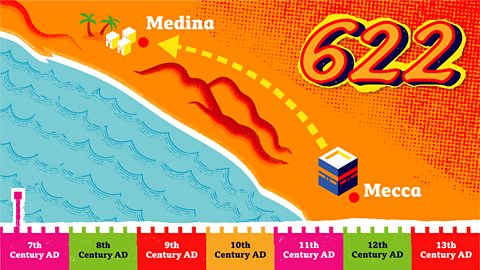
In AD622, the people of Mecca showed hostility (unkind behaviour) towards Prophet Muhammad because they didn’t like his message. He and his followers moved to Medina. He built a mosque, an Islamic place of worship.
Eight years later, he returned to Mecca and many more people became Muslims. Rulers in the Middle East began to accept Islam and Muhammad as their leader and Prophet.
Muhammad fell ill and died in AD632. After his death, leaders called caliphs ruled the Islamic Empire and it continued to grow.
What is a caliph?
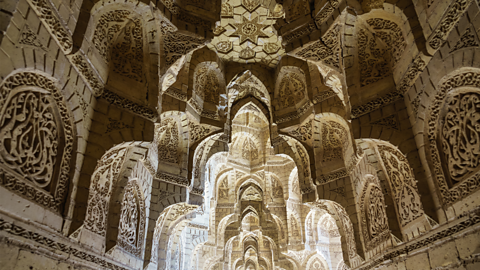
The Islamic Empire was made up of different Islamic states or areas. These states were known as caliphates and ruled by the same leader. Leaders of the Islamic Empire were known as caliphs. A caliph was seen as the successor to the Prophet Muhammad.
There were four main caliphates.
The three which took place during the early Islamic civilisation were; Rashidun, Umayyad and Abbasid.
The Ottoman Caliphate came much later and was not in this period.
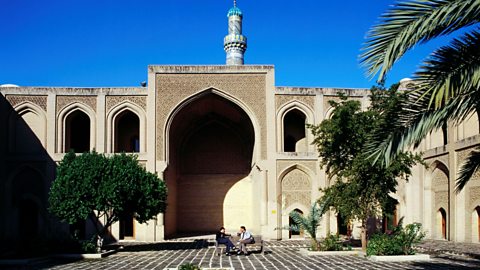
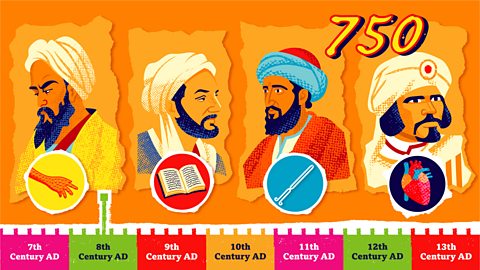
The Islamic Golden Age began during the Abbasid caliphate. Many advances were made in medicine, science, maths and art. People were encouraged to learn and discover new things.
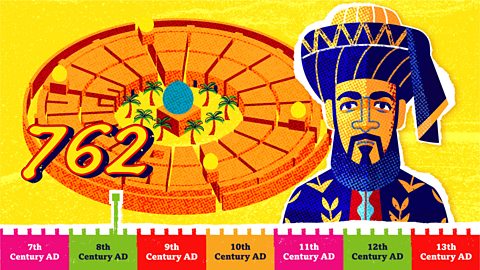
During the Golden Age, Caliph Al-Mansur ordered the construction of a new capital city. This city was built on the banks of the River Tigris and known as Baghdad, a place of learning.
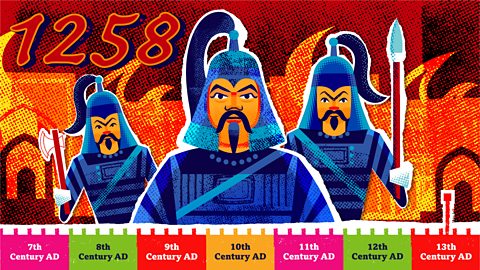
In 1258, the Mongol armies from the east destroyed Baghdad and ended Abbasid rule.
Think like a historian

Have a look at the thinking points below and think about your answer to each question. You could even write them down on a piece of paper or discuss them with somebody else if you want to.
How did the spread of the Islamic Empire affect the places it reached?
What role did the caliphs play after Muhammad’s death?
Why was the Abbasid caliphate important for learning and discoveries?
You might have considered how the spread of the Islamic Empire resulted in people learning about Islam and converting to the religion. Arabic became a common language. People shared their knowledge and learned from each other.
Perhaps you thought about how the caliphs were Muhammad’s successors and helped lead the empire. They made important decisions and helped the empire grow by spreading Islam to new places.
You might have considered how the Abbasid caliphate built schools and libraries, they encouraged people to learn. This led to big discoveries in medicine, science, maths and art.
Activity: Quiz – Introduction to early Islamic civilisation
Grown-ups corner
Are you a parent, carer or teacher?
Take a look at some of the links below on KS2 History which are packed full of knowledge, videos, quizzes and activities.
KS2 History: Non-European Societies
BBC Bitesize for Teachers
Baghdad in AD900
BBC Bitesize for Teachers
What did the Maya invent?
KS2 History
Horrible Histories: Raid and Trade game! game
Play Horrible Histories: Raid and Trade KS2 History
More on Islamic civilisation
Find out more by working through a topic
- count3 of 5