What were Indus homes like?
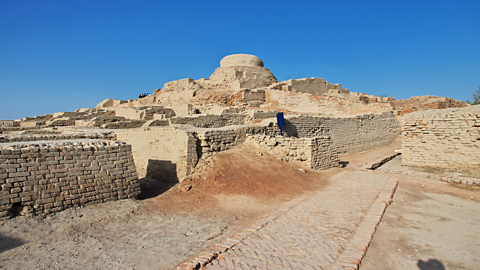
It was very hot in the Indus Valley so people spent a lot of time outside.
Most people had small homes which were also used as workshops and there was not much space to relax.
Richer families had courtyards (an unroofed area surrounded by walls), these were nice open spaces.
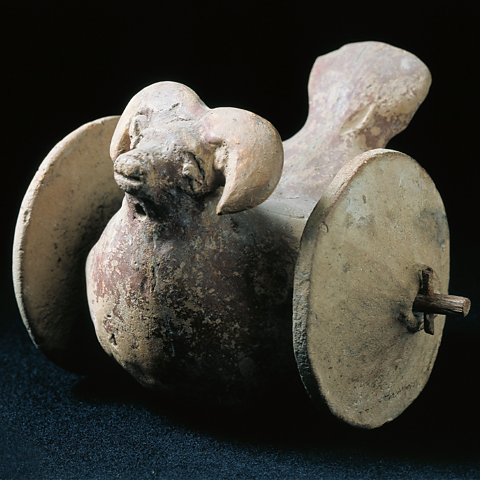
Children could play the courtyard with their toys or pets, such as monkeys and birds.
People who did not have a courtyard would still have a flat roof, these roofs were strong enough to walk on so some families used them as an extra room.
It was a cool place to sleep on a hot night and somewhere you could sit with friends.
Important words
Important words on what life was like in the Indus Valley.
| Keyword | Definition |
|---|---|
| Courtyard | An unroofed area surrounded by walls. |
| Priest | A person who leads religious ceremonies and activities. |
| Scribe | A person who writes or copies things out. |
Watch: What was everyday life like in the Indus Valley?
Find out about the busy cities, markets and farms of the Indus Valley, and learn about the mysterious writing that still puzzles us today.
Over 4,000 years ago, in what is now modern-day Pakistan and northern India, everyday life for the people of the Indus Valley was very organised. Farmers grew wheat, barley, and cotton. They used cutting tools called sickles, and ploughs to dig the soil.
Away from the farms, people lived in towns, in houses made of baked clay bricks. Many had courtyards where families cooked food in clay ovens.
The towns had busy markets. Craftspeople may have sold goods like cotton clothes, necklaces and children's toys. Weights and measures were used to make sure sales were fair.
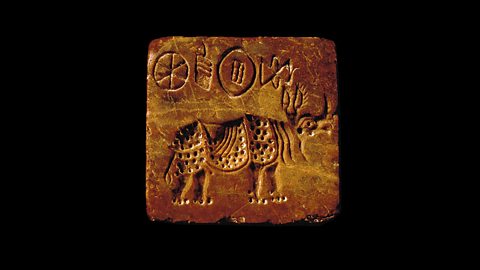
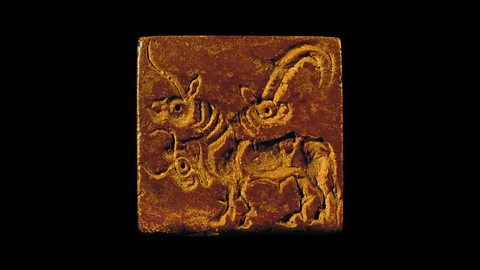
People also kept small statues and seals – little stone stamps with pictures. Historians think some of these might have had special religious meanings. This could show that religion was part of daily life in the Indus Valley, not just special ceremonies in places like the Great Bath at Mohenjo-daro.
The Indus Valley people also created their own writing system, although no one can read it today – it's a mystery still waiting to be solved.
Farming and trading were a part of everyday life in the Indus Valley. Many people lived in cities, and shared a life shaped by family, beliefs, and fairness.
Growing up in the Indus Valley
We only know a little about what it was like to be a child growing up in the Indus Valley cities.
We don't know how many children went to school.
A scribe (a person who writes or copies things out) would teach some children how to read and write and a priest (a person who leads religious ceremonies and activities) would teach religious lessons.
Even if they didn't go to school, most children worked hard.
Children were taught how to make things, how to farm and how to hunt.
It wasn't all work though, children could play in the courtyards of houses, and probably on the flat roofs too. The roof could be a fun place to play. You could wave to your friends across the street!
Children might have played board games with counters and dice.
Archaeologists have found cube dice with six sides and spots, just like the ones we use today. Historians think the Indus people invented dice.
How did Indus people buy things?
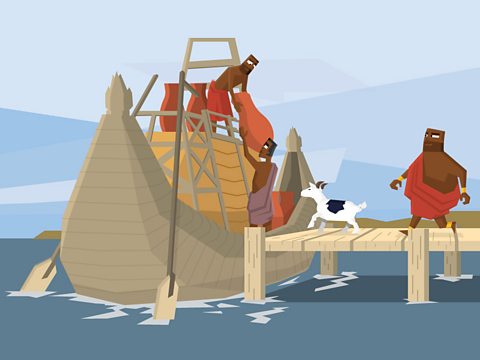
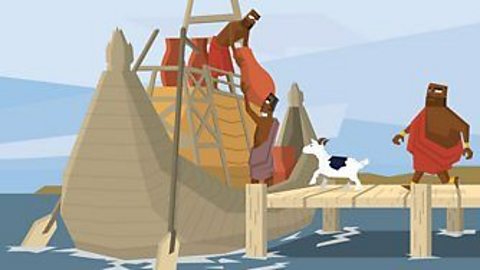
Indus Valley traders did not use money, so they probably exchanged goods.
They might have swapped two sacks of wheat for one basket of minerals, such as copper, lead or even gold…
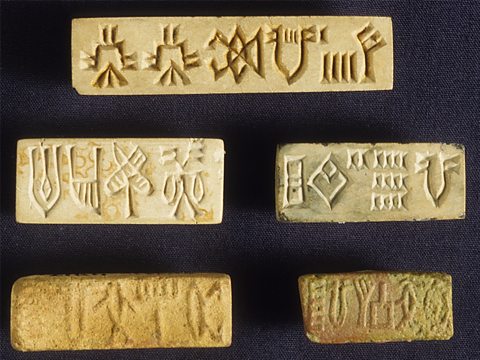
Archaeologists have discovered flat pieces of stone with writing carved into them in the Indus Valley.
At first they were confused, but then they realised these stones were seals.
If you pressed the seal into soft clay, it left a copy of itself on the clay.
When the clay dried hard, it could be used as a tag, which could then be tied to a pot or basket.
Over 3,500 seals have now been found!
What did the Indus seals look like?
Archaeologists think that the Indus traders might have used seals like labels, to show who owned a sack of grain, or that the correct city tax had been paid.
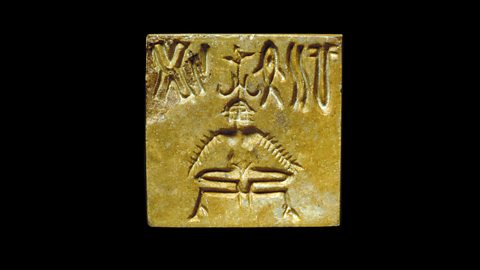
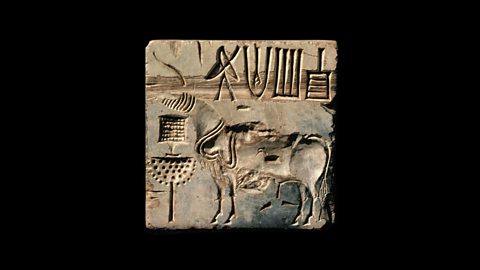
Lots of seals have pictures of animals on them, including elephants, rhinoceros, tigers and crocodiles.
The symbols and pictures that are on the seals may help historians and archaeologists translate the Indus script in the future.
Click through the slideshow to see some examples of Indus seals.
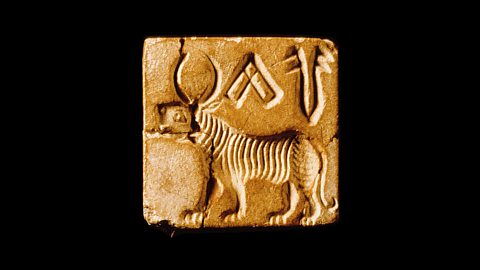
Image caption, This seal shows a tiger with many stripes. Tigers were common in the time of the Indus civilisation.
1 of 5
Think like a historian

Have a look at the thinking points below and think about your answer to the questions. You could even write it down on a piece of paper or discuss it with somebody else if you want to.
Why are the Indus seals a significant source for historians and archaeologists?
How have the roles of children changed over time?
Why might it have been more difficult for people to trade without using money?
The seals show different animals that the Indus people interacted with and some contain letters and symbols that might prove to be useful in translating their language at some point in the future.
Few children in the past would have gone to school, most would have worked or helped out at home. There would have been time for play, but most of the day would be given over to working or learning how to craft or farm.
Without using money, it might be difficult to know how much something was worth. If everybody decided on different amounts, you would have to speak with each other to decide what would be a fair swap.
Activities
Activity 1: Daily life
Click around below to find out more about daily life in the Indus Valley.
Activity 2: Jobs
Click below on these Indus people to find out about their jobs.
Activity 3: Quiz – Life in the Indus Valley
Grown-ups corner
Are you a parent, carer or teacher?
Take a look at some of the links below on KS2 History which are packed full of knowledge, videos, quizzes and activities.
KS2 History: Non-European Societies
BBC Bitesize for Teachers
KS2 History: Introduction to the Indus Valley
BBC Bitesize for Teachers
History KS2: The Story of China - The Rise and Fall of the Shang
BBC Bitesize for Teachers
Horrible Histories: Raid and Trade game! game
Play Horrible Histories: Raid and Trade KS2 History
More on Indus Valley
Find out more by working through a topic
- count4 of 8
- count5 of 8
- count6 of 8