Words you never thought to exist
There’s a good chance you’ve either seen or used an aglet today. You might even have waggled your minimus, or noticed your glabella in the mirror.
Like a drupelet or a ferrule, these are all names for things that play a part in everyday life. It’s just that we may never have needed to use their official titles before or are unaware they exist in the dictionary.
But by the time you reach the end of this article, BBC Bitesize aims to help you distinguish between an obelus and an octothorpe - even if you never use any of these words, ever again…
The gap between your eyebrows
If you feel comfortable doing it, touch the top of your nose and you’ll probably feel a small indentation. Immediately above that is the area of skin between your eyebrows.
It could be a part of your face that you rarely think about, but that patch of skin between the brows does have a name. It’s called the glabella, from the Latin term glabellus.
It means hairless, as it is usually a smooth, bald piece of skin.

The bumps on a raspberry
Did you know there's a name for the bumps on a raspberry? And not just a raspberry, this also applies to a blackberry.
Each of those lumpy segments that cover the surface of these fruits is called a drupelet. It comes from the word drupe, a fleshy fruit surrounding a single seed, such as a cherry.
Each of the bumps on a raspberry or blackberry can be considered a small (as in teeny-tiny) drupe, so it’s known as a drupelet. Cute!

The bit at each end of your shoelace
Allowing the ends of our shoelaces to run free and fray would make threading them through the holes (or eyelets) in our shoes a fiddly, time-consuming task. It was certainly something that wasn't going to delay someone's day in Ancient Rome.
They were among the earliest people to place a small solid tip on the end of a lace or ribbon to make it easier to thread and tie them. Whereas plastic or metal is usually used today, back then they would have been made from glass or stone, but possibly metal too, such as brass or silver.
Nowadays, these tips are called aglets, and were once known as aiglets. The name comes from the French word aigulette, a form of aiguille which means ‘needle’ - think about how you thread a lace onto your shoe and the aglet does act like a kind of needle!

The real name for your little fingers and little toes
This one is short but sweet - just like our own little toes and little fingers.
In anatomy, the smallest digits on our hands and feet, usually the outermost digits, are known as the minimus. It also applies to zoology, so your pet dogs and cats have their share of minimus (or minimi in the plural) too.

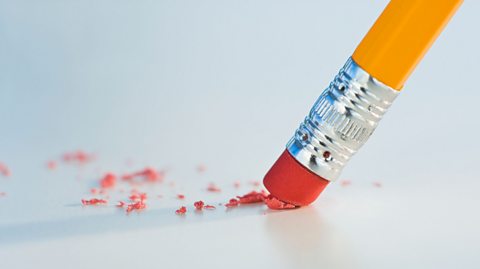
The metal that connects an eraser to a pencil
The first patent for a pencil with an attached eraser was granted in the USA in 1858.
Back then, the inventor enlarged part of the groove that housed the pencil lead, enabling the eraser to slot in. These days, we’re more likely to see a crimped metal tube that bridges the gap between the top of the pencil and the bottom of the eraser.
It’s called a ferrule, and the name comes from a combination of the Latin ferrum (for iron) and verrel or virl, another Latin word which suggests a small bracelet known as a viriola. That’s a lot of language in one little tube.
The official names for the hashtag and the division sign
Social media must have done wonders for the hash sign, or hashtag (#). The symbol can be used to indicate the subjects people are talking about and to help others search for that topic.
Its history is linked with telecommunications, when the symbol was adopted as one of the buttons on a telephone keypad. Looking a little like a noughts and crosses board, the engineers who developed it needed to give it a name. The prefix Octo was chosen to reflect the eight points on the symbol, but another syllable or two was required to complete the name. In the end, the symbol became known as the octothorp (or octothorpe), although it remains something of a mystery where the 'thorp/e' part of the name originated.
And a division sign (÷)? That’s an example of an obelus symbol (there are other obelus symbols, which look slightly different to the one we recognise from our maths books). The Swiss mathematician Johann Rahn is generally credited with being the first to use an obelus in this way in the 1659 book Teutsche Algebra. It’s not, however, a universal symbol for division - another example is the slash (/), also known as a solidus.

Challenge: How many of these everyday names do you know?
We've created a challenge to see if you can name the real names of objects and items mentioned in this article.
Don't scroll up! Test your knowledge and see if you can complete our Bitesize challenge - good luck!
This article was published in April 2022 and updated in July 2026
