Handedness through history
From a young age, we begin learning how to write letters and sentences, forming our own style and handwriting. Most children naturally pick up a crayon or pencil with their right hand and get to work, whereas a small percentage do the opposite – using their left hand instead.
But have you ever thought about how rare left-handedness is? And is it genetic?
Here, BBC Bitesize takes a closer look. From historic perceptions and superstitions to famous left-handed figures and more, there are plenty of interesting facts below.
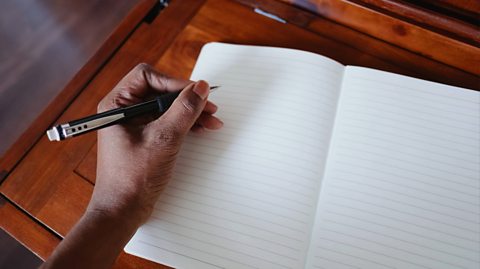
How do you know if a child will be right or left-handed?
Handedness – an individual's natural preference in using one hand for tasks such as writing – is developed from a young age.
As they grow, play and learn, babies will often use and swap both hands depending on what they are doing or what is convenient.
Occupational Therapist Lindsay Carr previously told CBeebies Parenting: “It might be that this hand is the one they tend to swap toys into for more complex tasks, or the one they reach out for things with. But I wouldn't say that actual handedness (hand dominance) develops until between three and six years.”
Every child is unique and develops at different times and in different ways. But as time goes on, parents and teachers can observe which hand a child naturally uses for fine motor actions, such as holding a pen or using a knife and fork.
The exact reason why people have different hand preferences is not clear, but studies suggest it is linked to everything from genetics to human evolution – which we will explore next.
Why are people mostly right-handed?
There have been various stigmas around being left-handed throughout time – which we will get onto shortly. As a result, more people through the generations claimed to be or opted to use their right hand instead of their left, which inevitably impacted how many people society thought to be right-handed.
According to archaeologist Natalie Uomini of the University of Liverpool: “There has never been any report of a human population in which left-handed individuals predominate.” So why is almost everyone right-handed?
About 90% of the world’s population is right-handed and over the decades, much research has been done regarding if this is due to development, the brain and genetics. It remains quite the enigma, but there are several studies and suggestions as to why most of the population is right-handed.
It would be impossible to name all studies and theory, but some argue that it could have something to do with the left hemisphere of the brain, which primarily controls the right side of the body. The left hemisphere of the brain is the centre for language and analytical thinking, so consequently, some argue that as the left hemisphere evolved for language and sequential tasks, perhaps so did the left brain's dominance over the right hand.
In May 2026, new research published in PLOS Biology and led by the University of Oxford suggests the answer comes down to “two defining features of human evolution.” These are walking on two legs and the dramatic expansion of the human brain.
The University of Oxford previously said: “The findings point to a two-stage story. Walking upright came first, freeing the hands from the work of locomotion and creating new selective pressure for fine, lateralised manual behaviours. Larger brains came later, and as they grew and reorganised, the rightward bias hardened into the near-universal pattern seen today.”
There is still much research to be done – but maybe one day a full explanation as to why we are right-handed, left-handed or even ambidextrous will come to light.
What is ambidextrous?
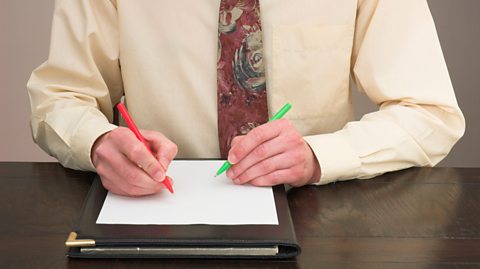
The word ambidextrous derives from the Latin word ‘ambidextor’ - a combination of the words ‘ambi' (both) and ‘dexter’ (right). It means having the ability to write with both your right and left hands with equal skill.
Thus, the translation suggests having the skill of a ‘right’ hand in both hands. Being ambidextrous is extremely rare, with many sources stating only 1% of the world's population is naturally ambidextrous.
With practice and patience, many people have trained themselves to be ambidextrous.
How rare is left-handedness?
Left handedness is said to date back to around 500,000 years ago to Neanderthals, our early human ancestors. But even today, being naturally left-handed is still very rare.
The exact percentage can vary depending on factors like region or age - but research suggests that around 10% to 12% of the world’s population is left-handed. This percentage will have varied over time, as in modern day, being left-handed is much more accepted and less stigmatised.
If you’re left-handed, you’ll also be pleased to know that there is a dedicated day to celebrate left-handed individuals. Taking place annually on 13 August, International Left-Handers Day celebrates the uniqueness of left-handers, while also raiding awareness of some of the challenges they face in a world that is largely designed for right-handed people.
1975: The world's first shop for left-handers
Originally broadcast on BBC One on 18 April 1975, this BBC Archive video captures life inside the world's first shop for left-handers. The footage is taken from current affairs programme Nationwide and shows presenter Susanne Hall visiting the shop in London.
The business catered for left-handed people and offered products to customers both in-store and via mail-order. Items available at the time included left-handed playing cards.
BBC Archive offers a unique collection of thousands of archive films, capturing life and events across the UK since the 1940s.
Video begins with a phone ringing and a shop owner answering
Answering the phone, the shop owner says: "Anything Left-handed Limited? Yes. Left-handed corkscrews. I'm very sorry, but we're waiting for those to come in. Would you like to give us a call in a month's time? Thank you - Very well. Goodbye."
Video cuts away to inside the shop
Holding scissors, one customer asks: "I suppose you don't stock left-handed forceps on a left-handed dentist."
The shop owner replies: "Oh."
Presenter Susanne Hall begins voice-over during the segment
Susanne Hall says: "Anything Left-handed is the world's first shop catering exclusively for the left-handed. And since an estimated five to 10% of the world's population is naturally left-handed, their mail order business is fairly brisk."
Presenter Susanne Hall enters the shop
Susanne Hall says: "Hello. This looks like the place for me, a left-handed shop. And there's a left-handed potato peeler. How much is that?"
The shop owner replies: "35 pence."
Susanne replies: "I'll have one of those for a start. Is it all right if I just have a look around and help myself?"
The shop owner replies: "Please do."
Susanne says: "Well, first of all, now, what could that be? Ah, yes, left-handed address book. That actuallyfeels just a little bit awkward to me. Left-handed note case. No notes in it, but very handy. A little bit further down, all sorts of different sorts of scissors. Pinking shears."
The shop owner says: "Yes."
Looking around, Susanne continues: "I have had difficulty, yes, with pinking shears. Pair of secateurs, especially for me, £4.50's worth. The chances are nobody else would pinch them. A trowel, a builder's trowel, a left-handed builder - sharp on the side that he would hammer his bricks with. That's… another novelty.
"A pack of cards. Now, people like me who live in a right-handed world have got used to doing that. Alternatively, it would be much simpler, of course, to do that. Oh, yes - and a left-handed moustache cup. Oh, dear. Are there any things that you haven't been able to get hold of that you would like to stock?"
The shop owner says: "Oh, yes. A tape measure. Everybody wants that. We've never been able to get one."
Susanne responds: "A left-handed tape measure?"
The shop owner says: "Yes, because the left-handed measures, as you see from the ruler, the opposite way."
Susanne says: "I'd never thought of that."
The shop owner continues: "And the chequebook. Everybody would like to have a left-handed chequebook. And, of course, again, in stock, the left-handed corkscrew, which is - so many people ask for."
Susanne asks: "What about gardening tools?"
The shop owner replies: "Gardening tools, we've… Again, we've lost the grass hook, which was left-handed grass hook, and we've got part of a left-handed sickle, but we can't get the blades for it. Well, I would think that the manufacturers should bear in mind, and that's what we're trying to do, and consider what fair proportion of left-handed items that they should produce. I mean, the scissor manufacturers have tackled that. So have the golf club manufacturers."
Cuts to Susanne holding a greetings card in the shop
Susanne said: "And just in case there's anybody who's thinking to themselves, I bet she doesn't write with her left hand. Well, I do. And just to prove it… I'm going to write with my left hand, my left -handed signature, with a left-handed pen on a left-handed greeting card."
Cuts to close up of Susanne writing out a greetings card
Susanne says: "But just one thing. Where is the shop for the ambidextrous?"
Cuts to close up of Susanne writing out a greetings card with both hands - end of segment
Is left-handedness genetic?
In some families, there is more than one person who is left-handed. But does that mean left-handedness is in fact genetic?
Well, it’s not as straightforward as that. Left-handedness does have a genetic component; however, it is not determined by a single gene and is not strictly hereditary.
Back in 2019, BBC News reported how scientists had found “the first genetic instructions hardwired into human DNA that are linked to being left-handed.” Many mysteries remain regarding the connection between brain development and the dominant hand.
But at the time, the genetic instructions reported seemed to be “heavily involved in the structure and function of the brain - particularly the parts involved in language.” At the time, Professor Gwenaëlle Douaud told BBC News: “It tells us for the first time that handedness has a genetic component.”
This isn’t the only study surrounding a link between DNA and left-handedness. A study by Northern Irish psychologist Peter Hepper previously looked at hundreds of scans of babies sucking their thumbs in their mother's womb before birth.
Newsround previously reported how 90% of the babies sucked their right thumb - and almost all of those same babies grew up to be right-handed. Three-quarters of the babies who sucked their left thumb also went on to become left-handed.
For a time, there was also a belief that left-handed people would live, on average, nine years less than those who were right-handed. However, this myth stemmed from a flawed research study from the late 1980s and early 1990s by psychologists Diane Halpern and Stanley Coren.
What are the left-handed superstitions?
Throughout time, there have been many superstitions around being left-handed - as well as some negative connotations.
The English word ‘left’ derives from the Old English ‘lyft,’ meaning ‘weak’ or ‘foolish.’ The Latin word for left is also ‘sinister,’ which in modern English means to be evil or threatening – so you can see where we’re going to go with this.
In some religious texts, the left side often symbolises foolishness or judgement. For centuries, there was the belief in some cultures that being left-handed was also a mark of the devil.
In Britain in the Middle Ages, those who favoured writing with their left hand were accused of witchcraft, a crime for which the punishment was being burned at the stake. Being left-handed was often seen as something that needed correcting, with generations forced to conform and use their right hand out of religious and cultural biases, as well as different practical limitations throughout time.
However – it’s not all bad. The superstition surrounding an itchy left hand is often considered to be a good thing, as it is said to symbolise incoming wealth. There has also long been a belief that those who are left-handed are more creative – but what do you think?
Which notable people are left-handed?

There are so many notable people spanning generations, and across different industries and professions, who are left-handed. And while it would be impossible to include everyone - here are a few famous faces you may or may not know are left-handed.
More historically, master painter Leonardo da Vinci, known for iconic works such as the Mona Lisa and The Last Supper, was famously left-handed. Sculptor and painter Michelangelo was widely reported to be innately left-handed; however, he is said to have trained himself
In the world of literature, Lewis Carroll, author of Alice’s Adventures in Wonderland, science fiction author H.G. Wells and Hans Christian Andersen, known for fairytales like The Little Mermaid, were also lefties. In fashion, Jean-Paul Gaultier is also left-handed, as well as sports legends Paula Radcliffe and Pelé.
When it comes to music, artists Sir Paul McCartney, Jimi Hendrix, David Bowie, Lady Gaga, Miley Cyrus, Justin Bieber and Celine Dion are all left-handed. In the media and entertainment industry, the left-handed list continues with directors James Cameron and Spike Lee and actors Robert Di Niro, Angelina Jolie, Tom Cruise, Jennifer Lawrence, Nicole Kidman, Julia Roberts and John Cena.
Other notable names include Barack Obama, Prince William, Oprah Winfrey, Marie Curie and Bill Gates.
Other interesting left-handed facts and theories
Here are some more facts and theories you may be interested in!
- What countries drive on the left?
There are many countries across the globe that drive on the left side of the road – not just the UK! This includes Ireland, Cyprus, Australia,Japan and Kenya.
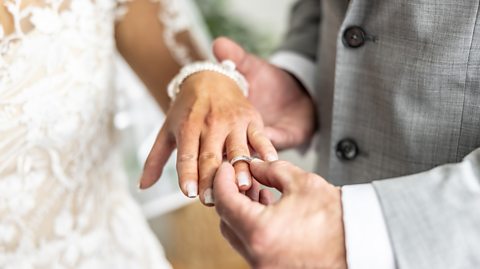
- Why are wedding rings worn on the left hand?
Wedding rings are traditionally worn on the left hand in many countries and cultures. The fourth finger on the left hand is typically known as the ‘ring finger’ – but how did this tradition begin? The tradition is said to stem from an ancient belief that a blood vessel – known as the ‘vena amoris’ (Latin for vein of love) - connects the fourth finger on the left hand directly to the heart.
- What is Fleming’s left-hand rule?
If you’ve ever studied electromagnets, you may have heard of Fleming’s left-hand rule. The direction of a motor effect force can be found using the rule, by holding your thumb, forefinger and second finger at right angles to each other. You can find out more about that here.
This article was written in July 2026
