Out of this world facts
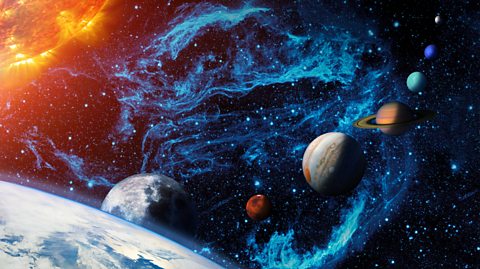
Full of celestial bodies orbiting the Sun, our Solar System has fascinated people for generations. There are eight planets in our Solar System - Mercury, Venus, Earth, Mars, Jupiter, Saturn, Uranus and Neptune - and the majority take their names from Roman or Greek mythology.
Billions of years old, our Solar System has been studied for generations and we are still continuing to learn more about it every day.
But, if you think you’re pretty clued up on all things Solar System, think again. Here, BBC Bitesize shares just 10 interesting facts that you likely didn't know about our Solar System.
1. You can't stand on Uranus
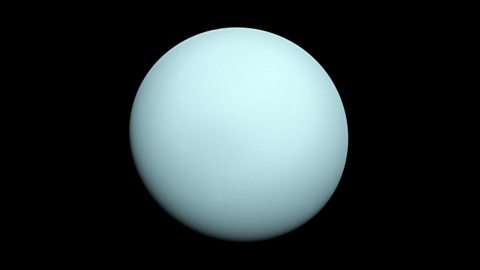 Image source, NASA
Planets are celestial bodies that orbit a star and can be made up of rock, gas or a mix of both. In order from distance from the Sun, the latter four planets - Jupiter, Saturn, Uranus and Neptune - are known as gas planets or gas giants.
If we ever manage to travel to the gas planets, you might be in for a bit of a shock when you step off the spaceship. That’s because Jupiter, Saturn, Uranus and Neptune don’t have solid surfaces - they have a rocky core, but are mainly big balls of hydrogen and helium.
Image source, NASA2. The whole of Mars is as cold as the South Pole
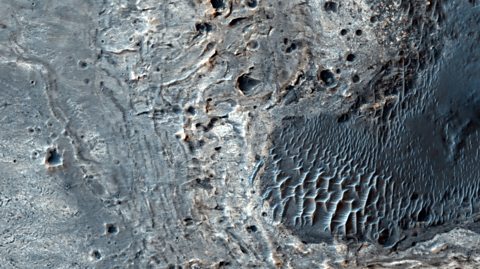
If you’re travelling to Mars anytime soon, be sure to bring your big coat. Its average temperature is roughly -60°C, the same as the South Pole (minus the penguins).
Some scientists, in the hopes of making it more habitable, have suggested ways in which we could make Mars warmer. One of these ideas is to build giant mirrors that will reflect the Sun's rays, and kick-start some speedy Martian warming.
3. Saturn's rings are 90% water
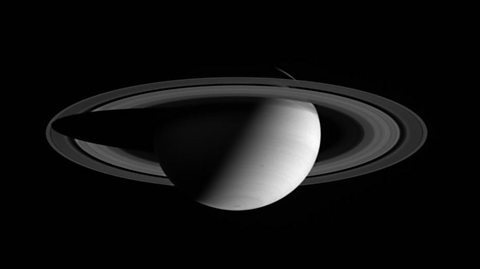 Image source, NASA
Saturn is home to the Solar System’s most epic ice rink. Being so far from the Sun, the water in its rings is frozen into ice.
It is one of four planets that have rings around them - the other gas planets do too. However, the rest were undiscovered until the 1970s when probes went to explore them and Saturn’s were the first rings seen through telescopes from Earth.
Image source, NASA4. Jupiter’s largest moon has a salty ocean with more water than Earth
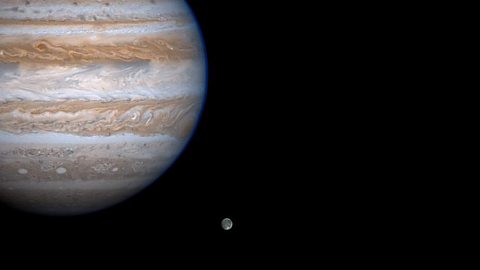 Image source, NASA
Forget holidays in the Mediterranean. If you want vast ocean views, Jupiter’s biggest moon Ganymede is the place to be. The moon is larger than Mercury and would be classed as a planet if it were orbiting the Sun rather than Jupiter.
Jupiter’s largest moon has a salty ocean that contains more water than Earth. The fifth planet from the Sun, Jupiter is also the largest planet in our Solar System.
Image source, NASA5. Mercury takes roughly three Earth months to orbit the Sun
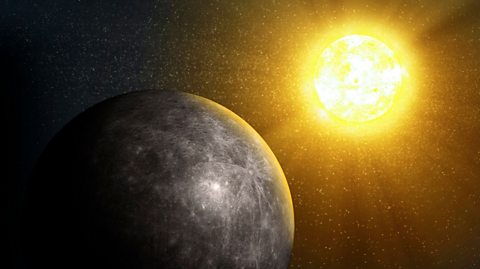
In three months you could write a book, pass your driving test or learn basic guitar. It’s also roughly the amount of time it takes Mercury to travel around the Sun.
It’s the shortest orbit in the Solar System, because Mercury is the closest planet to the Sun. So, next time someone asks you when you’ll get around to mowing the lawn, tell them it’ll be in roughly one Mercurian year.
6. Flying around the Sun would take longer than flying around Earth
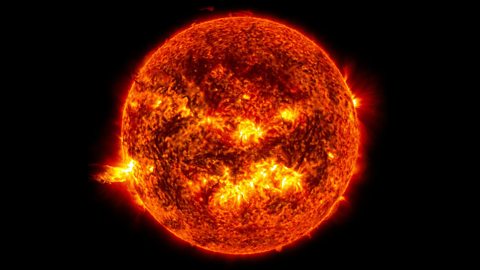 Image source, NASA
Long haul flights to the other side of the world can be gruelling, but it’s nothing compared to how long it would take to fly round the Sun. To go on this trip of a lifetime, you’d have to prepare yourself for a journey of 206 days.
Let’s hope there are places to stop to refuel along the way! Made up mostly of hydrogen, at the centre of the Solar System is the Sun.
Image source, NASA7. A day is longer than a year on Venus
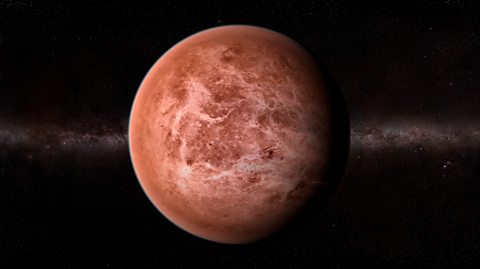
A day is how long it takes a planet to rotate fully, and a year is how long it takes a planet to orbit the Sun. Venus is one of only two planets that rotates clockwise, and it spins much slower than others in the Solar System.
Some think this is due to it being knocked into a different direction by another planet, or it just gradually slowed to a halt then started turning the other way. It takes 243 Earth days for Venus to do one complete rotation, and 225 Earth days to orbit the Sun - therefore, a day is longer than a year on Venus.
8. Pluto isn’t the only dwarf planet in our Solar System
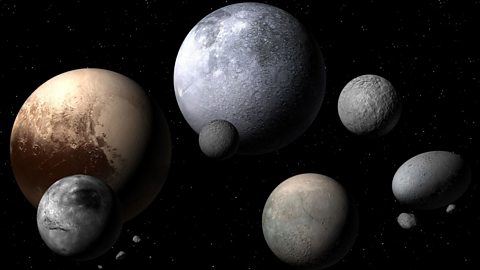
The first time you may have heard the term ‘dwarf planet’ was when Pluto got demoted to one in 2006 (RIP). However, we actually have six in our Solar System.
Pluto, Ceres, Makemake, Haumea, and Eris were the only five that we knew about up until very recently. But in more recent years, a new dwarf planet has been discovered, TG387, which has been given the nickname 'The Goblin'.
9. The Solar System is roughly 4.5 billion years old
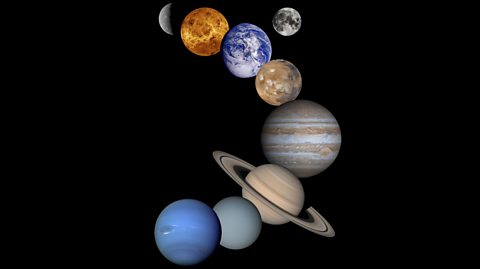 Image source, NASA
Made up of billions of objects, there is still so much to learn about the Solar System. Home to planets, dwarf planets, moons, asteroids and comets, the Solar System is ancient.
It is roughly 4.5 billion years old. But to put it into perspective, if the age of the Solar System were a year, humans would appear on Earth just before the countdown on New Year’s Eve.
Image source, NASA10. The Solar System might not end with Pluto
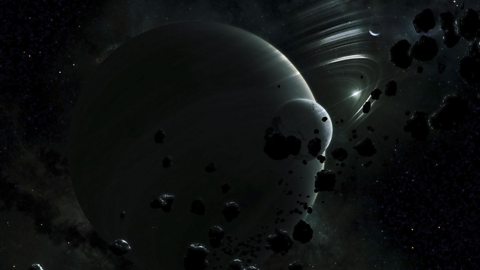
The Oort cloud is the Solar System's Terra Australis. It's a theoretical bubble of icy debris predicted by scientists to be the furthest part of our Solar System, but remains tantalisingly undiscovered.
If the Earth was 1 centimetre away from the Sun, the Oort cloud would be half a kilometre away. Even so, there are parts of the distant Solar System that we know about, such as the Kuiper Belt.
This article was published in October 2018 and updated in May 2026
