The end of 2020 saw some pretty exciting astronomical events.
On 21 December Jupiter and Saturn crossed in what was known as ‘the great conjunction’, and the Earth bid goodbye to its longest-orbiting minimoon.
Newlyweds will know a minimoon as a long weekend of luxury in lieu of a big honeymoon, but astronomers think of something quite different. A minimoon or ‘moonlet’ is a small natural satellite which temporarily orbits a planet or star. They get pulled in by Earth’s gravity, usually capturing them from the Sun's orbit. They're then flung out of orbit again after a period of around nine months.
A visit that was out of this world
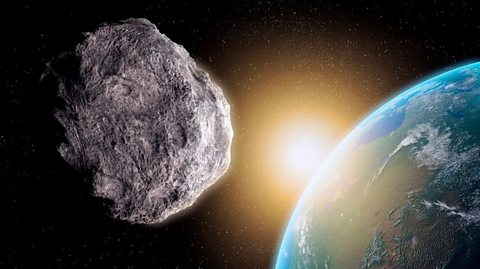
This particular minimoon - nicknamed 2020 CD3 - was only confirmed as such in February 2020. However, it was thought to have been in our planet’s orbit for over a year, possibly even as many as four years, which is rare for minimoons. It could be an asteroid captured away from the Sun, or a chunk of our main Moon which may have broken off. It went unnoticed for years due to its size (1-2 metres across), and chaotic orbit as it pulled between the gravity of the Moon and the gravity of the Earth. This means its cycle round the Earth varied between 70-90 days and went in all directions, making it difficult to observe.
It’s been viewed six or seven times by astronomers with the Catalina Sky Survey, a NASA-funded project that identifies potentially dangerous asteroids, and was confirmed to have been projected out of the Earth’s orbit and pulled into the Sun’s in May 2020. Scientists have predicted that 2020 CD3 may swing back close to the Earth in 2044, but is unlikely to return to the Earth’s gravitational pull - at least not for thousands of years.
Rock of ages
But what makes a moonlet different from asteroids and other celestial bodies?
A moon is any natural satellite that orbits an asteroid or planet - so anything orbiting Earth is considered a moon or moonlet - and this can include other asteroids.
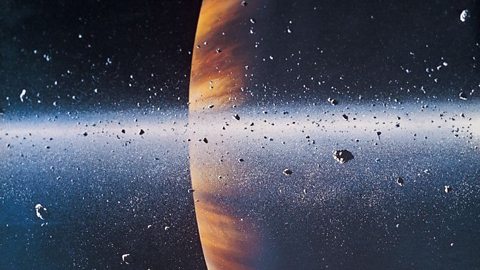
Asteroids are rocky objects leftover from the early formation of our solar system (over 4.6 billion years ago). There are over 1 million known asteroids in the solar system and most of them reside in the main asteroid belt between Mars and Jupiter. Jupiter’s massive gravitational pull can fling these asteroids out in all directions at any given time - talk about an absolute belter!
The three broad types of asteroid include C-types (carbonaceous or chondrite) which are dark, ancient rocks made up of clay and other materials, S-types (stony) which are made up of silicate materials and nickel-iron, and M-types (metallic) which consist of mainly iron and may have been exposed to high temperatures and partially melted.
The minimoon 2020 CD3 was assumed to be a C-type, the most common type of asteroid.
A meteor bite of knowledge
But there’s more! Meteors, meteorites and comets are different from asteroids, and the terms are not always interchangeable.
A meteoroid is a small rock, measuring anywhere between a grain of sand to a boulder, that breaks off from a comet or asteroid. These become a meteor when they vaporise in the Earth’s atmosphere. Meteors are also what we call ‘shooting stars’, though they’re not stars at all.
A meteoroid becomes a meteo_rite_ when it doesn’t burn up in the atmosphere and hits the Earth. It’s a lot to get your head around.
Whereas a comet is made up of dust or rock and ice, and consequently is sometimes known as a space snowball. These usually orbit the Sun and can be several miles in diameter. The debris from comets are responsible for many meteoroids.
A rocket takes a minimoon to Earth
Celestial objects can also have manmade satellites. Some satellites are machines which take pictures of our planet, or send TV and phone signals all over the world. Manmade satellites can also include pieces of 'space junk' which get pulled into orbit, such as rocket pieces discarded in flight.
Scientists at NASA spotted what was thought to be another asteroid in August 2020, dubbed 2020 SO, which would be the third of Earth's recorded minimoons. However, it was then identified to be the Surveyor 2 Centaur rocket booster which launched in September 1966! It's expected to stay in orbit for six months before bidding goodbye and travelling on its merry way.
Five times songs got things about space wrong
Can you really surf the sun? Is it worth waiting for a star to fall?
Have you got what it takes to be an astronaut?
Find out if you measure up to the European Space Agency's requirements.