The ones who coined the coin
Our lives would look very different without it, but for thousands of years money has been at the centre of everyday life of generations. Long before the days of online shopping, contactless payments, bank cards and even notes, coins made in different sizes, designs and materials were the main form of payment around the world.
And while trading has long been practised, some physical coins and currencies have stood the test of time. But have you ever been curious about which coins are the oldest in the world and how much they are worth?
Here, BBC Bitesize takes a closer look at the world’s oldest coins, as well as other fascinating facts and more recent finds.
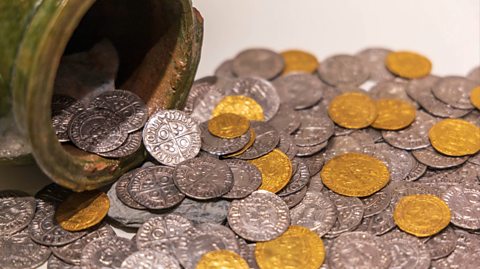
What is the oldest coin in the world?
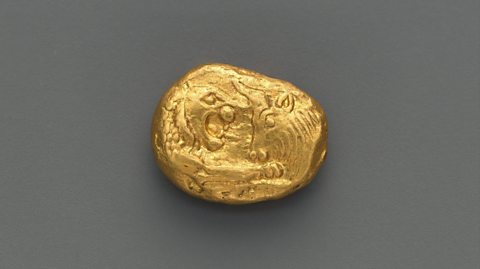
Trading has long been practised - but when it comes to coins, it is thought that the world’s oldest are the Lydian Lions. Believed to date back to around 600 BC, the coins are said to be some of the first in the world and were produced in Lydia, an ancient kingdom located in what is now modern-day Turkey.
The currency was made from a metal called electrum, which primarily consisted of gold and silver. The coins feature a lion and a bull and to create the deep impressions, a hammer was used to punch the images into the blank coin.
How much is the oldest coin in the world worth?

Often cited as the first coins, the Lydian Lions are very rare and of high historic value. Given their age and historical significance, it’s no surprise that they are worth a lot of money today.
Their value, like anything ancient or collectable, depends on condition – as well as their authenticity. Through the years, they have been sold and have varied in price, with different sources claiming they are worth anything from a few hundred pounds to thousands and even millions.
What is the oldest coin design still in circulation?
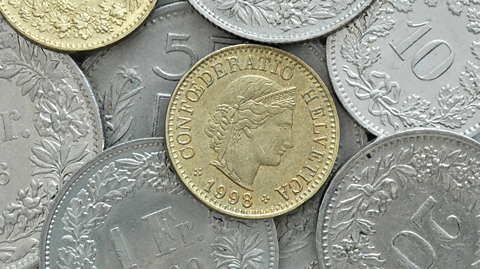
According to Guinness World Records, the oldest coin still in circulation is the 10 centimes coin, which has been produced by the Federal Mint Swissmint since 1879! Since that year, it has had the same “composition, size and design” and are still legal tender found in circulation.
The first version of the coin was designed by Carl Friedrich Voigt and 1879 saw the birth of the coin still current to this day. The coin was awarded the title by Guinness World Records back in 2021.
What is the oldest currency in the world still in use?
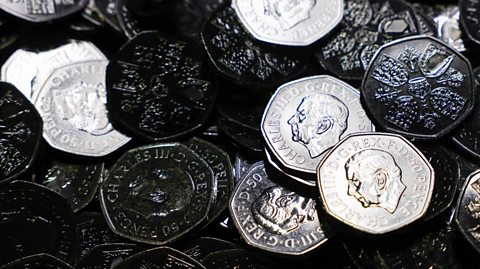
The UK currency, meaning the system of money we use, is the British Pound Sterling (GBP). Over time, our coins have changed a lot, from the days of pre-decimalisation - the currency system before 1971 - which used pounds, shillings and pence to how our coins have looked and the monarchs featured on them.
But did you know the British Pound Sterling is the world’s oldest currency still in use? The British pound actually dates back to AD 775 in Anglo-Saxon Britain, and the original coin was one pound of silver – equal to 240 pennies.
After Britain adopted the decimal system in 1971, the pound as we know it today was introduced first as a banknote but was later replaced by the pound coin in 1983.
For over 1000 years, the link between The Royal Mint, the official maker of UK coins, and the British monarchy has continued. The Royal Mint is one of the oldest mints in the world and are believed to have been established around AD 886.
According to their website, the oldest coins struck by The Royal Mint include the Alfred the Great Monogram Penny, Silver Cross Pennies, Edwardian Halfpennies, Edward I Groat, The Gold Noble, The Angel and of course, the Pound Sterling. Throughout our history, our currency has featured both monarch and milestone moments – but today, you’ll see more coins and notes with a portrait of King Charles III coming into circulation, following the death of his mother, the late Queen Elizabeth II, in 2022.
1972 - Shoppers on Decimal Day
Originally broadcast on 15 February 1971, this BBC Archive video captures shoppers' reactions to Decimal Day - when the British currency system switched over from the old £sd system of pounds, shillings and pence to the decimal system we still have today.
The change didn't happen overnight, but was officially introduced on 15 February 1971, which became widely known as Decimal Day. In the vox pop, which is a news segment where reporters ask the opinions of the public, members of the public share how they are coping with the switch to the new currency system.
BBC Archive offers a unique collection of thousands of archive films, capturing life and events across the UK since the 1940s.
*News segment begins on a street market - conversations can be heard in the background between stall holders and customers
A stall holder places change in a customers hand and counts: "170, 180."
Camera cuts to shoppers being interviewed
Shopper one said: "Well, it's not too bad. If I'm confused, I give them the two shillings and work it out from there."
The reporter asks: "You're trusting the traders?"
Shopper one replies: "Yes, more or less. I think they're more or less honest."
The reporter moves on to interviewing another shopper.
He said: "Excuse me, how are you getting on with decimal coinage?"
Shopper two replies: "Finding it very simple. I let them do the work."
The reporter asks: "How do you mean?"
Shopper two answers: "Well, they can just work out what the price is for me, take what I give tothem and give me the correct chain."
Camera cuts to another shopper being interviewed
The reporter asks: "Aren't you very clever?"
Shopper three replies: "I should be. I'm Scots, I should be."
The reporter said: "How are you getting on with the new coin?"
Shopper three responds: :Well, it's just terrible."
The reporter asks: "Are you able to do your shopping?"
Shopper three said: "Well, you're just going to do no shopping - and that's it, finished. Do none till you learn the whole thing, because you're out money."
Footage cuts to shoppers and a shop assistant at a till and then a new interviewee
The interviewee said: "I agree that it would be very helpful if the housewife would be clued up sufficiently to make quite sure that she always pays the right price for the right article. But I don't really think that one can expect a busy housewife to be able to do that when the girls in the shops who are familiar with it can't even begin to do that."
End of news segment
What are the oldest coins found in the UK?
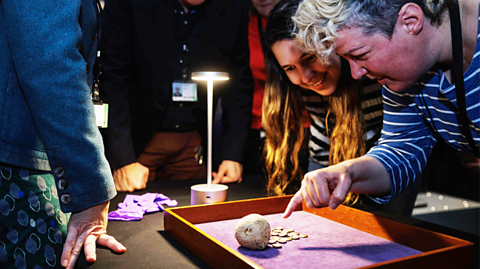
The UK has such a rich history and with that, it’s no surprise that a number of historic coins have been rediscovered. From archaeological digs to being unearthed by chance or by metal detectorists, there are so many fascinating stories to mention – but here are just a few recent examples.
In January 2026, BBC News reported how an ancient coin, which shows evidence of trading between two tribes thousands of years ago, was unearthed by a metal detectorist in Lelley, East Yorkshire. The coin is believed to date back to the Iron Age period, around 50-10 BC.
In 2025, a hoard of 13 silver coins was discovered by a metal detectorist in a field near Downham Market in Norfolk. One historian believes the coins were lost in the wake of the Roman invasion of Britain in AD43.
That same year, the BBC reported how a grant of almost £1m will mean a hoard of Norman-era treasure can be put on permanent display in the Museum of Somerset. Thought to be the highest-value treasure acquisition on record at £4.3m, the Chew Valley Hoard features 2,584 coins and dates from just after the Battle of Hastings in 1066.
In 2023, the earliest known coin to be minted in Scotland was also found by a metal detectorist in a wooded area near Penicuik, Midlothian, and has been dated to the second half of the 1130s. If you’re interested in historic coins, you may also have heard of the Hallaton Treasure.
On display at Harborough Museum in Leicestershire, in the year 2000, it was metal detectorist Ken Wallace and other volunteers from the Hallaton Fieldwork Group who first discovered Iron Age coins and Roman pottery in a field. An excavation saw a further discovery of over 5,000 coins and a unique 1st century Roman cavalry helmet.
This article was written in January 2026 and updated in August 2026
